


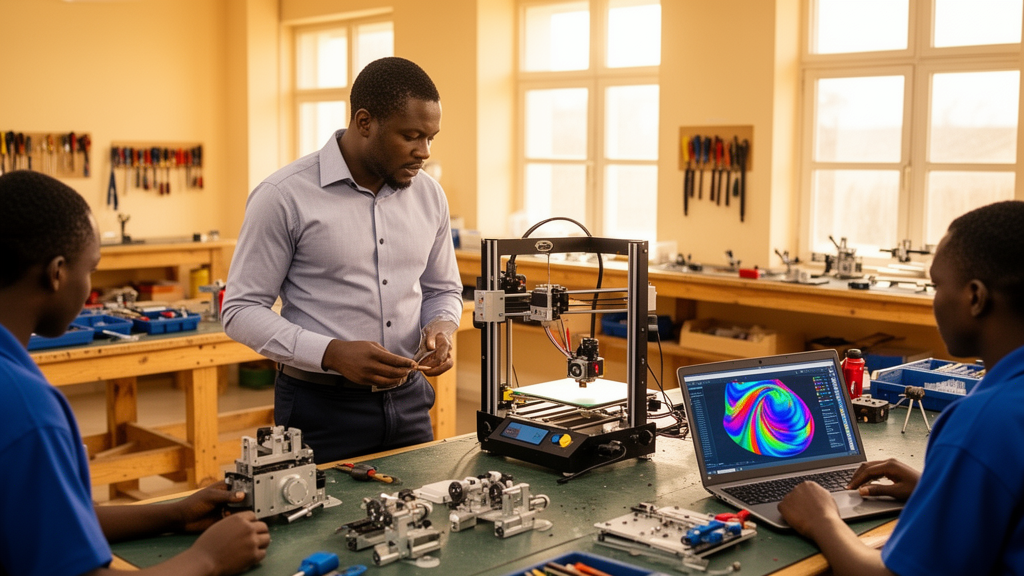
A qualitative study of vocational and technical education (VTE) lecturers and industry experts in Nigeria has found that artificial intelligence readiness is understood as a multidimensional professional capacity rather than a single technical skill. The research, published in Discover Sustainability, drew on semi-structured interviews with 35 purposively selected participants: 20 university VTE lecturers and 15 industry experts with relevant professional and digital or AI experience.
Using an interpretivist paradigm and a qualitative descriptive design, the researchers analysed the interviews thematically following Braun and Clarke’s approach. Participants described AI readiness as combining digital confidence, adaptability, critical thinking, ethical consciousness and pedagogical judgement. In other words, lecturers viewed successful AI integration as resting not only on technical fluency but on the ability to weigh when and how AI tools serve learning without displacing human agency or professional responsibility.
The study also identified substantial barriers standing in the way of AI-supported teaching. Respondents pointed to inadequate training, limited infrastructure, insufficient institutional support, policy uncertainty, and difficulties integrating AI with practical vocational learning. These obstacles matter particularly in vocational contexts, where hands-on workshop and laboratory experiences are central to the curriculum and cannot simply be replaced by digital tools.
When asked what competencies sustainable AI-supported teaching would require, participants listed technological skills, pedagogical skill, vocational content knowledge, ethical awareness, critical evaluation, assessment capability, and continuous professional learning. The findings suggest that lecturers themselves see AI adoption as an ongoing process of professional growth rather than a one-off training event.
Bringing together the perspectives of educators and industry practitioners, the authors propose a tentative conceptual relationship linking lecturer qualities, enabling institutional conditions and integrated competencies with sustainable AI-supported teaching. Within the study, sustainable teaching refers to continuing, appropriate and responsible AI use that supports learning while preserving practical vocational experiences.
On the basis of these findings, the researchers argue for investment in professional development, institutional infrastructure and guidance, and stronger collaboration between universities and industry. Because the study gathered perspectives from both education and the workplace, it offers a grounded picture of the conditions Nigerian VTE institutions would need to address as AI tools spread into teaching practice.
The authors are careful to note the limits of their evidence. The study examined reported perspectives rather than directly assessing lecturers’ actual AI competence, and it did not measure teaching sustainability over time. The findings therefore describe how participants understand readiness and its conditions, not verified outcomes of AI adoption in classrooms or workshops.
Even so, the study adds to a growing body of research on teacher AI competence by providing qualitative evidence from a setting where such data have been limited. It suggests that for vocational and technical education in Nigeria, building AI readiness will depend as much on institutional support, clear policy and preserved hands-on learning as on the technologies themselves.
Subject of Research: AI readiness among vocational and technical education lecturers in Nigeria
Article Title: Understanding artificial intelligence readiness among vocational and technical education lecturers for sustainable teaching in Nigeria
Article References: Ugwu, E. I., Okoro, J. O., Madu, M. A., Eze, E. C., Eya, C. C., Ekwueme, S. U., & Omeiza, C. (2026). Understanding artificial intelligence readiness among vocational and technical education lecturers for sustainable teaching in Nigeria. Discover Sustainability. https://doi.org/10.1007/s43621-026-05140-2
Image Credits: AI Generated
DOI: 10.1007/s43621-026-05140-2
Keywords: artificial intelligence, vocational education, Nigeria, teacher readiness, qualitative research, sustainable teaching, professional development, digital skills, educational technology, university-industry collaboration, Understanding, artificial
Cite Scienmag News
Violet Maxwell. (October 25, 2026). Nigerian Vocational Lecturers See AI Readiness as Multidimensional Skill Set. Scienmag. https://scienmag.com/nigerian-vocational-lecturers-see-ai-readiness-as-multidimensional-skill-set/
Violet Maxwell. "Nigerian Vocational Lecturers See AI Readiness as Multidimensional Skill Set." Scienmag, 25 October 2026, https://scienmag.com/nigerian-vocational-lecturers-see-ai-readiness-as-multidimensional-skill-set/. Accessed 25 October 2026.
Violet Maxwell. "Nigerian Vocational Lecturers See AI Readiness as Multidimensional Skill Set." Scienmag. October 25, 2026. https://scienmag.com/nigerian-vocational-lecturers-see-ai-readiness-as-multidimensional-skill-set/


