


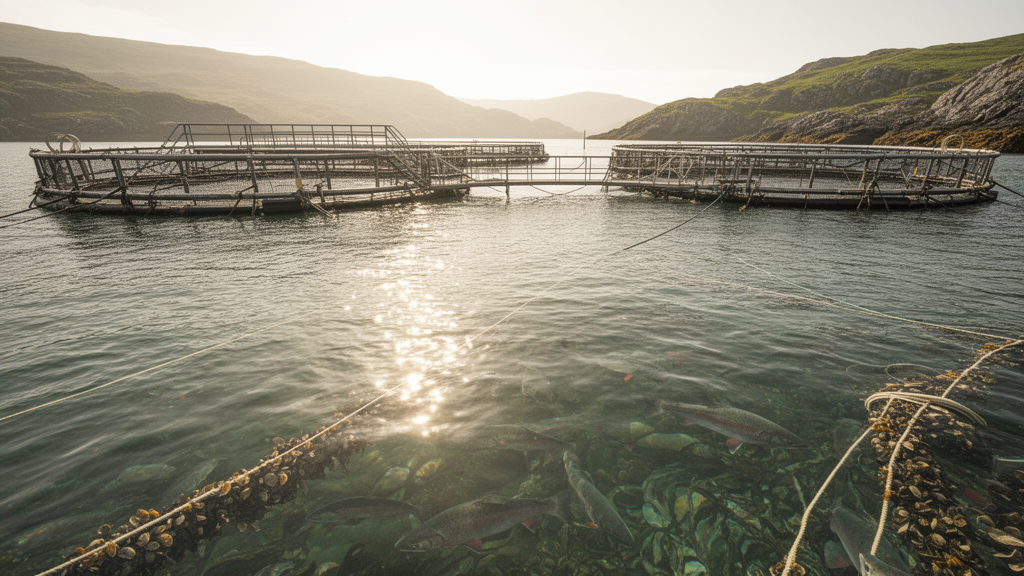
Marine heatwave exposure across Scottish aquaculture is changing at markedly different rates depending on where a farm sits along the coast, according to a new study published in Frontiers in Marine Science. Researchers from the University of Exeter, the Scottish Association for Marine Science, Plymouth Marine Laboratory and Cefas analysed daily satellite sea surface temperature data from 1990 to 2025 at the locations of 361 active Scottish finfish and shellfish farms, represented by 218 unique grid cells of roughly five kilometres each. Their central finding is that a broadly shared increase in marine heatwave occurrence conceals a sharper divergence in how long events last, how much anomalous heat they accumulate and how severe they become, with one group of coastal locations changing far faster than the other.
Marine heatwaves are discrete periods of anomalously warm water, commonly defined as events lasting at least five days during which temperature exceeds a seasonally varying local threshold. Once detected, an event can be described by several properties: how often events occur, how long they last, how far temperatures depart from the seasonal climatology, and how much anomalous warmth accumulates over the event. These distinctions matter biologically, because responses to heatwaves vary with duration, intensity, absolute temperature, species, life stage and previous thermal history. For aquaculture the stakes are particularly direct, since cultured organisms are held at fixed locations and cannot move away from unfavourable conditions.
The study used the Operational Sea Surface Temperature and Sea Ice Analysis, or OSTIA, a daily gap-free satellite product at approximately five kilometre resolution, to reconstruct heatwave histories at farm locations. Because surface temperatures may differ from those experienced within cages or shellfish lines, the team validated the satellite data against in situ records from eight Atlantic salmon farms on the west and north-west coasts, where daily temperatures are measured at about five metres depth as part of routine operations. Agreement was close: Pearson correlations ranged from 0.961 to 0.975, mean differences between the datasets spanned only −0.145 to 0.158 °C, and centred root mean square deviations were between 0.465 and 0.619 °C. The comparison was not intended to show exact equivalence between surface and cage temperatures, but it confirmed that OSTIA captures the main temporal variability relevant to heatwave detection.
Heatwaves were detected independently for each grid cell using a fixed 1990–2020 baseline climatology and the widely applied Hobday framework, with a seasonally varying 90th-percentile threshold. For each event the researchers calculated duration, mean intensity, maximum intensity and cumulative intensity, expressed in degree-days, and classified severity into Moderate, Strong, Severe or Extreme categories based on how far temperatures exceeded the local threshold. In total, 21,099 events were detected across the 218 aquaculture-associated cells over the 36-year record.
To characterise long-term exposure, the team summarised five heatwave metrics for each cell using principal component analysis and then grouped cells with hierarchical clustering. The first principal component, explaining 55.5 percent of the variance, was dominated by the three intensity-related metrics, while the second, explaining a further 39.9 percent, captured a duration–frequency gradient. Together the two axes accounted for 95.5 percent of the variation. Clustering produced two broad exposure profiles with moderate separation. Cluster 1, containing 173 cells, was the historically more intense profile, with a mean event intensity of 0.830 °C, maximum intensity of 1.07 °C and cumulative intensity of 13.8 degree-days. Cluster 2, with 45 cells, showed lower values on all three measures but slightly more frequent and longer events. Cluster 1 was distributed widely around the Scottish coast, including the Northern Isles, Outer Hebrides and west coast, whereas Cluster 2 concentrated along parts of the west coast, including sea-loch, inlet and channel areas.
The most striking result emerged when the researchers tested how these profiles changed through time using mixed-effects models. Annual heatwave frequency increased at almost identical rates in both clusters, roughly 5.9 percent per year, with no statistical evidence that the trends differed. The characteristics of individual events, however, diverged sharply. Mean event intensity remained essentially stable in Cluster 1, while Cluster 2 showed a small but significant increase. Event duration and cumulative intensity rose in both clusters but substantially faster in Cluster 2, and the probability of an event being classified as Severe or Extreme climbed by roughly 15 percent per year in Cluster 2 while showing no significant trend in Cluster 1.
A comparison of the periods 1990–2019 and 2020–2025 illustrates the magnitude of recent change. Model-estimated event duration increased by 44.6 percent in Cluster 1, from 9.52 to 13.8 days, but by 89.9 percent in Cluster 2, from 8.99 to 17.1 days. Cumulative intensity rose by 50.0 percent in Cluster 1, from 7.54 to 11.3 degree-days, and by approximately 127.5 percent in Cluster 2, from 3.86 to 8.77 degree-days. The estimated probability of a Severe or Extreme event rose from 1.8 to 6.1 percent in Cluster 1 but from 2.2 to 26.2 percent in Cluster 2, with all cluster-by-period interactions significant at p < 0.001. The results were robust when alternative boundary years of 2017, 2018 or 2019 were tested. The authors emphasise that the 2020 boundary is a descriptive division, not an estimated breakpoint or evidence of a regime shift.
This divergence means that locations with lower historical heatwave intensity are not necessarily experiencing weaker contemporary change. The dimension separating the two profiles most strongly over the full record, intensity, is not the dimension in which their trajectories differ most. The authors propose two non-exclusive explanations that their analysis cannot confirm: coastal locations may respond differently to the regional atmospheric conditions that generate heatwaves, as illustrated by the exceptional June 2023 Northwest European Shelf warming event, in which weak winds, high solar radiation and differences in mixed-layer depth and tidal mixing shaped how warming was expressed; and local hydrography, including water exchange, stratification and residence time, may influence whether warm anomalies are rapidly flushed or retained. Prior work shows coastal configuration does not automatically produce longer or more intense events, so the spatial pattern alone does not identify the mechanism.
The findings are relevant to aquaculture because different forms of thermal exposure create different biological challenges. Sustained warming can affect feeding, physiology and stress tolerance in Atlantic salmon, and experimental work has shown higher maintenance metabolic costs, reduced hypoxia tolerance and impaired immune responses in post-smolts held at 19 °C compared with 15 °C, along with elevated mortality after handling at warm temperatures. Warm conditions can also act indirectly through parasites, as seen in exceptional salmon-lice abundance during a 2024 heatwave in northern Norway. In Pacific oysters, 30 days of exposure to 28 °C reduced body weight and energy reserves despite increased filtration, while blue mussel studies have found stress responses persisting beyond the event itself and repeated heat stress reducing tolerance to later warming. Cumulative intensity, which combines anomaly magnitude with duration, has emerged in global analyses as one of the strongest predictors of ecological responses, reinforcing the importance of event persistence rather than peak intensity alone.
The authors frame their results within the IPCC risk framework, in which risk arises from interactions among hazard, exposure and vulnerability. Marine heatwaves represent the hazard and the presence of farms establishes exposure, but biological vulnerability and farm impacts were not measured directly, so the study does not establish that these changes have caused production losses. The exposure profiles should be read as different forms of physical thermal exposure rather than a ranking of biological risk. Practically, the authors suggest combining satellite heatwave information with continuous farm-level measurements at relevant depths, potentially including dissolved oxygen and stock health indicators, and note that forecasts indicating how long anomalous warmth may persist could support operational planning. The identified next step is to link these physical exposure histories with farm-level mortality, growth, health and production records, adding the vulnerability component needed for a fuller assessment of climate risk to Scottish aquaculture.
Subject of Research: Spatial and temporal variation in marine heatwave exposure across Scottish finfish and shellfish aquaculture sites from 1990 to 2025
Article Title: Marine heatwave exposure is changing unevenly across Scottish aquaculture sites
Article References: Toledo-Jaime, C., Graham, J., Hudson, B., Moffat, D., Townhill, B., & Palmer, S. (2026). Marine heatwave exposure is changing unevenly across Scottish aquaculture sites. Frontiers in Marine Science, 13, Article 1963854. https://doi.org/10.3389/fmars.2026.1963854
Image Credits: AI Generated
DOI: 10.3389/fmars.2026.1963854
Keywords: marine heatwaves, aquaculture, Scotland, sea surface temperature, Atlantic salmon, shellfish, climate change, coastal exposure, OSTIA, severity categories, cumulative intensity, spatial variability
Cite Scienmag News
Violet Maxwell. (October 24, 2026). Marine heatwaves are intensifying unevenly at Scottish fish and shellfish farms. Scienmag. https://scienmag.com/marine-heatwaves-are-intensifying-unevenly-at-scottish-fish-and-shellfish-farms/
Violet Maxwell. "Marine heatwaves are intensifying unevenly at Scottish fish and shellfish farms." Scienmag, 24 October 2026, https://scienmag.com/marine-heatwaves-are-intensifying-unevenly-at-scottish-fish-and-shellfish-farms/. Accessed 24 October 2026.
Violet Maxwell. "Marine heatwaves are intensifying unevenly at Scottish fish and shellfish farms." Scienmag. October 24, 2026. https://scienmag.com/marine-heatwaves-are-intensifying-unevenly-at-scottish-fish-and-shellfish-farms/


