


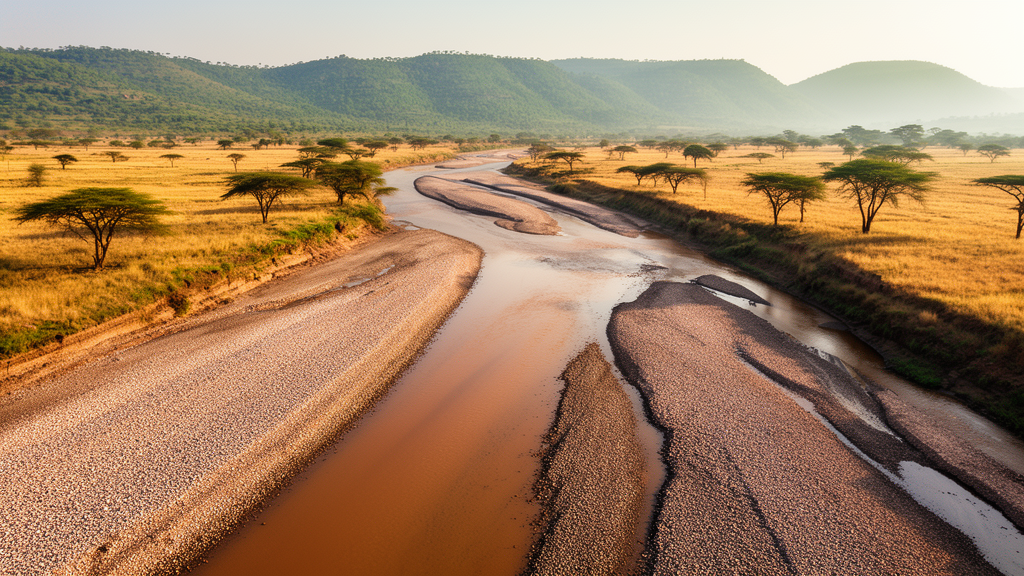
A statistical trend analysis of the Upper Baro River Basin in western Ethiopia has found that summer streamflow is declining significantly at the same time as maximum temperatures rise and rainfall remains unevenly distributed across the basin. The study, published in Discover Sustainability, examined the 23,322 square kilometre basin using historical records from 10 rainfall and 6 temperature stations operated by the Ethiopian Meteorological Institute, together with data from 3 streamflow stations maintained by the Ministry of Water and Energy. The researchers report that the Baro Gambella station recorded a significant decline in summer (kiremt) streamflow of 7.4 cubic metres per second at p < 0.05, a change they associate with reduced summer rainfall and rising temperatures, alongside documented forest loss and agricultural expansion in the basin.
The analysis applied several statistical techniques to the station records. Variability was evaluated using the Coefficient of Variation and the Standardized Anomaly Index, while trends were analyzed with the Mann–Kendall test, a Modified Mann–Kendall variant that corrects for serial autocorrelation (MK-TFPW), Sen’s slope estimator, Innovative Trend Analysis, and Linear Regression. Using this battery of tests, the team distinguished places and seasons where changes were statistically significant from those where the signal remained weak or ambiguous.
Rainfall in the basin showed strong spatial contrasts rather than a uniform shift. The southern highlands receive higher rainfall, while the western lowlands receive less. At the annual scale, rainfall variability was classified as low, but the winter season, known locally as bega, varied highly, with coefficients of variation between 36 and 69 percent.
Only two stations recorded significant annual rainfall increases. At Alem Teferi, rainfall rose by 12 millimetres per year at a significance level of p < 0.01, and a significant increase was also detected at Yubdo. Elsewhere in the basin, annual rainfall trends did not reach statistical significance in the analysis.
Temperature trends pointed toward warming at specific locations. Maximum temperatures rose significantly at Gore, by 0.025 degrees Celsius per year at p < 0.005, and at Dembidolo, where the increase was significant at p < 0.05. Minimum temperature, by contrast, showed a non-significant annual trend and mixed seasonal trends, indicating that warming in the basin has so far been expressed mainly through daytime maxima rather than nighttime minima.
The streamflow results are the study’s central hydrological finding. Winter streamflow exhibited high variability, and the significant summer decline at Baro Gambella stands out among the measured trends. The authors suggest this decline could be driven by reduced summer rainfall and rising temperatures, combined with land-cover changes that have been documented in the basin, including forest loss and agricultural expansion. Because the study is observational, it identifies associations between these factors rather than quantifying the individual contribution of each driver.
According to the researchers, the basin as a whole exhibits increasing hydroclimatic variability, warming temperatures, uneven rainfall distribution, and declining summer streamflow. They warn that these trends threaten local farming livelihoods and ecosystem health by creating severe water shortages.
The study is framed as local evidence for watershed planning. The authors argue that targeted watershed plans are needed to protect shared water resources, a goal they link to Sustainable Development Goal 6 on clean water and sanitation, and to build resilience against climate shocks, which they connect to Sustainable Development Goal 13 on climate action. By identifying which stations, seasons, and sub-regions show significant change, the analysis documents where the Upper Baro Basin is already changing and which seasons and communities are most exposed to those changes.
Subject of Research: Spatio-temporal assessment of hydro-climatic trends in the Upper Baro River Basin, Ethiopia
Article Title: Spatio-temporal assessment of hydro-climatic trends in the Upper Baro River Basin, Ethiopia
Article References: Adeko, N. C., Dibaba, W. T., & Demissie, T. A. (2026). Spatio-temporal assessment of hydro-climatic trends in the Upper Baro River Basin, Ethiopia. Discover Sustainability. https://doi.org/10.1007/s43621-026-04634-3
Image Credits: AI Generated
DOI: 10.1007/s43621-026-04634-3
Keywords: Spatio-temporal, assessment, hydro-climatic, trends, Upper, Baro, River, Basin, Ethiopia, scientific research
Cite Scienmag News
Violet Maxwell. (October 24, 2026). Significant Summer Streamflow Decline Detected in Ethiopia’s Upper Baro River Basin. Scienmag. https://scienmag.com/significant-summer-streamflow-decline-detected-in-ethiopias-upper-baro-river-basin/
Violet Maxwell. "Significant Summer Streamflow Decline Detected in Ethiopia’s Upper Baro River Basin." Scienmag, 24 October 2026, https://scienmag.com/significant-summer-streamflow-decline-detected-in-ethiopias-upper-baro-river-basin/. Accessed 24 October 2026.
Violet Maxwell. "Significant Summer Streamflow Decline Detected in Ethiopia’s Upper Baro River Basin." Scienmag. October 24, 2026. https://scienmag.com/significant-summer-streamflow-decline-detected-in-ethiopias-upper-baro-river-basin/


