


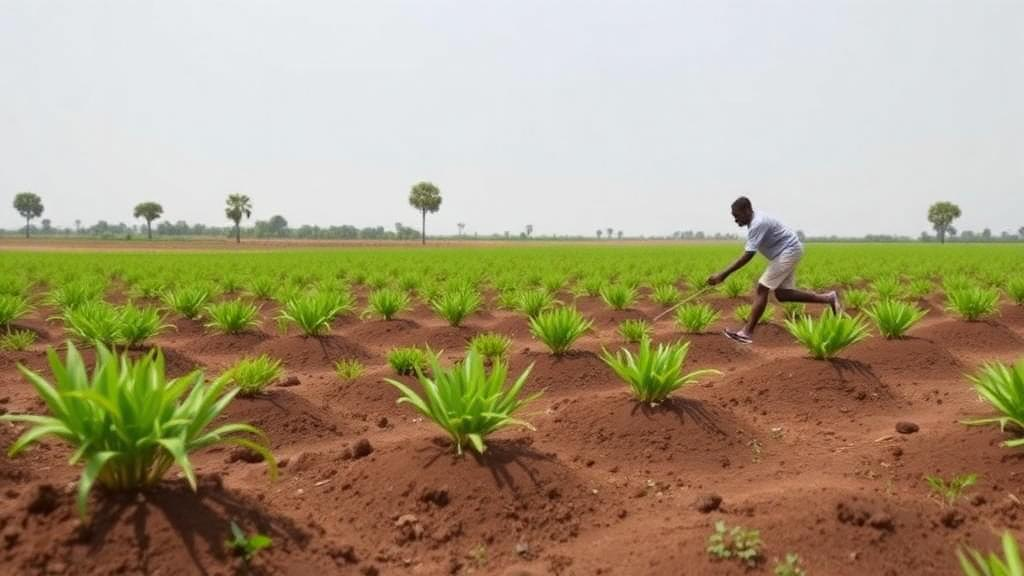
Farmers in Ethiopia's Upper Blue Nile Basin who adopt sustainable land management practices earn significantly more from their crops than they would without them, according to a new economic evaluation published in Discover Sustainability. Land degradation is a key global problem that affects sustainability and household welfare, and sustainable land management practices are increasingly promoted as a strategy to address it. The analysis draws on household survey data from 385 farming households, yielding 733 plot-level observations across the Upper Blue Nile Basin.
This plot-level design allowed the researcher to compare outcomes on parcels where bunds and related practices had been installed against those where they had not, within the same farming population. A central challenge in this kind of evaluation is that adoption is not random. Farmers who choose to build bunds may differ systematically from those who do not, in ways that also affect their crop returns, creating selection bias and endogeneity problems that can distort simple comparisons.
To address this, the study employed an endogenous switching regression model, which jointly models the adoption decision and the productivity outcome. The approach generates a counterfactual estimate of what each farm would have earned under the alternative choice, allowing the true effect of adoption to be isolated. The results confirmed that selection bias was indeed present, validating the use of the more demanding econometric framework.
The estimated treatment effects reveal gains on both sides of the adoption divide. Among adopters, the expected net crop value with the practices in place was US$ 777.43, compared with a counterfactual of US$ 704.03 had they not adopted, an average treatment effect on the treated of US$ 73.40. Among non-adopters, observed net crop value stood at US$ 565.29, but the model estimates they would have earned US$ 832.69 had they adopted, an average treatment effect on the untreated of US$ 267.40.
Both estimates were statistically significant. Perhaps the most striking result is the negative transitional heterogeneity effect of US$ 194.00, which indicates that the benefits of adoption would be larger for current non-adopters than for those who have already adopted. The findings carry direct policy implications.
Because the estimated impacts are positive under current circumstances, the study concludes that sustainable land management practices should be promoted in the basin. The author specifically recommends policies that include economic incentives to cover transitional disadvantages that farmers may face during the adoption process, thereby increasing net crop value while easing the burden of the transition. Nevertheless, the combination of a large plot-level dataset, a validated econometric approach, and consistent positive effects across both adopters and non-adopters strengthens the case that bunds and related practices are economically worthwhile investments.
For a basin where land degradation threatens both agricultural sustainability and household welfare, the message from the numbers is that conservation and income can move in the same direction.
Subject of Research: Economic impacts of sustainable land management practices on agricultural productivity in the Upper Blue Nile Basin, Ethiopia
Article Title: Impacts of selected land management practices on agricultural productivity in the Upper Blue Nile Basin, Ethiopia
Article References: Alemu, G. T. (2026). Impacts of selected land management practices on agricultural productivity in the Upper Blue Nile Basin, Ethiopia. Discover Sustainability. https://doi.org/10.1007/s43621-026-05110-8
Image Credits: AI Generated
DOI: 10.1007/s43621-026-05110-8
Keywords: Ethiopia, sustainable land management, soil bunds, agricultural productivity, Upper Blue Nile Basin, endogenous switching regression, land degradation, net crop value, smallholder farming, adoption incentives, Impacts, selected
Cite Scienmag News
Alan Morgan. (October 24, 2026). Soil Bunds Boost Farm Income in Ethiopia’s Upper Blue Nile Basin, Study Finds. Scienmag. https://scienmag.com/soil-bunds-boost-farm-income-in-ethiopias-upper-blue-nile-basin-study-finds/
Alan Morgan. "Soil Bunds Boost Farm Income in Ethiopia’s Upper Blue Nile Basin, Study Finds." Scienmag, 24 October 2026, https://scienmag.com/soil-bunds-boost-farm-income-in-ethiopias-upper-blue-nile-basin-study-finds/. Accessed 24 October 2026.
Alan Morgan. "Soil Bunds Boost Farm Income in Ethiopia’s Upper Blue Nile Basin, Study Finds." Scienmag. October 24, 2026. https://scienmag.com/soil-bunds-boost-farm-income-in-ethiopias-upper-blue-nile-basin-study-finds/


