


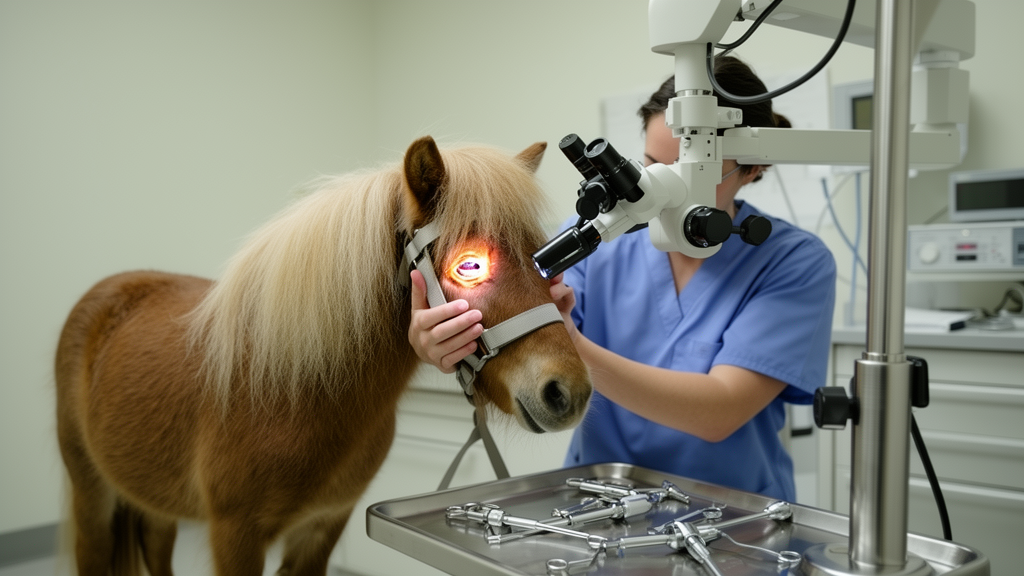
In a one-year-old miniature Shetland pony filly with eight weeks of unilateral purulent nasal discharge, veterinarians at the University of Veterinary Medicine Vienna restored access for sinus drainage with a transendoscopic diode laser fenestration. The 2026 case report records rapid clinical improvement after the procedure, discharge from the clinic six days later and no recurrent purulent discharge 14 months later. At that follow-up, the surgical opening had closed by scar formation, but the nasomaxillary aperture was accessible and the drainage angle appeared normal, changes the authors associated with continued growth of the pony’s skull.
The 60-kilogram filly was admitted to the university’s Equine Clinic in July 2025 with nasal discharge and a history of fever. She had been treated before referral with trimethoprim at 5 mg/kg and sulfadiazine at 25 mg/kg twice daily, plus acetylcysteine at 10 mg/kg once daily, without improvement. On examination, she was bright, alert and in good nutritional condition. She had bilateral conjunctival hyperemia, pale oral mucous membranes, mildly increased vesicular breath sounds and mild, non-painful bilateral mandibular lymph nodes, but no cough, facial swelling, nasal deformity, epiphora or respiratory distress.
Blood testing showed mild anemia and lymphopenia, along with elevated glutamate dehydrogenase, creatine kinase and serum amyloid A. Guttural pouch lavage grew Streptococcus equi subsp. zooepidemicus, while quantitative PCR was negative for S. equi subsp. equi. Upper-airway endoscopy also found mild left-sided mucosal edema, moderate retropharyngeal lymphadenopathy and mild dynamic tracheal collapse. A dental examination was age-appropriate and unremarkable. These findings did not by themselves settle the source of the persistent unilateral discharge, so clinicians evaluated the nasal passages, conchae, guttural pouches and other potential anatomical and infectious contributors.
Focused transnasal sinus endoscopy identified the key structural problem. In the caudal third of the right nasal passage, the dorsal concha was displaced dorsally and overlapped a hypoplastic ventral concha. Purulent material occupied the middle meatus between the two conchae, and the drainage angle was malformed. Standard radiographs suggested a marked disproportion between tooth size and number and the dimensions of the skull, focal increased soft-tissue opacity in the dorsal conchal bulla and deviation of the nasal septum to the left. However, superimposed structures limited interpretation of conventional images.
Computed tomography more clearly characterized marked right-sided sino-nasal abnormalities, including enlargement of the dorsal concha, hypoplasia of the ventral concha and caudal septal deviation. The three-dimensional images also showed asymmetry in the nasal cavities and paranasal sinuses, while the reserve crown of tooth 109 was visible within the maxillary sinus. The clinicians diagnosed congenital or developmental sino-nasal abnormalities associated with chronic nasal discharge and inadequate drainage. CT was used to map the abnormality and select the site for an endoscope-guided procedure, while the ventral concha was considered unsuitable because of its malformation and limited accessibility.
Conservative therapy initially included meloxicam at 0.6 mg/kg orally once daily for 10 days and doxycycline at 10 mg/kg orally twice daily for 12 days. The pony was isolated while S. equi subsp. equi was excluded by PCR. The medication did not resolve the discharge. Because the malformed conchal arrangement was limiting sinus drainage, the team selected fenestration of the dorsal concha to create access between the affected sinus system and nasal cavity, facilitate removal of retained material and permit subsequent transnasal lavage.
The approximately 15-minute procedure was performed under standing sedation and local anesthesia. The pony’s head was supported in a sling at the level of the withers. A 5.4-mm, 1.1-meter videogastroscope with a working channel was passed through the right nostril and advanced along the common nasal meatus. A 600-micrometer fiber from an 810-nanometer diode laser was angled dorsolaterally to reach the fenestration site in the confined anatomical space. Preoperative CT guided the incision from the caudal end of the overlap toward the rostral direction over approximately 3 centimeters.
The laser was used in contact mode at 15 watts in continuous-wave operation, delivering 600 joules over about 40 seconds in a single continuous pass. The resulting incision was slit-shaped and slightly oval, with thermal widening of the opening. Hemorrhage was minimal, and smoke did not prevent visualization. The new window provided direct access to the maxillary and conchal sinus system, where the surgeons evacuated a moderate quantity of inspissated, fluid-purulent material. Mucous membranes in the maxillary sinus appeared moderately to markedly inflamed. High-pressure transendoscopic lavage with 3 liters of sterile 0.9% saline removed debris, retained material and inflammatory fluid.
The filly showed increased appetite, improved general demeanor and noticeably less nasal discharge after surgery. She received one additional intravenous dose of flunixin meglumine at 1.1 mg/kg 12 hours after the procedure, followed by phenylbutazone at 2.2 mg/kg orally twice daily for three days to manage postoperative inflammation and discomfort. No postoperative antibiotics were administered because the clinicians considered drainage restored, repeated lavage possible and antimicrobial use unnecessary under their stewardship policy. Endoscopy on postoperative days two and five confirmed a patent, unchanged fenestration, visibly reduced mucosal inflammation and no further accumulation of purulent material; each examination included lavage with another liter of sterile saline.
By postoperative day six, the filly was bright and clinically stable, eating well and producing only minimal serous nasal discharge. She was discharged without further treatment. A telephone follow-up four months after surgery found that she remained free of clinical signs, and the owners reported a marked improvement in her energy level and quality of life. The pony was not brought back for the recommended six-month examination, but she was re-examined 14 months after surgery, when she was two years old. She was then in good general condition, with mild bilateral serous or mucous discharge, mild facial asymmetry and non-painful swellings over the maxillary and mandibular cheek teeth that were considered age-appropriate eruption bumps.
Endoscopy at the 14-month examination showed that scar tissue had formed at the laser site, and the fenestration into the dorsal conchal sinus was no longer patent. The previously overlapping portion of the dorsal concha was no longer visible. The region of the nasomaxillary aperture, which had not been visible endoscopically before surgery, was now accessible, and the drainage angle appeared normal. The authors considered this pattern consistent with maturation of the skull between one and two years of age. The interpretation is that the fenestration temporarily provided drainage and lavage access while the pony was small, after which physiological drainage developed without the opening remaining patent. Because this was a single case, that developmental mechanism remains a plausible explanation rather than a proven general mechanism.
Other findings at follow-up were considered clinically insignificant. The left nasal passage was largely unremarkable apart from mild mucous discharge and polypoid changes in the middle meatus at the level of the ventral conchal recess, with no left-sided signs directly attributable to those changes. A mild contralateral manifestation of the sino-nasal condition could not be excluded, so monitoring was recommended. The facial asymmetry had also been present on preoperative CT and was attributed to the underlying malformation rather than the operation. The case nevertheless has important limitations: it includes only one pony, the contribution of prior medical therapy to the outcome cannot be determined, intraoperative and early postoperative images were lost, and repeat radiography or CT was not performed at long-term follow-up.
The use of a different endoscope at the 14-month examination further limited direct comparison with the earlier endoscopic views. Histopathology was not performed because imaging and endoscopy revealed no discrete mass suggestive of a proliferative lesion, although an inflammatory or proliferative component could not be completely ruled out. The report therefore adds long-term follow-up to a technique for which evidence in miniature equids was limited, but it does not establish safety, effectiveness or optimal laser parameters across the wider population. For this filly, CT mapped the malformed right sino-nasal system, endoscopy directed the 3-centimeter fenestration and lavage cleared retained inflammatory material. The noteworthy outcome was that the opening itself healed, yet purulent discharge did not recur as the pony’s growing skull provided a more accessible and normally aligned drainage route.
Subject of Research: A case report of CT-guided diode laser fenestration for sino-nasal malformation in a miniature Shetland pony.
Article Title: Case Report: Diode laser fenestration for treating conchal malformation in a miniature pony
Article References: Trummer-Schug, P., Rother, O., Grünzweil, O. M., Gumpenberger, M., & Florczyk, A. (2026). Case Report: Diode laser fenestration for treating conchal malformation in a miniature pony. Frontiers in Veterinary Science, 13, Article 1843048. https://doi.org/10.3389/fvets.2026.1843048
Image Credits: AI Generated
DOI: 10.3389/fvets.2026.1843048
Keywords: miniature pony, diode laser, fenestration, sino-nasal malformation, computed tomography, chronic sinusitis, equine surgery, endoscopy, case report, Case, Report, Diode
Cite Scienmag News
Ophelia Keating. (October 24, 2026). Diode laser fenestration improves drainage in miniature pony case report. Scienmag. https://scienmag.com/diode-laser-fenestration-improves-drainage-in-miniature-pony-case-report/
Ophelia Keating. "Diode laser fenestration improves drainage in miniature pony case report." Scienmag, 24 October 2026, https://scienmag.com/diode-laser-fenestration-improves-drainage-in-miniature-pony-case-report/. Accessed 24 October 2026.
Ophelia Keating. "Diode laser fenestration improves drainage in miniature pony case report." Scienmag. October 24, 2026. https://scienmag.com/diode-laser-fenestration-improves-drainage-in-miniature-pony-case-report/


