


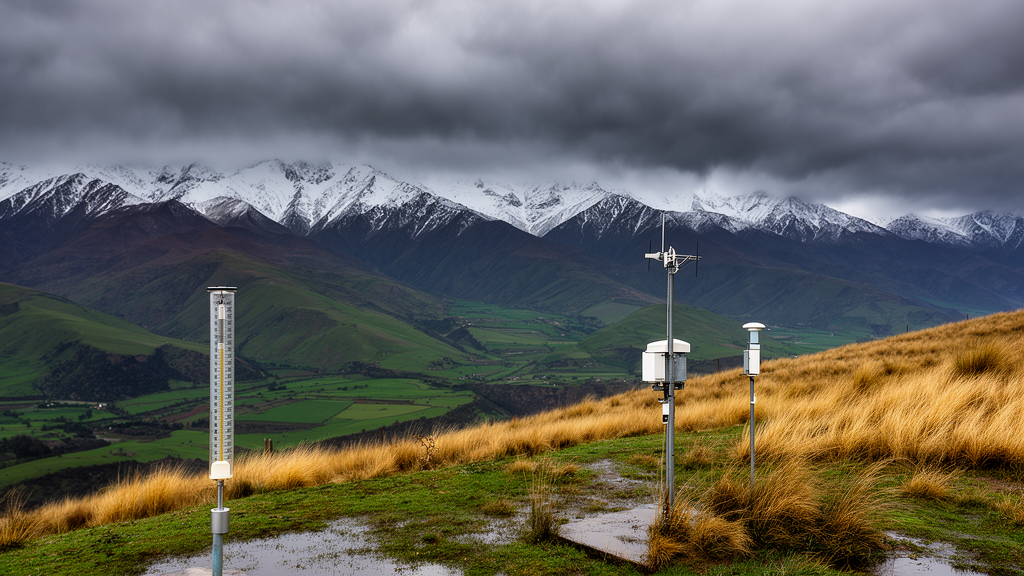
Chile’s winter rainfall is not simply disappearing — it is changing character. A new study of more than four decades of daily precipitation across continental Chile finds that the wettest, storm-driven weather regime that dominates the country’s winters is persisting for progressively shorter stretches each year, a statistically significant erosion of wet-state stability that coincides with rising global sea surface temperatures. The finding emerges from a sophisticated hybrid statistical framework that disentangles large-scale atmospheric regime dynamics from the fine-grained spatial structure of rainfall, offering one of the most detailed probabilistic portraits yet of how Chile’s hydroclimate is shifting.
The research, published in Hydrology and Earth System Sciences, was led by Mauricio Herrera-Marín and colleagues at the Research Center on Sustainability and Strategic Resource Management at Universidad del Desarrollo in Santiago. The team confronted a persistent challenge in hydroclimatology: Chile spans an extraordinary north–south gradient, from the hyperarid Atacama Desert around 18 to 26 degrees south to temperate and subpolar climates near 54 degrees south, and its rainfall varies strongly from year to year under the influence of the El Niño–Southern Oscillation. Traditional statistical models that assume linearity or stationarity struggle to capture hidden shifts in such a system, particularly in a country that has endured a decade-long megadrought in its central region since 2010, with annual precipitation deficits of 15 to 45 percent relative to the pre-2010 baseline.
At the heart of the study is a non-homogeneous Hidden Markov Model, a statistical machine that infers unobserved — or hidden — weather regimes from observed rainfall patterns. The model was trained on the CR2MET gridded precipitation product, a high-resolution 0.05-degree dataset developed specifically for Chile, using 462 grid points with uninterrupted daily records over the austral winter months of May through August from 1980 to 2021. That amounts to nearly 2.4 million daily observations. Crucially, the non-homogeneous extension allows the probabilities of transitioning between regimes to depend on time-varying atmospheric covariates, including zonal and meridional winds, geopotential height, sea-level pressure, sea surface temperature, vertically integrated moisture flux and its divergence, and standard ENSO indices such as the Southern Oscillation Index, the Oceanic Niño Index, and global mean sea surface temperature.
After testing a grid of 30 candidate configurations, the researchers settled on a five-state model. The five hidden regimes form a physically coherent spectrum from dry to wet. Composites of mean sea-level pressure, 850-hectopascal winds, and 500-hectopascal geopotential height confirmed that the dry states correspond to anticyclonic conditions — ridge–high couplets that displace the storm track poleward and strengthen subsidence over central Chile — while the wettest state features a deep trough extending from the Amundsen–Bellingshausen sector, paired with low surface pressure south of roughly 40 degrees south, intensifying a zonal low-level jet that impinges on central and southern Chile. Northern Chile remains dry in every regime, and the strongest wet-state anomalies appear between roughly 35 and 45 degrees south, where Andean orographic enhancement amplifies frontal rainfall.
The transition structure of the model proved as informative as the states themselves. The transition matrix is diagonally dominant, meaning regimes tend to persist: the driest state has the largest self-transition probability at 0.57, followed by the wettest state at 0.46. Direct jumps between the driest and wettest states are rare, at about 0.02 in each direction, which is dynamically consistent with the gradual synoptic reconfiguration required to swing between anticyclonic and deep cyclonic conditions. When the researchers analyzed annual transition proportions from 1980 to 2022 using binomial generalized linear mixed models with false-discovery-rate correction, one trend stood out: the wet state’s self-persistence has declined by approximately 0.34 percent per year, with a 95 percent confidence interval of 0.21 to 0.47 percent per year. Cumulatively, that represents a loss of roughly 14.5 percent in wet-regime persistence over the 42-year period. The dry state’s self-persistence, by contrast, showed no significant trend.
The implications of a shrinking wet-state residence time are substantial. Winter frontal systems account for approximately 70 to 90 percent of annual rainfall between 30 and 44 degrees south, dominating streamflow generation, groundwater recharge, and Andean snow accumulation. Shorter occupancy of the wet, cyclone-dominated regime translates directly into reduced winter accumulation and heightened hydroclimatic stress downstream. The study also found that wet-state occupancy correlates negatively with global mean sea surface temperature, consistent with increased subtropical stability and a poleward shift in baroclinicity under global warming, while the canonical ENSO signature — drier regimes during El Niño’s warm phase indices and wetter during La Niña-like conditions — modulates, but does not deterministically control, the regime frequencies.
But the Hidden Markov Model alone carries a known weakness: it assumes that once the hidden state is known, rainfall at different locations is independent of one another. In Chile’s complex terrain, that assumption fails, because orographic forcing and mesoscale circulations generate residual spatial dependence even after conditioning on the large-scale state. The team’s solution was a three-layer hybrid architecture. First, they partitioned the country into seven climatically coherent zones using hierarchical clustering on Dynamic Time Warping dissimilarities, a technique that measures how similar two rainfall time series are even when their events are slightly shifted in time. The seven-zone solution was selected by a consensus of five internal cluster validity indices and aligns with established climatic subregions of Chile.
Within each zone and for each hidden state, the researchers then modeled the full spatial dependence structure using Regular Vine copulas — flexible mathematical objects that decompose a high-dimensional joint distribution into a cascade of bivariate building blocks, each capable of capturing different tail behaviors. Rainfall marginals were specified as zero-inflated Gamma mixtures spliced with Generalized Pareto Distribution tails above the 90th percentile of positive precipitation. The tail analysis produced a physically telling pattern: anticyclonic dry states showed bounded or near-exponential tails, reflecting light, intermittent precipitation under blocking conditions, while episodic frontal states showed heavy, unbounded tails characteristic of intense, organized rainfall from deep frontal systems. Bootstrap confidence intervals confirmed that this sign contrast in the shape parameter is statistically robust.
The framework’s forecasting skill was tested out of sample on the winter of 2022, using 100-member daily ensembles conditioned on states decoded from observed covariates. Central 90 percent prediction intervals achieved near-nominal coverage of 88.8 to 97.7 percent across all seven zones, with interval widths increasing monotonically southward in line with climatological variance, and asymmetry degrees of at most 0.07. In the rainfall-active southern zones, the vine-copula layer delivered statistically significant gains over a conditionally independent baseline, with Diebold–Mariano tests yielding p-values below 0.001. Continuous Ranked Probability Skill Scores reached 0.51 in Zone 5 and 0.35 in Zone 6 relative to a climatological benchmark, and the area under the receiver operating characteristic curve exceeded 0.87 for detecting daily rainfall exceeding 25 millimeters. The copula layer reduced mean areal forecast error by 18 percent in Zone 5 and 26 percent in Zone 6 relative to the independence baseline.
The authors are candid about the framework’s limits. In two zones — the desert transition of the far north and the orographically heterogeneous Mediterranean center — zone-wide areal scoring proved numerically unreliable because extreme within-zone precipitation contrasts, from coastal stations receiving a few hundred millimeters per year to Andean stations receiving several times more, can distort the areal mean. Interval-based diagnostics at representative medoid stations showed well-calibrated performance in those regions, and the authors propose orographically weighted averages, dedicated zero-inflated marginals, and stratified validation as remedies. They also note that state-assignment errors from the decoding step can propagate to the copula layer, and that within-state nonstationarity is not explicitly captured. Even so, the study demonstrates that separating regime timing and drivers from residual spatial co-variability and extremes yields meteorologically coherent states, quantified trends consistent with Chile’s documented megadrought, and calibrated probabilistic forecasts — a transferable template for hydroclimate risk management in Chile and other topographically complex regions.
Subject of Research: Climate-driven shifts in Chilean winter rainfall regimes modeled with a hybrid Hidden Markov–copula framework
Article Title: Characterizing Climate-Driven Shifts in Chilean Rainfall Regimes with a Hybrid Hidden Markov–Copula Framework
Article References: Herrera-Marín, M., Kleisinger, F., Rivera, D., Wilson, A., & Godoy-Faundez, A. (2026). Characterizing Climate-Driven Shifts in Chilean Rainfall Regimes with a Hybrid Hidden Markov–Copula Framework. Hydrology and Earth System Sciences, 30(20), 6531-6547. https://doi.org/10.5194/hess-30-6531-2026
Image Credits: AI Generated
DOI: 10.5194/hess-30-6531-2026
Keywords: Chile, precipitation regimes, Hidden Markov Model, copulas, ENSO, megadrought, hydroclimate, Generalized Pareto Distribution, Dynamic Time Warping, probabilistic forecasting, climate change, storm track
Cite Scienmag News
Violet Maxwell. (October 23, 2026). Hidden Weather Regimes Reveal Chile’s Wet Winters Are Becoming Shorter. Scienmag. https://scienmag.com/hidden-weather-regimes-reveal-chiles-wet-winters-are-becoming-shorter/
Violet Maxwell. "Hidden Weather Regimes Reveal Chile’s Wet Winters Are Becoming Shorter." Scienmag, 23 October 2026, https://scienmag.com/hidden-weather-regimes-reveal-chiles-wet-winters-are-becoming-shorter/. Accessed 23 October 2026.
Violet Maxwell. "Hidden Weather Regimes Reveal Chile’s Wet Winters Are Becoming Shorter." Scienmag. October 23, 2026. https://scienmag.com/hidden-weather-regimes-reveal-chiles-wet-winters-are-becoming-shorter/


