


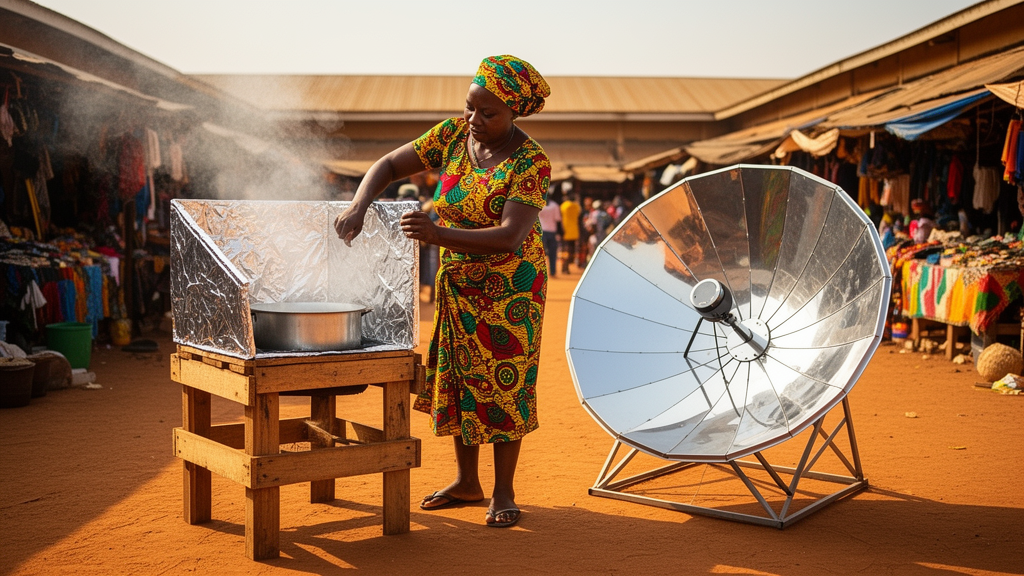
In Lubumbashi, a sprawling city in the Democratic Republic of the Congo where most households still cook with charcoal, a team of researchers has put solar cookers built from local and recycled materials to the test against commercial models. The comparative experiment, published in the journal Discover Sustainability, evaluated four locally manufactured prototypes alongside four commercial systems under real outdoor conditions, using a standardised international protocol to measure how much cooking power each device could actually deliver.
The study addressed a persistent gap. Although Sub-Saharan Africa receives abundant solar radiation, solar cooking has seen limited adoption across the region, in part because imported devices are costly and locally adapted designs remain scarce. Standardised experimental comparisons between locally manufactured and commercial cookers are particularly rare in Central Africa. To fill that gap, the researchers built two box-type cookers, one parabolic cooker and one hybrid configuration using materials available in Lubumbashi, including recycled reflective components such as aluminium. They then benchmarked these prototypes against four commercial products: the SK14 and Yamo Dudo parabolic cookers, the Fornelia and the Brother.
Performance was assessed according to the Solar Cookers International Performance Evaluation Process, known as SCI-PEP, with standardised cooking power serving as the primary indicator. The measurements revealed substantial differences between technologies. Commercial parabolic cookers achieved the highest standardised performance of anything tested. The SK14 reached 185.06 watts, followed by the Yamo Dudo at 124.31 watts. The best locally manufactured device, the parabolic prototype, delivered 113.22 watts, placing it within reach of the commercial parabolics but still behind them.
The box-type cookers fared considerably worse in raw power terms. Their standardised performance ranged from 25.57 to 31.77 watts, while the hybrid configuration reached 26.95 watts. Those figures are roughly a fifth of what the SK14 achieved. Yet the authors argue that raw cooking power is not the only criterion that matters in resource-constrained settings. Box-type and hybrid designs, they note, balance safety, efficiency and fabrication simplicity, and their construction requires neither specialised components nor advanced manufacturing capacity.
One of the study’s most consequential findings concerns materials. Reflectance measurements showed that recycled aluminium-based materials can provide optical properties suitable for solar concentration, the mechanism by which reflective surfaces focus sunlight onto a cooking vessel. That result supports the use of salvaged reflective components in low-cost solar cooker manufacture, and it underpins the feasibility argument at the heart of the research: functional concentrating cookers can be assembled from what is locally available, rather than relying on imported hardware.
The authors are careful about what their results do and do not show. The locally manufactured cookers did not match the thermal performance of the commercial parabolic systems, and the study was a technical performance assessment under outdoor conditions in a single city, not a trial of household adoption, fuel savings or health outcomes. What the results do demonstrate is that locally built devices can achieve measurable, quantified cooking power using recycled and locally sourced materials, establishing a baseline for designs adapted to resource-constrained environments.
The broader context gives the work its urgency. In many Sub-Saharan African cities, household cooking remains heavily dependent on charcoal, a dependence that contributes to deforestation, greenhouse gas emissions and adverse health impacts. Lubumbashi reflects that pattern. The researchers suggest that locally manufactured solar cookers could serve as complementary clean cooking technologies in rapidly growing urban areas of the region, sitting alongside rather than entirely replacing existing cooking fuels.
For the field, the study offers something comparatively rare: head-to-head standardised numbers for locally manufactured and commercial solar cookers tested side by side under the same outdoor conditions. The SCI-PEP framework allowed the prototypes to be compared directly with established commercial products such as the SK14. The gap between the local parabolic prototype at 113.22 watts and the SK14 at 185.06 watts quantifies how far low-cost local fabrication currently trails commercial engineering, while the box-type results define the lower performance tier that simpler designs occupy.
The findings also carry practical implications for where different designs might fit. The commercial parabolics clearly lead on cooking power, but the locally built box-type and hybrid cookers offer fabrication simplicity and safety advantages that may matter for community-scale production. Meanwhile, the demonstration that recycled aluminium reflective surfaces perform adequately for solar concentration opens a low-cost pathway for workshops and local manufacturers to enter the field without importing specialised optics.
As urban populations across Sub-Saharan Africa continue to grow and charcoal demand with them, the Lubumbashi experiments provide a measured, protocol-based starting point. They show that the performance ceiling for locally built solar cookers is real but not prohibitive, that recycled materials can do the optical work of solar concentration, and that the study’s scope leaves questions of sustained household use, adoption and real-world fuel savings for future work to address.
Subject of Research: Comparative experimental performance testing of locally manufactured and commercial solar cookers under outdoor conditions in Lubumbashi, Democratic Republic of the Congo
Article Title: Comparative experimental assessment of locally manufactured and commercial solar cookers under outdoor conditions in Lubumbashi, Democratic Republic of the Congo
Article References: Balume Baderha, S., Bijnens, L., Abrams, S., Banza Wa Banza, B., & Deferme, W. (2026). Comparative experimental assessment of locally manufactured and commercial solar cookers under outdoor conditions in Lubumbashi, Democratic Republic of the Congo. Discover Sustainability. https://doi.org/10.1007/s43621-026-05004-9
Image Credits: AI Generated
DOI: 10.1007/s43621-026-05004-9
Keywords: solar cookers, Lubumbashi, Democratic Republic of the Congo, clean cooking, recycled materials, parabolic cooker, box-type cooker, SCI-PEP protocol, charcoal dependence, Sub-Saharan Africa, renewable energy, appropriate technology
Cite Scienmag News
Violet Maxwell. (October 23, 2026). Locally Built Solar Cookers Trail Commercial Parabolic Designs in Congo Tests. Scienmag. https://scienmag.com/locally-built-solar-cookers-trail-commercial-parabolic-designs-in-congo-tests/
Violet Maxwell. "Locally Built Solar Cookers Trail Commercial Parabolic Designs in Congo Tests." Scienmag, 23 October 2026, https://scienmag.com/locally-built-solar-cookers-trail-commercial-parabolic-designs-in-congo-tests/. Accessed 23 October 2026.
Violet Maxwell. "Locally Built Solar Cookers Trail Commercial Parabolic Designs in Congo Tests." Scienmag. October 23, 2026. https://scienmag.com/locally-built-solar-cookers-trail-commercial-parabolic-designs-in-congo-tests/

