


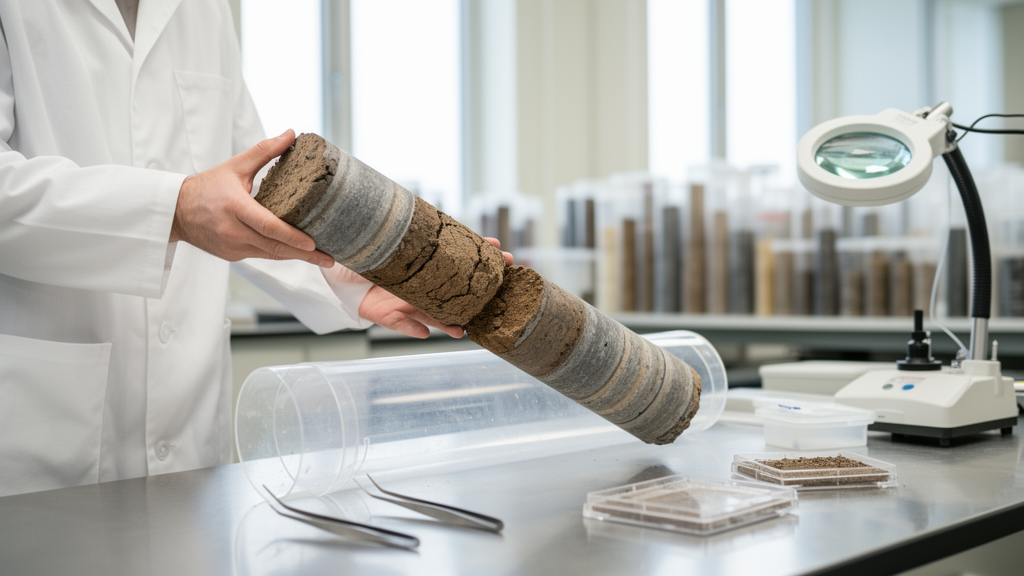
A new sediment core from southern Sweden is helping to untangle one of archaeology and climate science’s longest-running debates: what caused the Younger Dryas, a millennium-long return to near-glacial conditions that began nearly 13,000 years ago. The study, led by an international team including researchers at the University of South Carolina and published Sept. 30 in ScienceOpen Research, challenges the idea that the Laacher See volcanic eruption in western Europe triggered the pronounced cooling that swept across central Europe and the Arctic. By capturing the volcanic ash, a distinct particle-rich layer, and the onset of colder conditions within a single core, the researchers were able to separate three events that have often been discussed as one.
The core revealed a Younger Dryas Boundary (YDB) layer containing microspherules—tiny particles of melted material—and platinum-rich nanoparticles that the researchers interpret as possible evidence of an extraterrestrial event. Crucially, older, deeper layers in the same core contain volcanic ash from the Laacher See eruption, deposited roughly 150 years before the boundary layer formed. The younger, microspherule-rich layer lies immediately beneath sediments recording a shift to colder and wetter conditions at the start of the Younger Dryas. This stratigraphic ordering means the eruption and the boundary layer were separate events, spaced far enough apart in time that the eruption is an unlikely primary driver of the cooling.
Microscopic and chemical analyses of the boundary layer point to a mixed origin for its contents. Most of the melted particles appear to have formed from terrestrial material, but some of the platinum-rich nanoparticles show chemical ratios that overlap with those found in certain meteorites and other extraterrestrial material. The team also measured concentrations of several elements carried by the nanoparticles at roughly five to ten times higher levels in the YDB layer than in the surrounding sediments. That pattern was absent from the older volcanic ash and is consistent with fallout from a possible extraterrestrial impact or an atmospheric airburst—an explosion of a space object in the atmosphere rather than a ground collision.
The Swedish findings align with reports from numerous other Younger Dryas Boundary sites across the Americas, Europe, Africa and the Middle East, where researchers have previously identified unusual platinum enrichments and microscopic melted particles in sediments of comparable age. Such evidence has been cited in support of the Younger Dryas extraterrestrial impact hypothesis, though scientists continue to debate the origin of these particles and whether any such event actually contributed to the cooling. The new core does not settle that question, but it sharpens the timeline: at this site, the boundary layer precedes the environmental shift to colder, wetter conditions almost immediately, while the Laacher See ash sits clearly below it.
Lead author Christopher Moore, a research professor at the University of South Carolina, said the separation of events is the study’s central contribution. “This demonstrates that the volcanic eruption and the Younger Dryas Boundary were separate events,” Moore said. “At our site in southern Sweden, we identified this boundary layer through tiny, melted particles called microspherules and unusually high concentrations of platinum-group elements. This layer is followed almost immediately by evidence for a sudden shift to colder and wetter conditions.” He noted that the work helps distinguish the Laacher See eruption, the deposition of the boundary layer, and the beginning of Younger Dryas cooling—three events that have often been conflated.
The timing argument against a volcanic trigger rests on both sequence and duration. Although the Laacher See eruption may have caused some short-term atmospheric cooling in Europe, large volcanic eruptions typically produce brief cooling episodes lasting years to decades, not the more than 1,000 years of near-glacial conditions experienced across much of the Northern Hemisphere during the Younger Dryas. With the ash deposited about 150 years before the boundary layer, the researchers argue the eruption’s climatic fingerprint would have faded long before the cooling began.
The researchers favor an extraterrestrial impact or atmospheric airburst as a possible trigger for the Younger Dryas, but they acknowledge alternatives. Another volcanic eruption around the same time cannot be ruled out, and it is also possible that volcanic activity and an extraterrestrial event occurred together. Notably, no distinct volcanic ash layer was identified at the Younger Dryas Boundary in the Swedish core itself, although the authors caution that ash from an eruption elsewhere might simply not have reached or been preserved at the site—a limitation that keeps other volcanic scenarios open.
The Younger Dryas has attracted competing explanations for decades. Among the leading alternatives is a large release of glacial meltwater that may have disrupted Atlantic Ocean circulation, a mechanism that could plausibly sustain long-term cooling in the Northern Hemisphere. The Swedish core clarifies the order of events in southern Scandinavia—eruption, then boundary-layer deposition, then environmental change—but, as the authors emphasize, it does not establish what caused the cooling. What it does provide is a cleaner European archive for testing the competing hypotheses, allowing researchers to evaluate volcanic, extraterrestrial, and ocean-circulation explanations against a stratigraphy in which the key events can finally be told apart.
Subject of Research: Sediment core evidence separating the Laacher See volcanic eruption from the Younger Dryas Boundary layer and onset of Younger Dryas cooling
Article Title: New sediment core analysis sheds light on 13,000-year-old ‘cold case’
Article References: New sediment core analysis sheds light on 13,000-year-old ‘cold case’. Original publication (Bibliographic details unavailable.)
Image Credits: AI Generated
DOI: Not provided
Keywords: Younger Dryas, Laacher See eruption, sediment core, microspherules, platinum anomaly, extraterrestrial impact hypothesis, airburst, paleoclimatology, southern Sweden, volcanic ash, Quaternary climate, sediment
Cite Scienmag News
Violet Maxwell. (October 23, 2026). Swedish sediment core separates Laacher See eruption from Younger Dryas cooling. Scienmag. https://scienmag.com/swedish-sediment-core-separates-laacher-see-eruption-from-younger-dryas-cooling/
Violet Maxwell. "Swedish sediment core separates Laacher See eruption from Younger Dryas cooling." Scienmag, 23 October 2026, https://scienmag.com/swedish-sediment-core-separates-laacher-see-eruption-from-younger-dryas-cooling/. Accessed 23 October 2026.
Violet Maxwell. "Swedish sediment core separates Laacher See eruption from Younger Dryas cooling." Scienmag. October 23, 2026. https://scienmag.com/swedish-sediment-core-separates-laacher-see-eruption-from-younger-dryas-cooling/


