


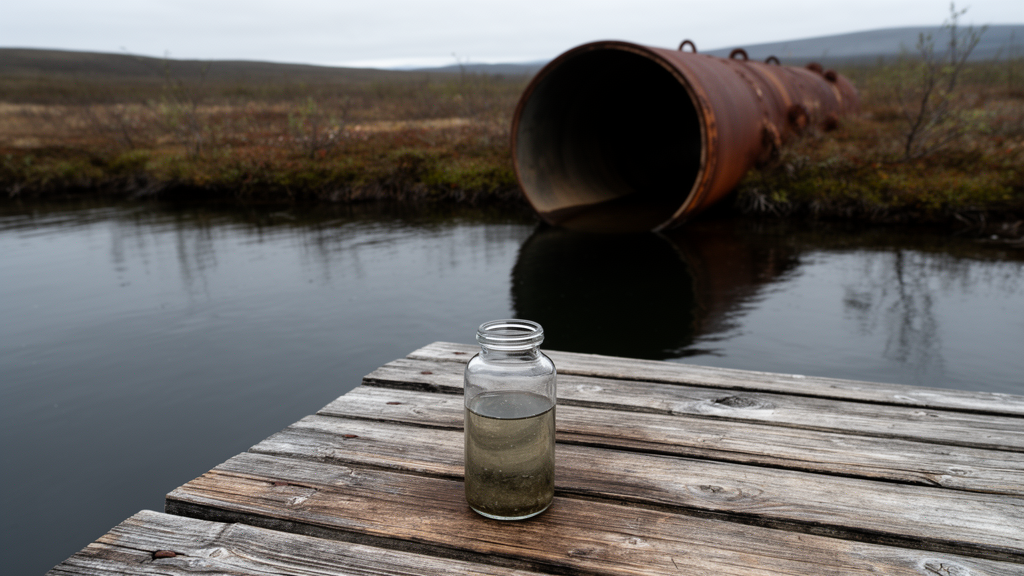
Researchers have documented the presence of per- and polyfluoroalkyl substances, commonly known as PFAS, in fish populations within the Brooks Range of Alaska, a region historically considered one of North America’s most ecologically intact landscapes. The study, published in Environmental Monitoring and Assessment, assessed metal and PFAS concentrations in aquatic environments and fish tissue from waterbodies along the Dalton Highway and three western Brooks Range rivers. While heavy metal levels were largely below thresholds for consumption advice, the detection of elevated PFAS in specific locations highlights emerging environmental concerns in this remote Arctic region. The findings provide critical baseline data for understanding how industrial infrastructure and climate change may influence contaminant loads in northern Alaska’s aquatic ecosystems.
The investigation focused on two distinct geographic areas to compare human-impacted watersheds with undeveloped systems. Sampling locations along the Dalton Highway, a heavily trafficked industrial corridor that has existed for over fifty years, were selected to represent areas subject to historical and ongoing industrial influence. In contrast, sections of the John, Alatna, and Kobuk rivers were sampled to provide baseline data from watersheds that would potentially be affected by the proposed Ambler Road, a 340-kilometer industrial corridor intended to service hard rock mining prospects. By comparing these two groups, the researchers aimed to establish current contaminant conditions and identify potential threats to fish health and human consumption safety in a landscape undergoing rapid change.
Fieldwork was conducted between 2023 and 2024, during which researchers collected samples of fish, aquatic invertebrates, vegetation, and sediment from various waterbodies. Fish species targeted included those commonly harvested for subsistence and recreational purposes, with a specific focus on slimy sculpin and larger-bodied predators such as Arctic grayling and northern pike. Slimy sculpin were prioritized because they are short-lived and sedentary, making them excellent indicators of local environmental conditions, while larger fish were analyzed to assess long-term bioaccumulation trends. Tissue samples were processed at the University of Alaska Fairbanks and analyzed at commercial laboratories using standardized EPA methods to measure total mercury, arsenic, copper, zinc, lead, and 28 individual PFAS analytes.
Results indicated that metal concentrations in sediment, aquatic vegetation, and invertebrates were generally low and did not substantially exceed probable effects levels for toxicity to freshwater biota at most sites. Total mercury levels in fish muscle tissue were largely below thresholds that trigger consumption advisories, with the exception of a subset of large-bodied individuals. Specifically, only two northern pike and one lake trout from Island Lake exhibited mercury levels high enough to warrant reduced consumption recommendations under Alaska Department of Health guidelines. These elevated mercury concentrations are consistent with patterns observed in other long-lived predatory fish across Alaska, where bioaccumulation in higher trophic levels is a natural process rather than an indicator of local industrial contamination.
The most significant finding of the study was the detection of PFAS in fish from waterbodies near the Dalton Highway. While PFAS were not detected in fish from the undeveloped western Brooks Range rivers, trace amounts were found in several samples from Dalton Highway-influenced sites. The most concerning concentrations were observed in Arctic grayling, round whitefish, and burbot collected from the Tea Lake outlet near its confluence with the Atigun River. In these samples, perfluorooctanesulfonic acid, or PFOS, reached levels that would trigger further investigation or fish consumption advisories in at least 45 other US states and countries. The highest observed concentration was 40 micrograms per kilogram in a composite grayling sample, a level that exceeds “Do Not Eat” thresholds established by several US states for sensitive populations.
The proximity of the affected Tea Lake to Trans-Alaska Pipeline System Pump Station 4 suggests a potential source for the PFAS contamination. Firefighting foams containing PFAS have historically been stored and used at pipeline infrastructure sites throughout Alaska, and while specific release events are not fully documented, the spatial correlation between the pump station and the elevated fish concentrations is notable. The researchers noted that PFAS is not currently listed as a contaminant of concern in the Alaska Department of Environmental Conservation’s entries for this specific pump station, making this study the first indicator that PFAS contamination may have occurred at the location. This finding underscores the need for further investigation to delineate the extent of contamination in both terrestrial and aquatic environments near industrial outposts.
Statistical analysis revealed that while mercury levels in sediment and northern pike did not significantly differ between the Dalton Highway sites and the western Brooks Range rivers, Arctic grayling from the undeveloped rivers had significantly higher mercury concentrations than those near the highway. This counterintuitive result was likely an artifact of sampling bias, as the grayling from the western rivers were significantly larger on average, leading to greater bioaccumulation of mercury over their longer lifespans. In contrast, PFOS concentrations were significantly higher in fish from Dalton Highway-influenced sites compared to the undeveloped rivers, reinforcing the link between industrial infrastructure and PFAS presence. The absence of PFAS in the western Brooks Range rivers reflects the lack of historical activities in those watersheds that required the storage and use of aqueous film-forming firefighting foam.
The study highlights the importance of fish as bioindicators of ecosystem health in the face of climate change and resource development. Permafrost thaw, a phenomenon exacerbated by climate change, can mobilize naturally occurring metals and release them into aquatic systems, a process sometimes referred to as “rusting rivers.” While the current data does not show widespread metal contamination from this source, the researchers emphasize the need for periodic monitoring to track changes in environmental conditions. If the proposed Ambler Road is constructed, it would intersect all of the western Brooks Range rivers sampled in this study, potentially exposing aquatic environments to new contaminants from road runoff, fugitive ore dust, and mining activities. Regular sampling every three to ten years could help identify shifts in contaminant levels and assess risks to fish health and wild food harvesters.
The researchers recommend further investigation of the Tea Lake site and similar industrial infrastructure outposts throughout Alaska to determine the source and extent of PFAS contamination. They also call for the formalization of PFAS fish consumption guidance at both the Alaska state and US federal levels, a process that has been delayed for over a decade. Currently, the US Food and Drug Administration and the Alaska Department of Health do not provide specific consumption guidelines for fish containing PFAS, leaving subsistence and recreational anglers without clear guidance on potential health risks. Establishing these guidelines is essential to protect the health of people who rely on wild fish for food, particularly in communities where fish can comprise up to 50 percent of the wild harvest.
This study provides a crucial baseline for understanding contaminant dynamics in the Brooks Range, a region of global ecological significance. As land use changes and climate impacts accelerate in northern Alaska, continued monitoring of aquatic media and fish populations will be vital for characterizing current conditions and identifying potential threats. The detection of PFAS in fish near industrial infrastructure serves as a reminder that even in remote Arctic landscapes, human activities can leave lasting chemical signatures. Future research should prioritize filling spatial gaps in contaminant data, particularly in waterbodies adjacent to the Dalton Highway and in areas with proposed land use changes, to ensure that environmental management decisions are informed by comprehensive and up-to-date scientific evidence.
Subject of Research: PFAS and metal concentrations in aquatic environments and fish of the Brooks Range, Alaska
Article Title: Metals and PFAS concentrations in aquatic environments and fish of the Brooks Range, Alaska
Article References: Fraley, K. M., Snodgrass, W., Kelly, B. T., & Robards, M. D. (2026). Metals and PFAS concentrations in aquatic environments and fish of the Brooks Range, Alaska. Environmental Monitoring and Assessment, 198(11), 1246. https://doi.org/10.1007/s10661-026-16052-z
Image Credits: AI Generated
DOI: 10.1007/s10661-026-16052-z
Keywords: PFAS, Alaska, Brooks Range, Fish Contamination, Environmental Monitoring, Dalton Highway, Mercury, Subsistence Fishing, Industrial Infrastructure, Permafrost Thaw, Metals, concentrations
Cite Scienmag News
Violet Maxwell. (October 23, 2026). PFAS Detected in Alaska Fish Near Industrial Infrastructure. Scienmag. https://scienmag.com/pfas-detected-in-alaska-fish-near-industrial-infrastructure/
Violet Maxwell. "PFAS Detected in Alaska Fish Near Industrial Infrastructure." Scienmag, 23 October 2026, https://scienmag.com/pfas-detected-in-alaska-fish-near-industrial-infrastructure/. Accessed 23 October 2026.
Violet Maxwell. "PFAS Detected in Alaska Fish Near Industrial Infrastructure." Scienmag. October 23, 2026. https://scienmag.com/pfas-detected-in-alaska-fish-near-industrial-infrastructure/


