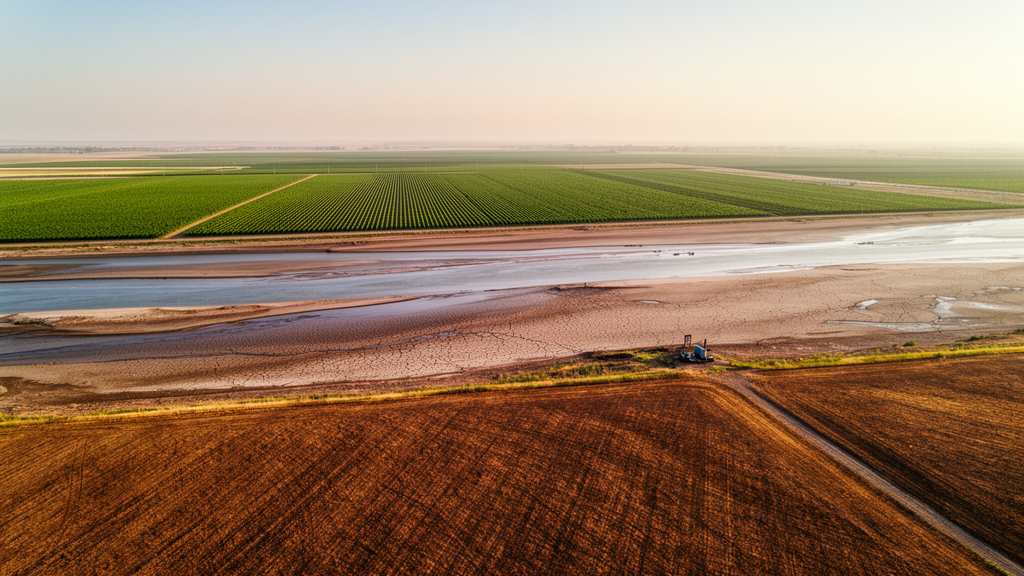
Water scarcity in the United States will not unfold uniformly, according to a new study published in Nature Communications by Joey Blumberg and Travis Warziniack. Using high-frequency water withdrawal data from 2000 to 2020, the researchers disentangled the effects of climate, hydrology, and socioeconomic factors on three major uses: public water supply, crop irrigation, and cooling water for thermoelectric power generation. Their analysis shows that each sector responds differently to warming, producing a picture of future water stress that is strongly seasonal and regionally variable rather than a single national trend.
To look ahead, the team projected water demands for 2040 to 2070 using recent climate and socioeconomic scenarios. The projections span 1.0 to 2.9 degrees Celsius of warming and population growth ranging from 1 percent to 44 percent. Across 28 scenarios, and contingent on continued adaptive efforts, estimated annual changes in water use ranged from a decrease of 10.7 percent to an increase of 28.9 percent for public use, an increase of 32.1 to 43.6 percent for crop irrigation, and a decrease of 19.9 to 27.9 percent for thermoelectric power cooling.
The sectoral contrasts are striking. Irrigation demand rises consistently across all scenarios, reflecting the sensitivity of agriculture to hotter conditions, while cooling water withdrawals decline in the projected scenarios. Public water use, by contrast, could move in either direction depending on how population growth and adaptation interact with local climate conditions.
These are model-based estimates of future demand, not observations of change that have already occurred. Beyond the totals, the study highlights seasonal mismatches between when water is available and when it is needed, a dynamic that determines whether a region actually experiences stress even when annual supplies appear adequate. Regional shifts in water stress under future warming follow from these timing differences, meaning that adaptation strategies tailored to specific seasons and places matter more than aggregate national figures suggest.
The authors note that their projections assume continued adaptive efforts, so outcomes could differ where adaptation stalls or accelerates.
Subject of Research: Projected climate-driven changes in seasonal and regional water stress across US public supply, irrigation, and power cooling sectors
Article Title: Climate-driven water stress in the United States is seasonal, regional, and shaped by adaptation
Article References: Blumberg, J., & Warziniack, T. (2026). Climate-driven water stress in the United States is seasonal, regional, and shaped by adaptation. Nature Communications. https://doi.org/10.1038/s41467-026-78688-2
Image Credits: AI Generated
DOI: 10.1038/s41467-026-78688-2
Keywords: water stress, climate change, water use projections, crop irrigation, thermoelectric cooling, public water supply, food-energy-water nexus, seasonal water demand, regional adaptation, scenario modeling, United States, Climate-driven
Cite Scienmag News
Sloane Callahan. (October 23, 2026). US Water Stress Under Climate Change Is Seasonal and Regional. Scienmag. https://scienmag.com/us-water-stress-under-climate-change-is-seasonal-and-regional/
Sloane Callahan. "US Water Stress Under Climate Change Is Seasonal and Regional." Scienmag, 23 October 2026, https://scienmag.com/us-water-stress-under-climate-change-is-seasonal-and-regional/. Accessed 23 October 2026.
Sloane Callahan. "US Water Stress Under Climate Change Is Seasonal and Regional." Scienmag. October 23, 2026. https://scienmag.com/us-water-stress-under-climate-change-is-seasonal-and-regional/