


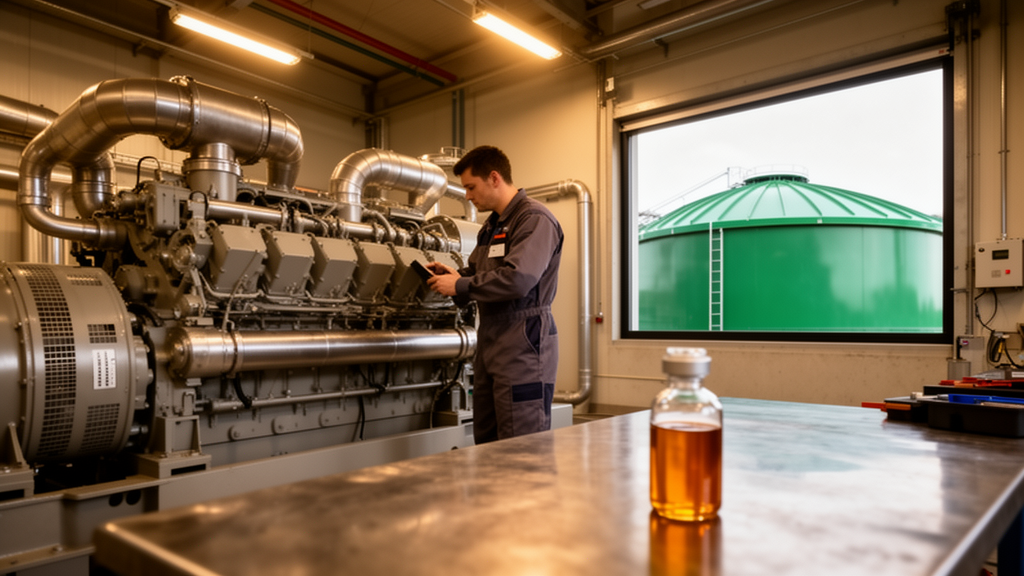
A simulation study of biogas-fueled homogeneous charge compression ignition (HCCI) engines reports that optimized blends of three fuel additives — methanol, ethanol and acetone — could raise predicted power output from 17.5 kilowatts in a base biogas case to as much as 23.5 kilowatts, while keeping peak in-cylinder temperature in check as a qualitative indicator of thermal nitrogen oxide formation tendency. The study, carried out by researchers at the University of Jordan, UiT The Arctic University of Norway and the University of Tripoli Alahlia, is published in Frontiers in Energy Research in the section on Advanced Clean Fuel Technologies.
The team built a multi-zone combustion model based on six distinct combustion zones, each with a different initial gas composition and temperature, to represent combustion of biogas dosed with the additives. On top of this model, they performed multi-objective optimization using three algorithms: a standard Genetic Algorithm, the Nondominated Sorting Genetic Algorithm II (NSGA-II), and a Pareto Search method. Each algorithm searched for additive mixtures that maximized peak pressure, net heat release rate and accumulated gas heat production while minimizing in-cylinder temperature, the quantity the authors used to gauge the tendency toward thermal NOx formation.
The predicted gains were substantial for two of the three solutions. The Genetic Algorithm raised modeled power output to 23.1 kilowatts, while NSGA-II reached 23.5 kilowatts, compared with 17.5 kilowatts for the base case. Indicated mean effective pressure rose from 6.8 bar to 10.6 and 10.8 bar respectively, and the corresponding computed efficiencies were 40.1 percent for the Genetic Algorithm and 40.8 percent for NSGA-II. The Pareto Search solution produced the highest indicated mean effective pressure of the three, at 11.3 bar, but a lower power output of 21.0 kilowatts and a lower efficiency of 38.7 percent. According to the authors, this is because its advanced combustion phasing produces negative work near top dead center.
The optimal additive fractions differed between the algorithms. The Genetic Algorithm identified 0.015 ethanol, 0.015 acetone and 0.021 methanol; NSGA-II selected 0.021 ethanol, 0.014 acetone and 0.020 methanol; and Pareto Search landed on considerably richer fractions of 0.075 ethanol, 0.035 acetone and 0.090 methanol. Across all three solutions, methanol showed the strongest enhancement effect among the additives tested in the model.
The authors are explicit about the limits of these findings. Every result is simulation-based and has not been experimentally validated, and the study provides a numerical framework intended to guide future experimental work rather than proof of achievable engine performance. Even so, the predicted figures — roughly a 32 to 34 percent power gain for the two genetic-algorithm solutions, with computed efficiencies above 40 percent — give researchers a concrete set of additive fractions and combustion outcomes to test against real biogas-fueled HCCI engines, and quantify the trade-off between power, efficiency and the temperature conditions associated with thermal nitrogen oxide formation.
Subject of Research: Multi-objective optimization of methanol, ethanol and acetone fuel additives to improve biogas combustion performance and limit NOx formation tendency in HCCI engines
Article Title: Performance enhancement and emission tendency of biogas-fueled engines using fuel additives
Article References: Alrbai, M., Qawasmeh, B. R., Duwaairi, H., Mustafa, M., & Abusorra, M. (2026). Performance enhancement and emission tendency of biogas-fueled engines using fuel additives. Frontiers in Energy Research, 14, Article 2001753. https://doi.org/10.3389/fenrg.2026.2001753
Image Credits: AI Generated
DOI: 10.3389/fenrg.2026.2001753
Keywords: biogas, HCCI engines, fuel additives, methanol, ethanol, acetone, combustion modeling, multi-objective optimization, genetic algorithm, NOx emissions, engine efficiency, Performance
Cite Scienmag News
Denise Maddox. (October 23, 2026). Fuel Additives Could Boost Biogas Engine Power, Simulation Study Finds. Scienmag. https://scienmag.com/fuel-additives-could-boost-biogas-engine-power-simulation-study-finds/
Denise Maddox. "Fuel Additives Could Boost Biogas Engine Power, Simulation Study Finds." Scienmag, 23 October 2026, https://scienmag.com/fuel-additives-could-boost-biogas-engine-power-simulation-study-finds/. Accessed 23 October 2026.
Denise Maddox. "Fuel Additives Could Boost Biogas Engine Power, Simulation Study Finds." Scienmag. October 23, 2026. https://scienmag.com/fuel-additives-could-boost-biogas-engine-power-simulation-study-finds/


