


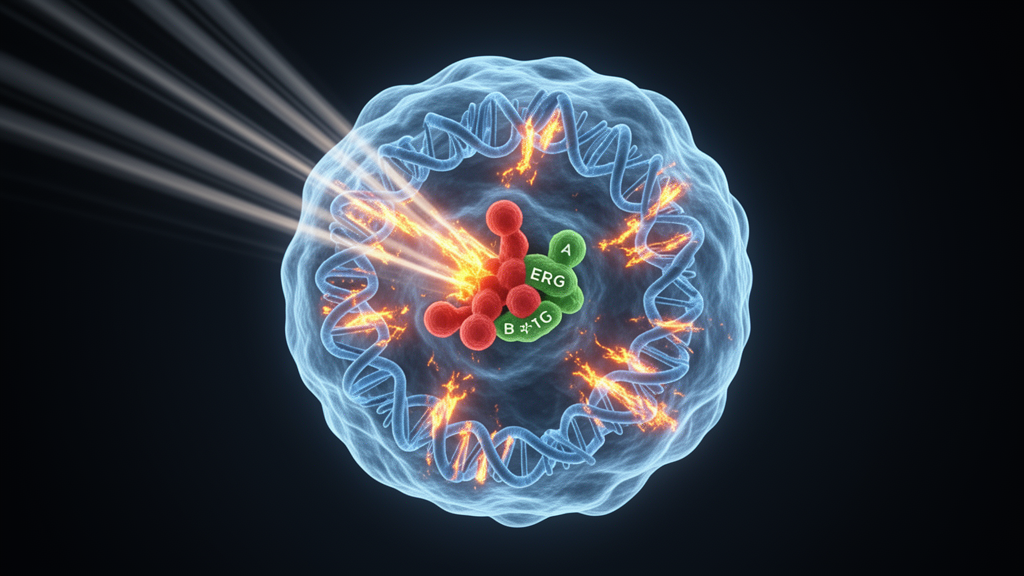
Roughly half of all prostate cancers carry the TMPRSS2-ERG gene fusion, a rearrangement that drives overproduction of the ERG transcription factor and defines a distinct molecular subtype of the disease. A new study published in Journal of Experimental & Clinical Cancer Research reports that directly inhibiting ERG selectively compromises the ability of these ERG-positive tumor cells to repair radiation-induced DNA damage, while leaving ERG-negative cells largely unharmed. The finding offers a mechanistic rationale for pairing ERG-targeted drugs with radiotherapy in molecularly defined patient groups.
Radiation therapy is a cornerstone of treatment for localized and locally advanced prostate cancer, yet a substantial number of patients still experience treatment failure. The research team, led by Wael Y. Mansour, asked whether ERG overexpression itself creates a therapeutic vulnerability that could be exploited to improve radiosensitivity. Their answer came from a multi-model experimental strategy that combined cell lines, freshly cultured patient tissue, and patient-derived organoids.
The researchers used ERG-positive VCaP prostate cancer cells alongside ERG-negative DU145 and BPH1 cells as controls. They also established ex vivo tissue slice cultures from 14 prostate cancer samples obtained from 10 patients, and grew patient-derived organoids from two additional cases. These models were treated with two small-molecule ERG inhibitors, ERGi-USU and VPC-18005, or with ERG-targeted siRNA, either alone or in combination with irradiation doses ranging from 2 to 6 gray.
To track DNA repair, the team measured residual gamma-H2AX and 53BP1 foci, well-established markers of unrepaired DNA double-strand breaks, using immunofluorescence. They also quantified end-joining activity with a pEJ-GFP reporter assay and assessed long-term reproductive survival through clonogenic assays in both two-dimensional and three-dimensional formats.
The results were consistent across model systems. In ERG-positive VCaP cells, in the ex vivo patient tissue slices, and in the patient-derived organoids, ERG inhibition or ERG knockdown significantly increased the number of residual gamma-H2AX and 53BP1 foci after irradiation and reduced clonogenic survival. In contrast, ERG-negative models were unaffected, indicating that the radiosensitizing effect is selective for tumors dependent on the fusion-driven ERG program.
To identify the molecular machinery behind this vulnerability, the researchers performed label-free quantitative proteomics using LC-MS/MS on treated cells. The analysis revealed that ERG inhibition downregulates key components of the PARP1-mediated end-joining pathway, including PARP1 itself, the ligase LIG3, the scaffold protein XRCC1, and the end-resection factor MRE11. Immunoblotting and promoter activity assays using GLuc-ON reporter plasmids confirmed that these changes occur at the level of pathway regulation.
Functional assays then showed that ERG inhibition and PARP inhibition converge on a common mechanism: both block alternative end joining, a repair route that cancer cells rely on to survive radiation-induced breaks. This convergence suggests that ERG-positive tumors may be primed for combination approaches that simultaneously target the transcription factor and the repair enzyme it regulates.
The study also explored interactions with androgen receptor signaling, the dominant therapeutic axis in prostate cancer. When ERG inhibition was combined with androgen receptor pathway inhibition, growth suppression was further enhanced in ERG-positive spheroids and patient-derived organoids. The authors attribute this added effect, at least in part, to metabolic reprogramming within the treated cells.
Taken together, the data position ERG not merely as a marker of the TMPRSS2-ERG fusion subtype but as a master regulator of DNA repair dependencies in ERG-positive prostate cancer. By showing that pharmacological ERG blockade delays the resolution of radiation-induced damage signals and selectively kills irradiated ERG-positive models, the study provides a strong preclinical foundation for clinical evaluation of ERG-directed radiosensitization.
The work remains at the preclinical stage, and the reported findings derive from cell lines, tissue slices, and organoids rather than from treated patients. Nevertheless, the selectivity observed across ERG-positive and ERG-negative systems, and the convergence of ERG and PARP inhibition on alternative end joining, outline a precision medicine strategy in which molecular profiling of the fusion status could guide which patients receive ERG inhibitors alongside radiotherapy or androgen receptor inhibitors in future trials.
Subject of Research: ERG inhibition and radiosensitization in ERG-positive prostate cancer
Article Title: ERG inhibition selectively sensitizes ERG-positive prostate cancer to radiation through DNA repair vulnerabilities and enhances response to androgen receptor inhibitors
Article References: Moustafa, A., Elsesy, M. E., Siebels, B., Hahn, J., Oh-Hohenhorst, S.-J., Schudy, C., Rieckmann, T., Burdak-Rothkamm, S., Tilki, D., Maurer, T., Petersen, C., Rothkamm, K., von Amsberg, G., Bokemeyer, C., Schlüter, H., Köcher, S., & Mansour, W. Y. (2026). ERG inhibition selectively sensitizes ERG-positive prostate cancer to radiation through DNA repair vulnerabilities and enhances response to androgen receptor inhibitors. Journal of Experimental & Clinical Cancer Research. https://doi.org/10.1186/s13046-026-03854-9
Image Credits: AI Generated
DOI: 10.1186/s13046-026-03854-9
Keywords: prostate cancer, ERG, TMPRSS2-ERG fusion, radiotherapy, DNA repair, PARP1, alternative end joining, androgen receptor, radiosensitization, precision medicine, patient-derived organoids, inhibition
Cite Scienmag News
Nathaniel Bowman. (October 23, 2026). Blocking ERG Protein Radiosensitizes ERG-Positive Prostate Cancers by Disabling DNA Repair. Scienmag. https://scienmag.com/blocking-erg-protein-radiosensitizes-erg-positive-prostate-cancers-by-disabling-dna-repair/
Nathaniel Bowman. "Blocking ERG Protein Radiosensitizes ERG-Positive Prostate Cancers by Disabling DNA Repair." Scienmag, 23 October 2026, https://scienmag.com/blocking-erg-protein-radiosensitizes-erg-positive-prostate-cancers-by-disabling-dna-repair/. Accessed 23 October 2026.
Nathaniel Bowman. "Blocking ERG Protein Radiosensitizes ERG-Positive Prostate Cancers by Disabling DNA Repair." Scienmag. October 23, 2026. https://scienmag.com/blocking-erg-protein-radiosensitizes-erg-positive-prostate-cancers-by-disabling-dna-repair/


