

Friday, October 23, 2026
Science
No Result
View All Result
  • Login
  • HOME
  • SCIENCE NEWS
  • CONTACT US
  • HOME
  • SCIENCE NEWS
  • CONTACT US
No Result
View All Result
Scienmag
No Result
View All Result
Home Science News Space

Deep Learning Reads Active Region Shape to Forecast Solar Flares

October 23, 2026
in Space
Blake Davidson
By Blake Davidson Scienmag Editorial Profile - Data Science
Reading Time: 3 mins read
0
Deep Learning Reads Active Region Shape to Forecast Solar Flares

Deep Learning Reads Active Region Shape to Forecast Solar Flares

65
SHARES
587
VIEWS
Share on FacebookShare on Twitter
ADVERTISEMENT

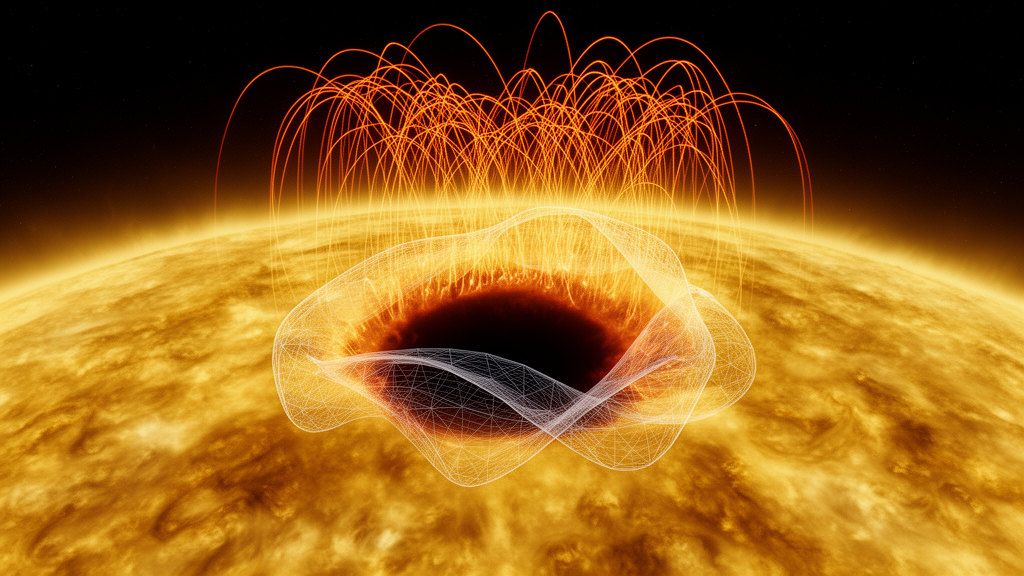
A new study published in Solar Physics argues that this parameterization squeezes the spatial structure of active regions and may discard information relevant to flare initiation. The research shows that deep convolutional neural networks trained directly on the spatial distributions of several active region properties can achieve flare forecasting performance, and that the raw morphology of an active region appears to carry usable flare signatures on its own. The study was carried out by Ashwini Nagaraj Shenoy, Adithya H.N., Deepu Vijayasenan, Sreejith Padinhatteeri, and B. S. Raghavendra.

Instead of relying on parameterized, hand-engineered features derived from active regions, the team trained deep convolutional neural networks on the spatial distributions of several active region physical properties. The researchers hypothesized that the morphology of an active region, in and of itself, encodes meaningful information about its flare potential, and they tested this idea by training separate models on different physical properties and comparing how the models performed. One practical obstacle in training such models is that solar active regions come in different sizes and shapes, while the networks require standardized input dimensions.

To address this, the authors proposed a resizing technique called Pad-crop, which standardizes the dimensions of active region inputs across the dataset so that many different regions can be fed into the same convolutional architecture. The paper presents this as a method for standardizing input dimensions rather than as a validated forecasting improvement in itself. The central result is that models trained on different physical properties achieved comparable forecasting performance.

According to the authors, this indicates that the morphology of active regions in itself may encode meaningful flare signatures, a finding that motivates morphology-based approaches to solar flare forecasting. To examine what the networks were learning, the team applied Gradient-weighted Class Activation Mapping, known as Grad-CAM. The Grad-CAM analysis indicated that the models focused on physically meaningful zones of the active regions, suggesting that relevant features were indeed being captured rather than the networks relying on arbitrary patterns.

The study also examined where the forecasts went wrong. An analysis of false-positive predictions suggested that intermediate C-class flares occurring during the prediction window may contribute to model confusion, meaning that some events counted as false alarms may reflect weaker flaring activity within the window rather than pure model error. The researchers emphasize that spatial structure in active region properties deserves greater attention in future forecasting work, and they note that the source code associated with the study will be made publicly available.

The findings are drawn from the training data and evaluation performed in the study, and the authors frame the results as motivation for further exploration of morphology-based approaches to solar flare forecasting rather than as a completed forecasting solution. Within that scope, the work adds evidence that the two-dimensional arrangement of physical properties across an active region holds flare-relevant information that conventional parameterized features may leave behind, and it offers a reproducible pipeline, from the Pad-crop resizing method to the Grad-CAM diagnostics, for other groups to build on.

Subject of Research: Deep learning-based solar flare forecasting using the spatial distributions of active region properties

Article Title: Solar Flare Forecasting Using the Spatial Distributions of Active Region Properties

Article References: Shenoy, A. N., H.N., A., Vijayasenan, D., Padinhatteeri, S., & Raghavendra, B. S. (2026). Solar Flare Forecasting Using the Spatial Distributions of Active Region Properties. Solar Physics, 301(10), Article 161. https://doi.org/10.1007/s11207-026-02751-w

Image Credits: AI Generated

DOI: 10.1007/s11207-026-02751-w

Keywords: solar flares, space weather, active regions, convolutional neural networks, Pad-crop, Grad-CAM, forecasting, solar physics, machine learning, morphology, Solar, Flare

Cite Scienmag News

Blake Davidson. (October 23, 2026). Deep Learning Reads Active Region Shape to Forecast Solar Flares. Scienmag. https://scienmag.com/deep-learning-reads-active-region-shape-to-forecast-solar-flares/

Blake Davidson. "Deep Learning Reads Active Region Shape to Forecast Solar Flares." Scienmag, 23 October 2026, https://scienmag.com/deep-learning-reads-active-region-shape-to-forecast-solar-flares/. Accessed 23 October 2026.

Blake Davidson. "Deep Learning Reads Active Region Shape to Forecast Solar Flares." Scienmag. October 23, 2026. https://scienmag.com/deep-learning-reads-active-region-shape-to-forecast-solar-flares/


Tags: active region morphology analysisactive regionsautomated solar flare forecasting modelschallenges in standardizing solar data for neural networksconvolutional neural networksconvolutional neural networks for solar activity forecastingdeep learning techniques in solar physicsfeature extraction from solar active regionsflareforecastingGrad-CAMimpact of active region shape on flare initiationMachine learningmachine learning in space weather predictionmorphologyPad-cropPad-crop resizing method for solar image analysissignificance of raw active region morphologysolarsolar flare prediction using deep learningsolar flaressolar physicsspace weatherspatial distribution of active region properties
Share26Tweet16
Previous Post

Twin Tracers, Different Signatures: Bone Scans for Cardiac Amyloidosis Are Not Interchangeable

Next Post

Smart sensors that never forget: three learning paradigms collide in activity recognition

Related Posts

Model of Radioactive Background Sharpens Solar Orbiter’s X-Ray View of Weak Flares
Space

Model of Radioactive Background Sharpens Solar Orbiter’s X-Ray View of Weak Flares

October 23, 2026
A self-shadowing black hole accretion disk at sub-Eddington luminosities
Space

A self-shadowing black hole accretion disk at sub-Eddington luminosities

October 22, 2026
Modeled Lunar Free Oscillations Remain Below TianQin Noise Requirement
Space

Modeled Lunar Free Oscillations Remain Below TianQin Noise Requirement

October 22, 2026
QCD sum rules sharpen Bc decay constants and form-factor bounds
Space

QCD sum rules sharpen Bc decay constants and form-factor bounds

October 22, 2026
Quasar survey finds statistical evidence of recoiling supermassive black holes
Space

Quasar survey finds statistical evidence of recoiling supermassive black holes

October 22, 2026
Magnetic fields could imprint distinctive extreme-mass-ratio gravitational waves
Space

Magnetic fields could imprint distinctive extreme-mass-ratio gravitational waves

October 22, 2026
Next Post
Smart sensors that never forget: three learning paradigms collide in activity recognition

Smart sensors that never forget: three learning paradigms collide in activity recognition

  • Mothers who receive childcare support from maternal grandparents show more optimized

    Mothers who receive childcare support from maternal grandparents show more parental warmth, finds NTU Singapore study

    27656 shares
    Share 11059 Tweet 6912
  • University of Seville Breaks 120-Year-Old Mystery, Revises a Key Einstein Concept

    1061 shares
    Share 424 Tweet 265
  • Bee body mass, pathogens and local climate influence heat tolerance

    682 shares
    Share 273 Tweet 171
  • Researchers record first-ever images and data of a shark experiencing a boat strike

    546 shares
    Share 218 Tweet 137
  • Groundbreaking Clinical Trial Reveals Lubiprostone Enhances Kidney Function

    531 shares
    Share 212 Tweet 133
Science

Embark on a thrilling journey of discovery with Scienmag.com—your ultimate source for cutting-edge breakthroughs. Immerse yourself in a world where curiosity knows no limits and tomorrow’s possibilities become today’s reality!

RECENT NEWS

  • Patient-Tailored Gilteritinib Triplet Therapy Shows Tolerability Gains in Relapsed FLT3-Mutated AML
  • Genomic test may identify which prostate cancer patients benefit from added abiraterone
  • Wax Oleogel Releases Rosemary Oil Vapor to Shield Leather Artifacts for Weeks
  • Green AI framework aims to make smart cities computationally sustainable

Categories

  • Agriculture
  • Anthropology
  • Archaeology
  • Athmospheric
  • Biology
  • Biotechnology
  • Blog
  • Bussines
  • Cancer
  • Chemistry
  • Climate
  • Earth Science
  • Editorial Policy
  • Marine
  • Mathematics
  • Medicine
  • Pediatry
  • Policy
  • Psychology & Psychiatry
  • Science Education
  • Science News
  • Social Science
  • Space
  • Technology and Engineering

Subscribe to Blog via Email

Enter your email address to subscribe to this blog and receive notifications of new posts by email.

Join 5,151 other subscribers

© 2025 Scienmag - Science Magazine

Welcome Back!

Login to your account below

Forgotten Password?

Retrieve your password

Please enter your username or email address to reset your password.

Log In
No Result
View All Result
  • HOME
  • SCIENCE NEWS
  • CONTACT US

© 2025 Scienmag - Science Magazine

Discover more from Science

Subscribe now to keep reading and get access to the full archive.

Continue reading