


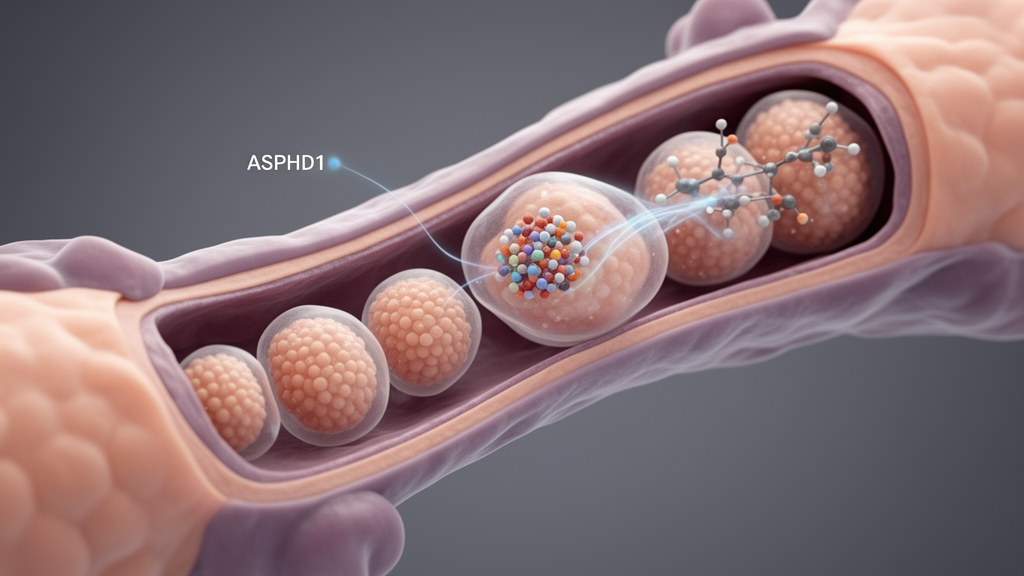
Human kidney transcriptomic analyses linked ASPHD1 to an adaptive proximal-tubule state in acute kidney injury, while experiments in a commercial proximal-tubule cell line found that silencing ASPHD1 increased apoptosis- and ferroptosis-associated vulnerability after cisplatin exposure. The combined results identify ASPHD1 as a candidate regulator of regulated cell death, but the study did not establish a clinical diagnostic test or show that manipulating the gene improves outcomes in patients.
The researchers analyzed two independent human kidney transcriptomic cohorts separately. Candidate genes had to replicate in the same direction, with adjusted statistical significance and an effect-size floor defined before candidate qualification. Nine genes met that strict cross-cohort criterion. The investigators then localized these candidates in a patient-resolved single-nucleus kidney atlas, using individual-level composition analysis and patient-state pseudobulk profiles. ASPHD1 was elevated in native-kidney and transplant-associated acute kidney injury and was preferentially associated with the adaptive proximal-tubule state rather than being distributed uniformly across all injured tubular states.
Gene sets defined before correlation analysis were used to assess apoptosis, ferroptosis, a pyroptotic inflammatory response and programmed necrotic cell death. Apoptosis-associated transcriptional enrichment extended across both adaptive and degenerative proximal-tubule states, whereas ferroptosis-associated enrichment was most evident in degenerative proximal tubules. This pattern indicates that different regulated cell-death programs were associated with distinct states within injured human kidneys. However, candidate-to-death and death-to-immune correlations did not survive correction for the complete statistical family, so the study did not support those correlations as robust relationships.
The investigators also examined whether injury-associated signals could be detected in urine or related to clinical course. ASPHD1 was detectable in urinary cells classified as renal proxies, but the unpaired urinary single-cell data did not establish diagnostic utility. A longitudinal transplant-biopsy cohort constrained interpretation of temporal changes rather than demonstrating recovery utility for ASPHD1 or the other candidates. The data therefore did not show that urinary expression could serve as a standardized indicator of intracellular cell-death programs or that the candidate could predict resolution of acute kidney injury.
Functional experiments were conducted in commercial RPTEC/TERT1 cells exposed to cisplatin. Cisplatin induced ASPHD1, whereas ASPHD1 silencing reduced post-injury cell viability and increased the fractions of cells positive for Annexin V and cleaved caspase 3. The silenced cells also showed higher BAX and BBC3 expression and lower BCL2 expression, consistent with the measured increase in apoptosis-associated responses. ASPHD1 silencing additionally increased oxidation of the lipid-sensitive probe C11-BODIPY, reduced GPX4 fluorescence and shifted SLC7A11, ACSL4 and PTGS2 in a ferroptosis-associated direction. The pan-caspase inhibitor z-VAD-FMK and the ferroptosis inhibitor ferrostatin-1 each partially rescued the corresponding phenotypes, supporting contributions from both processes in the cell model rather than identifying a single pathway as the complete explanation for cell loss.
Overall, the study presents ASPHD1 as an adaptive-state candidate whose reduction is associated with greater apoptotic and ferroptosis-associated injury in a cisplatin-treated commercial proximal-tubule cell line. The human evidence is based on transcriptomic cohorts and patient-resolved tissue mapping, not an intervention in patients. The urinary data were unpaired, the longitudinal biopsy analysis did not establish recovery utility, and the fully corrected correlation analyses did not support proposed links among candidate genes, cell-death programs and immune cells. These limits keep the findings at the stage of a context-dependent candidate and experimental vulnerability phenotype, without establishing a validated human biomarker or therapeutic strategy.
Subject of Research: ASPHD1-associated regulated cell death in proximal-tubule states during acute kidney injury
Article Title: Regulated cell-death programs across patient-resolved proximal-tubule states in acute kidney injury: ASPHD1-silencing increases apoptosis and lipid peroxidation
Article References: Wang, Z., Gui, Q., Zhou, H., Lan, X., Liu, Y., & Zhang, Y. (2026). Regulated cell-death programs across patient-resolved proximal-tubule states in acute kidney injury: ASPHD1-silencing increases apoptosis and lipid peroxidation. Frontiers in Cell and Developmental Biology, 14, Article 1954743. https://doi.org/10.3389/fcell.2026.1954743
Image Credits: AI Generated
DOI: 10.3389/fcell.2026.1954743
Keywords: acute kidney injury, ASPHD1, proximal tubule, regulated cell death, apoptosis, ferroptosis, single-nucleus transcriptomics, urinary cells, cisplatin injury, RPTEC/TERT1 cells, Regulated, cell-death
Cite Scienmag News
Juliet Wilcox. (October 22, 2026). ASPHD1 links adaptive kidney-tubule states to cell-death vulnerability. Scienmag. https://scienmag.com/asphd1-links-adaptive-kidney-tubule-states-to-cell-death-vulnerability/
Juliet Wilcox. "ASPHD1 links adaptive kidney-tubule states to cell-death vulnerability." Scienmag, 22 October 2026, https://scienmag.com/asphd1-links-adaptive-kidney-tubule-states-to-cell-death-vulnerability/. Accessed 22 October 2026.
Juliet Wilcox. "ASPHD1 links adaptive kidney-tubule states to cell-death vulnerability." Scienmag. October 22, 2026. https://scienmag.com/asphd1-links-adaptive-kidney-tubule-states-to-cell-death-vulnerability/


