


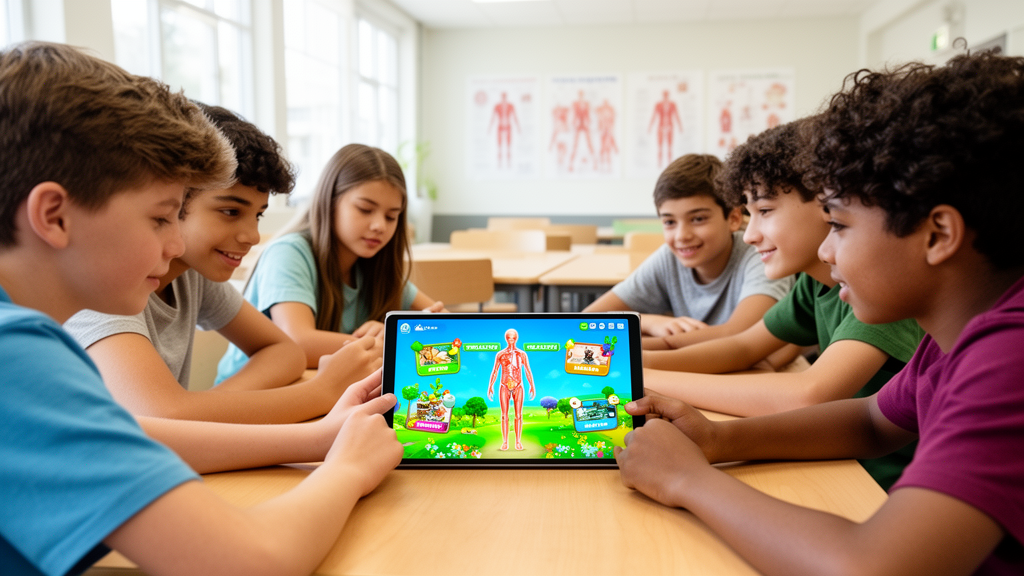
A concept analysis published in the nursing-science literature proposes a working definition of serious games in youth health education: “the intentional use of game design elements and rules with the primary purpose of educating young individuals about health-related subjects and fostering a favorable influence on their knowledge, attitudes, and/or skills related to maintenance and improvement of health.” The analysis is intended to clarify a field in which serious games, gamification and related digital resources are often used interchangeably, but it does not itself establish that every such game improves health outcomes.
Researchers used the eight-step concept-analysis procedure developed by Walker and Avant, adapted from Wilson’s original process, to identify the concept’s uses, defining attributes, antecedents, consequences, empirical references and illustrative cases. The method is intended to examine how a concept is understood in existing literature rather than test an intervention in a new trial. The central objective was to determine what distinguishes a serious game used for youth health education from entertainment, simple gamification, or static health-information tools.
The evidence base combined peer-reviewed research with selected grey literature and dictionary definitions. Searches covered health sciences, education, psychology, engineering, computer science and multidisciplinary databases, including PubMed, CINAHL, ERIC, PsycINFO, ProQuest, the Cochrane Library, Compendex and IEEE Xplore. Contemporary applications published from 2013 through 2023 were eligible, while foundational publications and dictionaries were exempt from the date restriction. The Boolean search combined terms for serious games, gaming, gamification or digital games with health education, education and youth-related terms.
Of 1,494 records identified, 455 duplicates were removed and 1,039 titles and abstracts were screened. Two authors assessed the full text of 96 potentially eligible publications, resolving disagreements by consensus and consulting a third author when necessary. Sixty-six reports were excluded because they were unrelated to serious games in youth health education, did not address relevant attributes, antecedents or consequences, or were not available in English. Thirty publications entered the final analysis. Data were abstracted thematically, coded into conceptually similar groups and compared to identify recurring attributes, antecedents and possible consequences.
The analysis distinguished serious games from gamification, which applies game elements to a non-game context. It also separated full serious games from related and borderline examples. A flashcard activity with points and answer feedback was judged borderline because it lacked structured educational design, meaningful interactivity and youth-centered health objectives. A mobile application delivering daily health facts was classified as related because it provided youth-oriented information but lacked game mechanics, feedback and interactive engagement. A youth gaming platform offering puzzles, sports and adventures was a contrary case because entertainment was its purpose and it contained no health-related educational component.
The concept’s defining attributes were gamification, game mechanics, educational content and a health-related objective, tailoring for youth and adaptability, real-life relevance, engagement, interactivity, a safe environment, and feedback and assessment. Game mechanics may include avatars, narrative, graphics, tasks, player interaction, progressive difficulty, timers, leaderboards and rewards. The health content can address areas such as nutrition, physical activity, disease self-management, substance-use prevention and mental health. Youth tailoring may involve adjusting content, instructions, mechanics and difficulty to cognitive abilities, developmental stages, interests and preferences, while real-world scenarios can connect abstract knowledge to everyday health decisions.
Engagement and interactivity were presented as central mechanisms rather than merely cosmetic features. Players can make choices, explore consequences and practice decisions in a controlled environment where mistakes do not carry serious real-world consequences. Feedback may take the form of immediate messages, progress indicators, scores, points, rankings, leaderboards or individualized guidance. Research cited in the analysis reported a strong association between rewards and engagement, with narratives and character identification helping maintain interest and immersion. Other cited work found that 80% of children in a nutrition game were motivated to replay until they succeeded, although this observation came from one included study rather than the analysis as a whole.
The proposed antecedents were educational gaming, health-education initiatives, technological advancement and interdisciplinary collaboration. Computers, mobile devices and gaming consoles enable immersive and interactive experiences, while collaboration among educators, developers and health professionals helps align game mechanics with learning objectives and health content. The model also recognizes family or community advisory input as a way to represent the backgrounds, needs and preferences of intended users. Proposed consequences include improved health knowledge, attitudes and behaviors, greater self-efficacy in managing health, and the possibility of reducing disparities in access to health education, although the authors stated that further research is needed to show measurable reductions in disparities.
Several studies summarized in the analysis provide empirical examples for evaluating the proposed attributes. A sexual-health game evaluated through player feedback and quizzes achieved an average System Usability Scale score of 77.7, with 96% of participants willing to recommend it and an average learning score of 3.96 out of 4 for sexually transmitted infections. In an alcohol-prevention application, 66% of students reported positive overall satisfaction, with an average game-satisfaction score of 3.2 out of 5. A cluster-randomized trial of a digital game for responding to cyberbullying in secondary schools in Flanders, Belgium, found small but statistically significant improvements in self-efficacy for ending cyberbullying and in appropriate social skills, as well as stronger intentions concerning positive bystander behavior.
The findings remain conceptual rather than a demonstration of universal clinical benefit. The review was restricted to English-language publications, focused on youth and health education, and depended on the literature available in the searched databases, so additional defining features may have been missed. Implementation also faces barriers involving accessibility, curriculum alignment, differences in technological proficiency, educator training, funding and long-term maintenance. The authors say the framework could support clearer design, selection and evaluation of youth health-education games and future standardized assessment tools. They call for rigorous studies across health topics and settings, including emerging uses of virtual and augmented reality and wearable sensors, while emphasizing that the definition and attributes of serious games may continue to change as research and technology evolve.
Subject of Research: Concept analysis of serious games for youth health education
Article Title: Serious games in youth's health education: A concept analysis
Article References: Ou, L., Reifsnider, E., Chen, A. C.-C., Todd, M., Amresh, A., & Mun, C. J. (2026). Serious games in youth's health education: A concept analysis. Heliyon, 12(16), Article e45567. https://doi.org/10.1016/j.heliyon.2026.e45567
Image Credits: AI Generated
DOI: 10.1016/j.heliyon.2026.e45567
Keywords: serious games, youth health education, game-based learning, gamification, health literacy, interactive learning, digital health, nursing science, concept analysis, health education, Serious, games
Cite Scienmag News
Courtney Benton. (October 22, 2026). Concept analysis defines serious games for youth health education. Scienmag. https://scienmag.com/concept-analysis-defines-serious-games-for-youth-health-education/
Courtney Benton. "Concept analysis defines serious games for youth health education." Scienmag, 22 October 2026, https://scienmag.com/concept-analysis-defines-serious-games-for-youth-health-education/. Accessed 22 October 2026.
Courtney Benton. "Concept analysis defines serious games for youth health education." Scienmag. October 22, 2026. https://scienmag.com/concept-analysis-defines-serious-games-for-youth-health-education/


