

Saturday, November 14, 2026
Science
No Result
View All Result
  • Login
  • HOME
  • SCIENCE NEWS
  • CONTACT US
  • HOME
  • SCIENCE NEWS
  • CONTACT US
No Result
View All Result
Scienmag
No Result
View All Result
Home Science News Biology

scDIG software study enables interactive single-cell population gating

October 22, 2026
in Biology
Drew Townsend
By Drew Townsend Scienmag Editorial Profile - Cell Biology
Reading Time: 2 mins read
0
scDIG software study enables interactive single-cell population gating

scDIG software study enables interactive single-cell population gating

65
SHARES
587
VIEWS
Share on FacebookShare on Twitter
ADVERTISEMENT

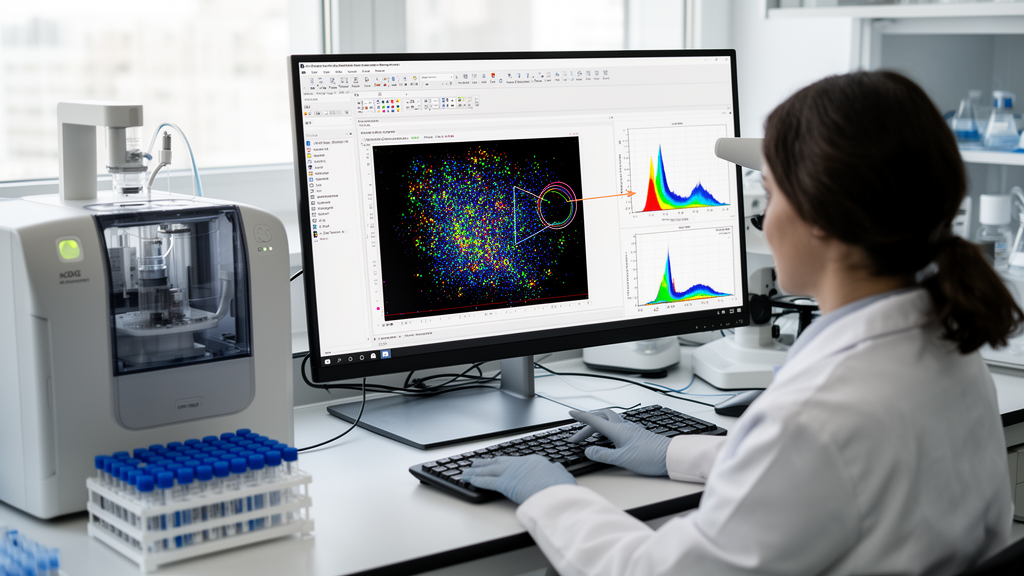
The open-access scDIG application combines feature selection, feature-weighted kernel density estimation and interactive contour-based gating to help researchers define cell populations in two-dimensional projections of single-cell RNA and protein data. Designed for scRNA-seq and CITE-seq datasets, the R Shiny tool offers an interactive middle ground between subjective manual selection and fully automated clustering algorithms that may obscure rare but biologically significant populations. Delineating meaningful populations in these views can be difficult to reproduce when decisions rely mainly on an analyst’s visual judgment.

The workflow begins with a bimodal index-driven procedure for selecting informative features. It then uses feature-weighted kernel density estimation and displays the resulting density as interactive contours that can be gated. The application was built in R Shiny and supports both gene-expression measurements and combined transcript-protein data, allowing the same interactive framework to be used for scRNA-seq and CITE-seq datasets.

The reported aim is to combine the interpretability of expert-guided population selection with a systematic basis for defining and reproducing those selections. In a software application study using CITE-seq peripheral blood mononuclear cell data from participants in the Cardiovascular Assessment Virginia cohort, scDIG resolved transcriptionally distinct CD4-positive T-cell subpopulations within continuous embeddings that conventional clustering did not readily capture. Applied to RNA-expression data, the tool also identified GZMB-enriched cytotoxic lymphocyte subsets.

The authors also conducted sensitivity analyses to assess whether the gates identified in two-dimensional views corresponded to coherent populations in the original high-dimensional feature space. They reported that the defined gates corresponded to coherent cellular groupings, supporting the use of interactive density contours as a way to connect visual population definition with underlying measurements. scDIG is freely available for non-commercial use, and its source code is available through GitLab.

Its central contribution is an interactive method for defining cell populations in single-cell embeddings while retaining researcher oversight. By translating weighted density estimates into adjustable contours, the application provides a practical framework for investigating distinct cell groups in scRNA-seq and CITE-seq data and for evaluating whether selected gates remain coherent in high-dimensional feature space.

Subject of Research: Interactive density-based gating of single-cell proteomic and transcriptomic data

Article Title: scDIG: an R Shiny application for interactive density-based gating of single-cell proteomic and transcriptomic data

Article References: Bombina, P., Bellapu, A., Fogel, L., Coombes, K. R., & Ley, K. (2026). scDIG: an R Shiny application for interactive density-based gating of single-cell proteomic and transcriptomic data. BMC Bioinformatics. https://doi.org/10.1186/s12859-026-06718-3

Image Credits: AI Generated

DOI: 10.1186/s12859-026-06718-3

Keywords: scDIG, single-cell analysis, scRNA-seq, CITE-seq, cell gating, kernel density estimation, R Shiny, bioinformatics, cytotoxic lymphocytes, software, Shiny, application

Cite Scienmag News

Drew Townsend. (October 22, 2026). scDIG software study enables interactive single-cell population gating. Scienmag. https://scienmag.com/scdig-software-study-enables-interactive-single-cell-population-gating/

Drew Townsend. "scDIG software study enables interactive single-cell population gating." Scienmag, 22 October 2026, https://scienmag.com/scdig-software-study-enables-interactive-single-cell-population-gating/. Accessed 14 November 2026.

Drew Townsend. "scDIG software study enables interactive single-cell population gating." Scienmag. October 22, 2026. https://scienmag.com/scdig-software-study-enables-interactive-single-cell-population-gating/

Tags: applicationbimodal index-driven feature selectionbioinformaticscell gatingCITE-seqCITE-seq data analysiscombining transcriptomics and proteomics for cell classificationcontour-based gating in single-cell studiescytotoxic lymphocytesexpert-guided vs automated clustering in single-cell analysisfeature selection in single-cell datainteractive scRNA-seq analysisKernel Density Estimationkernel density estimation for cell populationsR ShinyR Shiny tools for single-cell data visualizationrare cell population detection in single-cell datasetsreproducible cell population delineationscDIGscRNA-seqShinysingle-cell analysissingle-cell population gatingsoftware
Share26Tweet16
Previous Post

Gudan Wan reduced liver injury in mouse model of MASH

Next Post

Antimicrobial activity of antibiotic-induced resistant lactobacilli against carbapenemase-producing Enterobacterales

Related Posts

Circulating Cholesterol Fuels SARS-CoV-2 Replication Through Viral ORF3a Receptor Stabilization
Biology

Circulating Cholesterol Fuels SARS-CoV-2 Replication Through Viral ORF3a Receptor Stabilization

November 14, 2026
Mitochondrial NNT Loss Impairs Whole-Body Glucose Tolerance in Male and Female Mice
Biology

Mitochondrial NNT Loss Impairs Whole-Body Glucose Tolerance in Male and Female Mice

November 14, 2026
Time Drives Early Marine Biofilm Assembly More Than Plastic Substrate Type
Biology

Time Drives Early Marine Biofilm Assembly More Than Plastic Substrate Type

November 14, 2026
Bioengineering Platforms May Improve Respiratory Rehabilitation Precision
Biotechnology

Bioengineering Platforms May Improve Respiratory Rehabilitation Precision

November 14, 2026
Mesenchymal Stem Cell Vesicles Show Preclinical Promise for Intrauterine Adhesions
Biotechnology

Mesenchymal Stem Cell Vesicles Show Preclinical Promise for Intrauterine Adhesions

November 14, 2026
Magnesium Framework Scaffold Enhances Bone Regeneration and Vascularization in Rats
Biotechnology

Magnesium Framework Scaffold Enhances Bone Regeneration and Vascularization in Rats

November 14, 2026
Next Post
Antimicrobial activity of antibiotic-induced resistant lactobacilli against carbapenemase-producing Enterobacterales

Antimicrobial activity of antibiotic-induced resistant lactobacilli against carbapenemase-producing Enterobacterales

  • Mothers who receive childcare support from maternal grandparents show more optimized

    Mothers who receive childcare support from maternal grandparents show more parental warmth, finds NTU Singapore study

    27656 shares
    Share 11059 Tweet 6912
  • University of Seville Breaks 120-Year-Old Mystery, Revises a Key Einstein Concept

    1061 shares
    Share 424 Tweet 265
  • Bee body mass, pathogens and local climate influence heat tolerance

    682 shares
    Share 273 Tweet 171
  • Researchers record first-ever images and data of a shark experiencing a boat strike

    546 shares
    Share 218 Tweet 137
  • Groundbreaking Clinical Trial Reveals Lubiprostone Enhances Kidney Function

    531 shares
    Share 212 Tweet 133
Science

Embark on a thrilling journey of discovery with Scienmag.com—your ultimate source for cutting-edge breakthroughs. Immerse yourself in a world where curiosity knows no limits and tomorrow’s possibilities become today’s reality!

RECENT NEWS

  • Climate Models Project Severe Declines in Brazilian Eucalyptus Plantation Productivity
  • Banqiaotou Archaeobotanical Finds Reveal Gradual Consolidation of Rice Farming in China
  • Structural Anchors Improve Long Legal Document Summarization in Language Models
  • Circulating Cholesterol Fuels SARS-CoV-2 Replication Through Viral ORF3a Receptor Stabilization

Categories

  • Agriculture
  • Anthropology
  • Archaeology
  • Athmospheric
  • Biology
  • Biotechnology
  • Blog
  • Bussines
  • Cancer
  • Chemistry
  • Climate
  • Earth Science
  • Editorial Policy
  • Marine
  • Mathematics
  • Medicine
  • Pediatry
  • Policy
  • Psychology & Psychiatry
  • Science Education
  • Science News
  • Social Science
  • Space
  • Technology and Engineering

Subscribe to Blog via Email

Enter your email address to subscribe to this blog and receive notifications of new posts by email.

Join 5,150 other subscribers

© 2026 Scienmag - Science Magazine

Welcome Back!

Login to your account below

Forgotten Password?

Retrieve your password

Please enter your username or email address to reset your password.

Log In
No Result
View All Result
  • HOME
  • SCIENCE NEWS
  • CONTACT US

© 2026 Scienmag - Science Magazine

Discover more from Science

Subscribe now to keep reading and get access to the full archive.

Continue reading

