


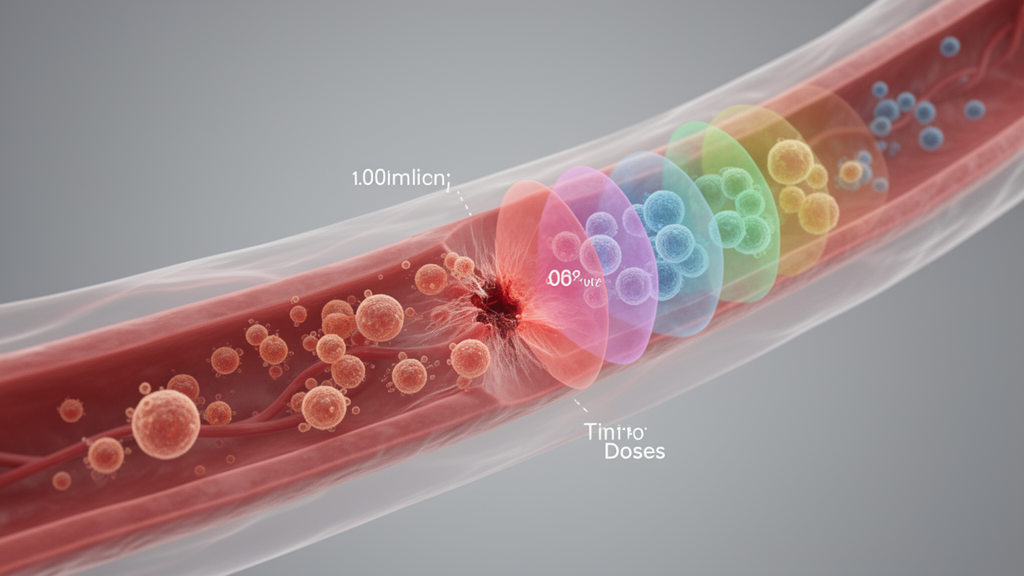
A multiscale computer simulation suggests that restoring endothelium after disturbed blood flow may depend less on simply producing more nitric oxide than on ensuring that nitric oxide is generated in the right places before reactive oxygen species consume it. The model linked oscillatory wall shear stress, intracellular AKT signaling, nitric oxide and reactive oxygen species, endothelial phenotype changes, monocyte recruitment and macrophage accumulation. Its central finding was that simulated endothelial dysfunction arose from a spatial mismatch between nitric oxide production and reactive oxygen species consumption, while repair depended non-linearly on when and how strongly AKT was activated. These results describe model predictions rather than outcomes from a clinical treatment trial.
The researchers extended a previously validated cellular Potts model into a coupled ordinary-differential-equation, partial-differential-equation and cellular framework. The molecular component used 16 equations to represent shear-induced AKT activation, endothelial nitric oxide synthase phosphorylation and nitric oxide production. Tissue-scale equations modeled the diffusion, production and decay of nitric oxide, reactive oxygen species and the chemokine MCP-1. At the cellular scale, a modified Monte Carlo algorithm updated endothelial states, cell movement, adhesion, proliferation, monocyte migration and macrophage differentiation. The simulations used a two-dimensional arterial slice measuring 0.8 by 0.2 millimeters, with one Monte Carlo step corresponding to one minute of biological time and a total duration of seven days.
Mechanical loading was prescribed rather than calculated from a resolved blood-flow field. The wall shear-stress amplitude varied spatially from 5 to 15 dyn/cm2 in a symmetric V-shaped profile, with its minimum at the center, and a cosine function introduced periodic reversal of flow direction. This configuration represented the low, oscillatory stresses associated with vulnerable regions such as arterial bends and bifurcations, but the model did not solve fluid velocity or direction explicitly. Each live endothelial cell contained the molecular signaling module, while its nitric oxide output entered the surrounding chemical field. Activated endothelial cells and pro-inflammatory M1 macrophages generated reactive oxygen species, and a non-linear Michaelis-Menten term represented direct chemical consumption of nitric oxide by reactive oxygen species, including formation of peroxynitrite.
In the untreated simulation, endothelial injury progressively worsened. Quiescent endothelial cells began disappearing around day 1, activated cells became the dominant endothelial population, and dead endothelial cells increased. By the end of the seven-day period, activated cells represented approximately 70% of the endothelial population, dead cells about 30%, and quiescent cells nearly none. Activated cells and M1 macrophages also secreted MCP-1, creating a chemical gradient that directed monocytes toward the injured region. Monocytes that contacted activated endothelium differentiated into M1 or M2 macrophages at a preset ratio of 2 to 1. At day 7, the approximate conversion proportions were 0.5 for M1 macrophages, 0.3 for M2 macrophages and 0.2 for dead monocytes, indicating a predominantly pro-inflammatory modeled environment.
The temporal redox results showed why total nitric oxide concentration alone was an inadequate measure of endothelial health. Nitric oxide increased during the simulation, but reactive oxygen species accumulated more rapidly at later stages. The contribution of nitric oxide from quiescent endothelial cells fell toward zero around day 1.5, because cells in the low-stress region crossed the model’s damage threshold and became activated. Their impaired production continued at roughly 0.6 times the quiescent-cell rate, allowing total nitric oxide to rise even as functional protection deteriorated. The model therefore attributes localized injury not to a universal shortage of nitric oxide, but to the mismatch between where nitric oxide is produced and where reactive oxygen species consume it. In the model, this chemical imbalance also reinforced inflammatory signaling and limited the return of activated cells to a quiescent state.
Validation focused on the molecular core rather than on direct testing of the complete repair model. Under static conditions, a 2.5-fold increase in simulated AKT activity predicted a 2.17-fold increase in endothelial nitric oxide synthase phosphorylation; published Western blot data reported a 2.27-fold increase after AKT overexpression. Simulations under different pulsatile shear stresses and after PI3K, AKT or endothelial nitric oxide synthase inhibition reproduced the trends and approximate magnitudes reported in experimental studies. Predicted nitric oxide concentrations at shear stresses of 8, 16 and 24 dyn/cm2 also closely matched a previously published reference model, including cases with enhanced AKT signaling. These checks support the parameterization of the AKT-to-nitric-oxide pathway, but they do not independently validate every cellular or biochemical rule in the larger multiscale framework.
Simulated intervention timing had a substantial effect on recovery. For this comparison, AKT activation was set at four times the baseline activation parameter. Starting treatment on day 1 produced the most favorable pattern: endothelial layers on either side of the central injury remained intact, activated cells began returning to a quiescent phenotype by day 5, reactive oxygen species accumulation was restrained and MCP-1 declined by day 7. Quiescent-cell recovery began around day 6, while the final proportion of quiescent cells exceeded that in the delayed-treatment groups. Starting on day 3 improved the outcome relative to no intervention, but nitric oxide production rose only after day 5, oxidative stress persisted and inflammation was stronger. Starting on day 5 produced little conversion back to quiescent cells, the lowest late nitric oxide peak, prominent central reactive oxygen species accumulation and the highest MCP-1 signal among the treatment groups.
The model also identified a non-linear response to activation strength when treatment began on day 3. Three simulated levels were compared: 3.4 times baseline as weak activation, 3.8 times as moderate activation and 4.2 times as strong activation. Under weak activation, the first activated-to-quiescent transition occurred at about 146 hours, nitric oxide recovery was slow and both reactive oxygen species and MCP-1 remained elevated. Moderate activation moved the first transition to 134 hours, produced a more uniform nitric oxide field and more closely balanced reductions in oxidative stress and inflammation. Strong activation advanced the transition to 124 hours, accelerated the fall in reactive oxygen species and drove the activated-cell proportion close to zero by the end of the simulation. However, the authors characterized the moderate condition as the most balanced combination of nitric oxide restoration, oxidative control and inflammatory resolution; the model did not explicitly simulate all downstream consequences of maximal AKT activation.
Immune effects in the simulations arose primarily through altered recruitment rather than a direct change in macrophage polarization. Because the M1-to-M2 differentiation ratio was fixed at 2 to 1, the model could not test whether AKT directly alters the choice between macrophage phenotypes. Instead, restoring endothelial function reduced the number of activated cells, which lowered their MCP-1 output and weakened the chemotactic signal drawing in monocytes. It also reduced cellular reactive oxygen species production, improving the local redox environment and indirectly changing the abundance of macrophages. This coupling created a feedback loop: better nitric oxide availability favored endothelial recovery, recovery reduced inflammatory recruitment, and lower inflammation reduced further damage. It also explains why delayed intervention performed poorly: newly generated nitric oxide entered an environment already loaded with reactive oxygen species that could rapidly neutralize it.
The findings remain limited by the model’s scope. It is a two-dimensional representation that does not capture the three-dimensional architecture of the vessel wall or diffusion barriers such as the internal elastic lamina. Its biochemical network concentrates on the AKT/eNOS/NO/ROS axis and omits crosstalk involving pathways such as Notch and TGF-β, as well as downstream effects of peroxynitrite, including possible eNOS uncoupling. Monocyte recruitment is regulated mainly by endothelial activation rather than directly by flow-dependent adhesion, and other immune cells and a wider cytokine network are absent. The results therefore provide a computational account of timing- and activation-dependent endothelial repair within the model, but they do not establish a clinical dosing schedule, demonstrate benefit in patients, or show that a particular AKT-targeted therapy can safely produce the modeled effects.
Subject of Research: Multiscale modeling of AKT-mediated endothelial repair under oscillatory shear stress
Article Title: Multiscale modeling reveals non-linear dynamics of AKT-mediated NO-ROS crosstalk in shear stress-induced endothelial phenotype
Article References: Zhang, Y.-Y., Wang, Y.-T., Qiu, Y., Li, Y.-J., Chen, D., & Qin, K.-R. (2026). Multiscale modeling reveals non-linear dynamics of AKT-mediated NO-ROS crosstalk in shear stress-induced endothelial phenotype. PLOS Computational Biology, 22(10), e1014860. https://doi.org/10.1371/journal.pcbi.1014860
Image Credits: AI Generated
DOI: 10.1371/journal.pcbi.1014860
Keywords: endothelial dysfunction, AKT signaling, nitric oxide, reactive oxygen species, oscillatory shear stress, atherosclerosis, multiscale modeling, inflammation, computational biology, vascular repair, Multiscale, modeling
Cite Scienmag News
Drew Townsend. (October 21, 2026). Computer model finds timing and dose govern simulated endothelial repair. Scienmag. https://scienmag.com/computer-model-finds-timing-and-dose-govern-simulated-endothelial-repair/
Drew Townsend. "Computer model finds timing and dose govern simulated endothelial repair." Scienmag, 21 October 2026, https://scienmag.com/computer-model-finds-timing-and-dose-govern-simulated-endothelial-repair/. Accessed 21 October 2026.
Drew Townsend. "Computer model finds timing and dose govern simulated endothelial repair." Scienmag. October 21, 2026. https://scienmag.com/computer-model-finds-timing-and-dose-govern-simulated-endothelial-repair/


