


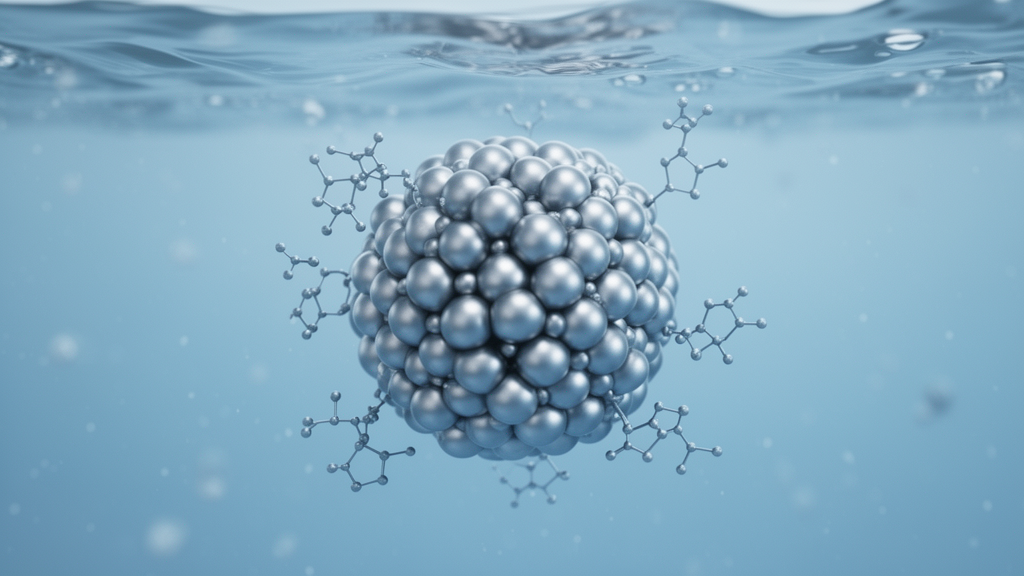
A computational study suggests that two aluminum-based nanoclusters may be able to carry isoproterenol, a synthetic catecholamine used in managing bradycardia, heart block and cardiac arrest. Density functional theory calculations found favorable adsorption of the drug on Al₁₂N₁₂ and Al₁₂O₁₂, while molecular docking indicated that the resulting complexes bound more strongly to the β₁-adrenergic receptor than free isoproterenol. Short molecular-dynamics simulations also found no obvious disruption of the loaded nanoclusters at 300 K, although the results remain predictions that require experimental and clinical validation.
Researchers evaluated Al₁₂N₁₂ and Al₁₂O₁₂ as inorganic nanocarriers using density functional theory at the B3LYP/6-311 + G(d) level. The investigators assessed the geometry, electronic structure and spectroscopic properties of complexes formed when isoproterenol was adsorbed onto each nanocluster. They also performed molecular docking against the β₁-adrenergic receptor and used ab initio molecular-dynamics simulations to examine the thermal and structural stability of the most stable complexes. This was a computational investigation rather than a laboratory study involving cells, animals or human participants.
The calculated adsorption energies showed consistently stronger interaction between isoproterenol and Al₁₂O₁₂ than between the drug and Al₁₂N₁₂. In the gas phase, the calculated binding-energy ranges were approximately −29 to −33 kcal/mol for isoproterenol/Al₁₂N₁₂ and −61 to −88 kcal/mol for isoproterenol/Al₁₂O₁₂. Simulations in water produced somewhat weaker values: about −25 to −28 kcal/mol for the Al₁₂N₁₂ complexes and −54 to −75 kcal/mol for the Al₁₂O₁₂ complexes. The authors attributed the stronger interaction with the oxide cluster to oxygen’s higher electronegativity. These energy estimates indicate favorable adsorption under the modeled conditions, but they do not by themselves establish the performance, safety, release behavior or bioavailability of the proposed carriers.
Complex formation was also associated with a substantial increase in dipole moment, which the researchers proposed could improve aqueous solubility and potentially assist cellular uptake. Electronic and spectroscopic calculations were used to characterize changes associated with adsorption, providing a molecular description of how the drug interacts with the two clusters. The authors described Al₁₂N₁₂ and Al₁₂O₁₂ as previously unexplored candidates for isoproterenol delivery. Their findings therefore point to a possible design strategy for inorganic nanocarriers, not a demonstrated delivery system, and the implications for therapeutic use still depend on physical, toxicological and pharmacological testing.
Molecular docking produced the largest numerical contrast between the free drug and the nanocarrier complexes. The calculated docking scores were −15.98 kcal/mol for the isoproterenol/Al₁₂N₁₂ complex and −16.56 kcal/mol for isoproterenol/Al₁₂O₁₂, compared with −7.41 kcal/mol for free isoproterenol. In the docking model, the loaded clusters therefore interacted more favorably with the β₁-adrenergic receptor. Ab initio molecular-dynamics simulations of the most stable complexes at 300 K ran for 10 picoseconds and showed no apparent dissociation or major structural distortion, supporting short-term stability under the simulated conditions. The brief trajectories cannot represent long-term behavior, experimental conditions or the many biological barriers faced by a drug carrier, so the results offer a computational starting point for further investigation rather than evidence of improved treatment in patients.
Subject of Research: Computational evaluation of aluminum nanoclusters as isoproterenol drug carriers
Article Title: Computational DFT and docking investigation of isoproterenol delivery using Al₁₂N₁₂ and Al₁₂O₁₂ inorganic nanocarriers
Article References: Al Omari, R. H., saraswat, S. K., Abosaoda, M. K., Rekha, M. M., Ray, S., Chennakesavulu, K., Sharma, R., & Kashyap, A. (2026). Computational DFT and docking investigation of isoproterenol delivery using Al₁₂N₁₂ and Al₁₂O₁₂ inorganic nanocarriers. Scientific Reports, 16(1), Article 33017. https://doi.org/10.1038/s41598-026-74607-z
Image Credits: AI Generated
DOI: 10.1038/s41598-026-74607-z
Keywords: isoproterenol, drug delivery, nanoclusters, density functional theory, molecular docking, β₁-adrenergic receptor, aluminum nitride, aluminum oxide, molecular dynamics, Computational, docking, investigation
Cite Scienmag News
Denise Maddox. (October 21, 2026). Computations favor aluminum nanoclusters for isoproterenol delivery. Scienmag. https://scienmag.com/computations-favor-aluminum-nanoclusters-for-isoproterenol-delivery/
Denise Maddox. "Computations favor aluminum nanoclusters for isoproterenol delivery." Scienmag, 21 October 2026, https://scienmag.com/computations-favor-aluminum-nanoclusters-for-isoproterenol-delivery/. Accessed 21 October 2026.
Denise Maddox. "Computations favor aluminum nanoclusters for isoproterenol delivery." Scienmag. October 21, 2026. https://scienmag.com/computations-favor-aluminum-nanoclusters-for-isoproterenol-delivery/


