


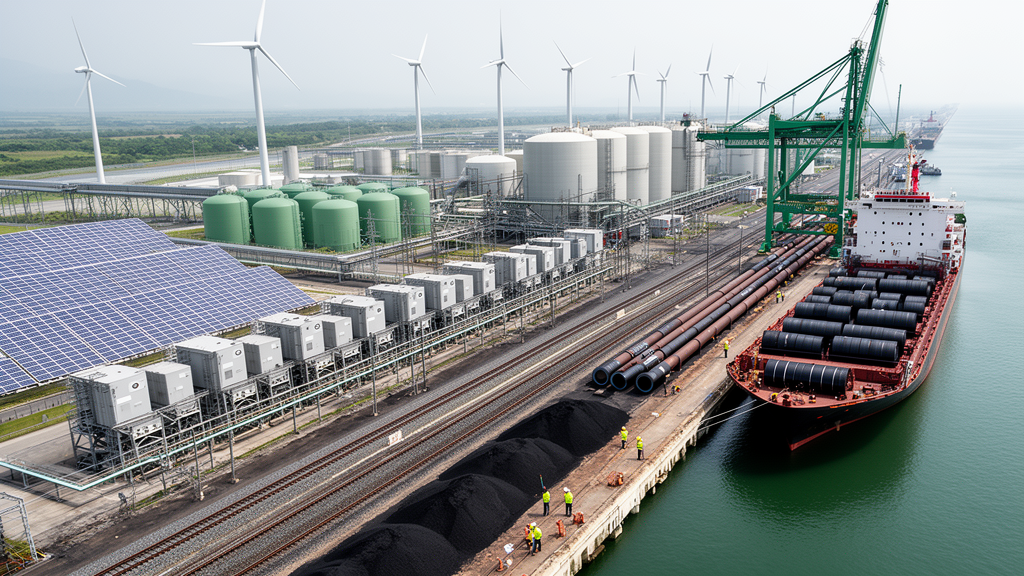
A life-cycle assessment of iron and steel production facilities worldwide estimates that current crude steel production generates about 3.7 gigatonnes of carbon dioxide equivalent each year, with the emissions highly concentrated in Asia. The study also projects how emissions from the sector could change by 2040 and estimates the infrastructure needed to support lower-emission production. The assessment places current global greenhouse gas emissions from crude steel production in the context of a sector responsible for approximately 7–9% of global emissions.
Its global scope includes current production facilities and prospective emissions under a future 2°C scenario, allowing the researchers to compare the scale of present emissions with possible outcomes in 2040. Under the modeled 2°C scenario, greenhouse gas emissions from global crude steel production could fall by as much as 70% by 2040. The resulting annual total is estimated at 1.1–2.3 gigatonnes of carbon dioxide equivalent.
Beyond emissions, the analysis examines the supporting requirements associated with decarbonizing steel production. Depending on the future scenario, lower-emission production may require hydrogen use of up to 90 million tonnes per year, carbon dioxide storage of up to 1.0 gigatonne per year, and/or electricity supply reaching as much as 6,000 terawatt-hours per year. The upper electricity estimate is more than twice the European Union’s current electricity supply.
Hydrogen and carbon dioxide storage emerge as alternative or complementary components of the modeled infrastructure needs. The analysis does not establish that hydrogen production, carbon storage, and expanded low-carbon electricity systems must all be deployed at the same scale everywhere. Instead, it identifies the potential requirements associated with different routes toward lower-emission steel production.
Regional context is central to the findings. Because current crude steel emissions are concentrated in Asia, the infrastructure implications differ across producing regions rather than forming one uniform global requirement. The study therefore emphasizes the importance of accounting for regional emissions patterns when assessing the future demand for hydrogen, storage capacity, and electricity.
Overall, the research combines life-cycle emissions accounting with prospective infrastructure estimates to show how deeply decarbonization could reshape the resource base of global steelmaking.
Subject of Research: Global greenhouse gas emissions and infrastructure requirements for decarbonizing iron and steel production
Article Title: Regionalized greenhouse gas emissions and infrastructure requirements for future global iron and steel production
Article References: Terlouw, T., Harpprecht, C., & Bauer, C. (2026). Regionalized greenhouse gas emissions and infrastructure requirements for future global iron and steel production. Communications Earth & Environment. https://doi.org/10.1038/s43247-026-04129-z
Image Credits: AI Generated
DOI: 10.1038/s43247-026-04129-z
Keywords: steel production, greenhouse gas emissions, industrial decarbonization, green hydrogen, carbon dioxide storage, industrial electrification, life-cycle assessment, climate scenario, regional emissions, ironmaking, Regionalized, greenhouse
Cite Scienmag News
Sloane Callahan. (October 21, 2026). Study maps infrastructure needs for lower-emission global steel production. Scienmag. https://scienmag.com/study-maps-infrastructure-needs-for-lower-emission-global-steel-production/
Sloane Callahan. "Study maps infrastructure needs for lower-emission global steel production." Scienmag, 21 October 2026, https://scienmag.com/study-maps-infrastructure-needs-for-lower-emission-global-steel-production/. Accessed 21 October 2026.
Sloane Callahan. "Study maps infrastructure needs for lower-emission global steel production." Scienmag. October 21, 2026. https://scienmag.com/study-maps-infrastructure-needs-for-lower-emission-global-steel-production/


