


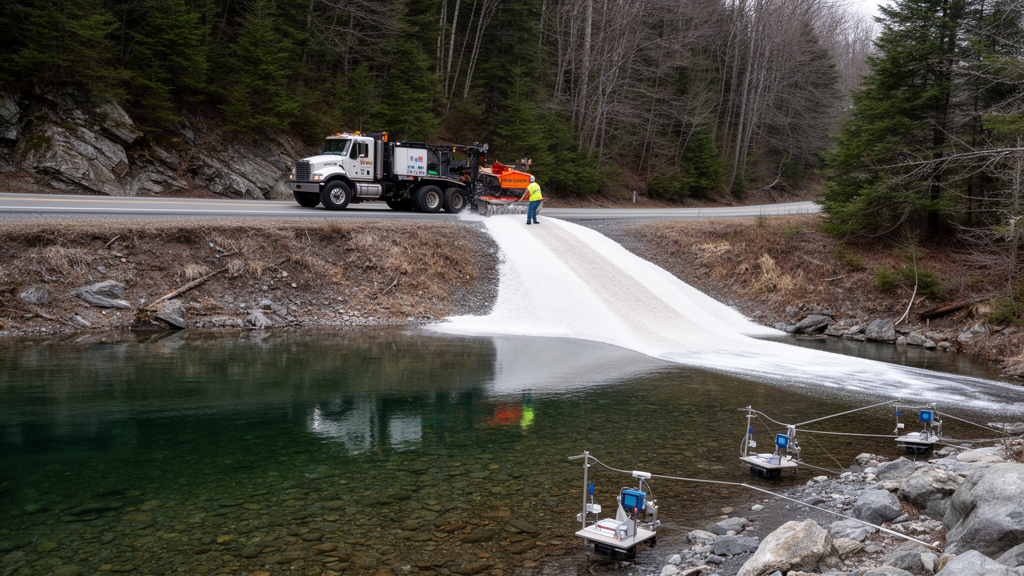
Reducing winter road-salt applications across an entire watershed may have only a limited effect on peak conductivity in a major drinking-water reservoir, according to a modeling study of the Wachusett Reservoir in the northeastern United States. Using CE-QUAL-W2 to compare salt-reduction scenarios in 10 tributary subbasins, researchers found that a feasible 40% reduction during the November–March salt season would lower peak conductivity at the Cosgrove Intake and Basin North by less than 20% on average. The results point to a more targeted strategy: concentrating reductions in the subbasins carrying the highest flows into the reservoir.
The study focused on the Wachusett watershed, which supplies metropolitan Boston and sends water to the Wachusett Reservoir through minor tributaries, the Quinapoxet and Stillwater rivers, and the Quabbin Aqueduct transfer. The modeled tributaries differed substantially in hydrology and water chemistry. Their annual average flows ranged from 0.056 to 2.12 m³/s, while mean specific conductivity varied from approximately 100 to 800 µS/cm. Researchers used these contrasts to ask whether salt controls would be most effective in subbasins with high discharge or in those where incoming water already had high salt concentrations. The comparison of these two classes of subbasins had not previously been tested systematically, according to the study.
Scenario results showed that the amount of salt removed at the watershed level was not the only consideration. A 40% reduction in salt application across the entire watershed during the winter season produced an average maximum reduction of less than 20% in peak conductivity at the two assessed reservoir locations. In contrast, a 20% reduction applied specifically to the subbasins with the highest flows produced reductions in peak reservoir conductivity comparable to those achieved by reducing salt applications by 40% in the subbasins with the highest salt concentrations. Scenarios that reduced salt only in high-concentration, low-flow subbasins did not have a significant impact on reservoir water quality. Together, these modeled outcomes suggest that the volume of water entering the reservoir may be more influential for this planning question than salt concentration alone.
The findings offer managers a quantitative basis for prioritizing road-salt reductions rather than treating every subbasin as equally important. The work is a scenario-based modeling analysis of one reservoir system, not a direct measurement of changes following salt reductions. Its conclusions also depend on the watershed configuration, the modeled flow and conductivity conditions, the reservoir locations examined, and the assumed application-reduction scenarios. Even with those limits, the study demonstrates how computational tools can explore management choices under different combinations of traffic-safety needs and water-quality objectives. Its central result is that targeted reductions in the highest-flow tributaries could improve the modeled reservoir response more efficiently than broad, watershed-wide cuts or reductions concentrated in less influential subbasins.
Subject of Research: Modeling targeted road-salt reductions and conductivity in the Wachusett Reservoir watershed
Article Title: Translating scientific findings into actions: Modeling the effects of salt application reduction on reservoir water quality using CE-QUAL-W2
Article References: Marques, A. C., Veras, C. E., Tobiason, J. E., & Guzman, C. D. (2026). Translating scientific findings into actions: Modeling the effects of salt application reduction on reservoir water quality using CE-QUAL-W2. PLOS Water, 5(10), e0000611. https://doi.org/10.1371/journal.pwat.0000611
Image Credits: AI Generated
DOI: 10.1371/journal.pwat.0000611
Keywords: road salt, Wachusett Reservoir, water quality, conductivity, CE-QUAL-W2, watershed management, salt reduction, drinking water, subbasins, Translating, scientific, findings
Cite Scienmag News
Violet Maxwell. (October 21, 2026). Reservoir model links targeted road-salt cuts to Wachusett water quality. Scienmag. https://scienmag.com/reservoir-model-links-targeted-road-salt-cuts-to-wachusett-water-quality/
Violet Maxwell. "Reservoir model links targeted road-salt cuts to Wachusett water quality." Scienmag, 21 October 2026, https://scienmag.com/reservoir-model-links-targeted-road-salt-cuts-to-wachusett-water-quality/. Accessed 21 October 2026.
Violet Maxwell. "Reservoir model links targeted road-salt cuts to Wachusett water quality." Scienmag. October 21, 2026. https://scienmag.com/reservoir-model-links-targeted-road-salt-cuts-to-wachusett-water-quality/


