


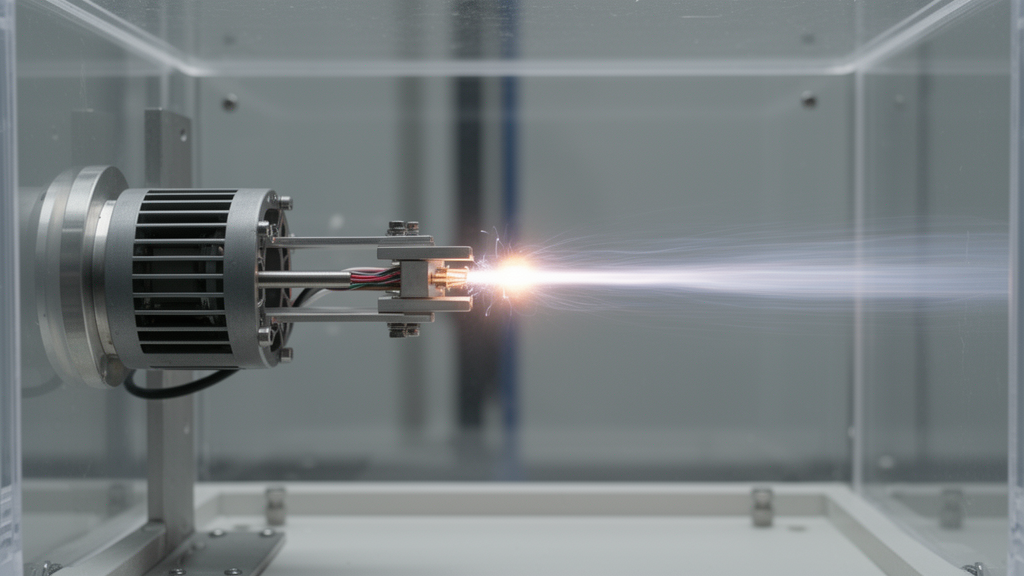
Longitudinal airflow can sharply suppress the drifting and ablation of the electrical arc formed between a train’s pantograph and overhead contact wire, according to a modeling and experimental study of pantograph–catenary systems under low-pressure conditions. The researchers built a magnetohydrodynamic model that coupled electric, magnetic, thermal, fluid and arc-motion dynamics, then tested the method in a vacuum chamber with copper and carbon electrodes. In experiments conducted at atmospheric pressure, increasing the airflow to 45 metres per second reduced the measured arc drift height from 27.6 millimetres to zero and shortened the arc-root distance from 51.3 to 3.9 millimetres. The same airflow setting also produced progressively less carbon-electrode damage, supporting the proposal as a possible current-collection control method for railways operating at high altitude.
The need for such control arises because the pantograph–catenary system carries the electrical energy used by electric trains, while the stability of its contact strongly affects operating safety and efficiency. Lower atmospheric pressure presents a particularly difficult environment. The study notes that reduced air density and breakdown-field strength can lower the ignition threshold for pantograph–catenary arcs, increase their frequency and duration, and enlarge the region affected by arcing. Repeated arcing can cause irreversible high-temperature ablation and electrical wear on contact wires and pantograph strips. It can also generate broad-band electromagnetic interference that may affect onboard signalling and traction-control systems, with potential consequences including insulator flashover and disruption of the traction network. These background risks motivate efforts to understand and restrain the spatial movement of arcs in plateau environments.
Existing arc models include the Cassie and Mayr black-box approaches, which support analysis of interactions between arcs and traction-network circuits but do not represent an arc’s changing spatial shape. Magnetohydrodynamic models offer a more physical alternative by coupling electromagnetic, flow and thermal fields. Previous work represented crosswind effects on pantograph–catenary arcs and examined how decreasing pressure affects arc-root jumping, in which the root forms at a new location after the elongated column reaches a critical length. Other studies have shown that magnetic fields can stabilize welding and switching arcs. Airflow regulation, however, has been investigated more extensively in welding than in pantograph–catenary systems, whose dissimilar electrodes, high operating speed, open environment, changing electrode gap and constrained vehicle installation space make their arc dynamics more complicated.
The new model represents an arc initially 6 millimetres long and 2 millimetres in diameter between a copper anode and a carbon cathode. It includes the surrounding air, both electrodes and a central longitudinal-airflow channel beneath the copper electrode, including a 1.5-millimetre control-airflow inlet. A separate inlet represents train-induced airflow and was set to 40 metres per second. Calculations covered pressures of 101, 80 and 60 kilopascals, longitudinal airflow from zero to 80 metres per second and a total simulation time of 25 milliseconds. Air properties were adjusted with pressure, while the electrodes were assigned distinct densities, resistivities, thermal conductivities and heat capacities. The governing equations represented electrical potential and current, magnetic-vector potential, mass and momentum conservation, energy conservation, viscous dissipation, Joule heating and net volumetric radiation.
The calculations use several explicit simplifications. Arc ignition is omitted, and the plasma is treated as being in local thermodynamic equilibrium. Flow in the air and arc domains is assumed laminar and incompressible, while metal vapour generated by electrode evaporation and phase change is excluded. These assumptions make it possible to examine large-scale arc motion and temperature distribution but prevent the simulation from directly calculating electrode mass loss, crack width or crater area. Copper was assigned the anode and carbon the cathode; a Gaussian distribution represented current entering through the copper electrode, and the bottom of the carbon electrode was grounded. The air boundary was treated as magnetically insulated, and the initial temperatures were set to 300 kelvin for the air and electrodes and 5,000 kelvin for the arc domain. The experimental apparatus was separate from the numerical model and provided direct physical measurements of damage.
Without longitudinal airflow, the simulated arc passed through two stages. During the first 10 milliseconds, its column elongated continuously, bent under airflow influence, and developed greater drift height and arc-root distance. From 10 to 25 milliseconds, the column and root distance fluctuated through repeated shortening and elongation. The authors associate this behaviour with the electrical and mechanical limits of the arc: once a column reaches a critical length, the voltage and energy available between the electrodes may no longer sustain continuous burning, and a shorter path of lower resistance may form on the electrode surface. The resulting root “jump” shortened the column before airflow stretched it again. Arc development became faster and both drift height and root distance increased as pressure fell. Temperature briefly exceeded 10,000 kelvin and reached a maximum within roughly two to three milliseconds before fluctuating, while arc voltage rose as the column lengthened and resistance increased.
Longitudinal airflow changed these trajectories in the simulations. As speed increased, drift height, root distance and temperature all declined, with the greatest reductions occurring at lower airflow speeds before the curves began to level off. At 101 kilopascals, the calculated drift height fell from 37.5 millimetres without control airflow to zero at 45 metres per second, while root distance decreased from 57.3 to 3.7 millimetres and temperature dropped from 12,900 to 8,650 kelvin. The airflow needed to eliminate drift was 45, 40 and 35 metres per second at pressures of 101, 80 and 60 kilopascals, respectively; speeds required to bring root distance below 5 millimetres were 45, 40 and 30 metres per second. The authors attribute the stronger response at lower pressure to reduced plasma density, which weakens the arc’s inherent rigidity, Lorentz force and thermal buoyancy, allowing airflow load to become a more dominant influence on its motion.
The temperature response also revealed a practical plateau. The researchers defined the optimal airflow speed as the point after which increasing speed by 5 metres per second changes arc temperature by less than 3 per cent. At atmospheric pressure this occurred at 40 metres per second, compared with 30 metres per second at 60 kilopascals. The reported temperature reduction was 33.8 per cent at 101 kilopascals and 38.1 per cent at 60 kilopascals. Airflow strengthened convective heat removal, which lowered plasma temperature and, in turn, increased deionization and reduced Joule heating. Once thermal exchange approached saturation and the minimum temperature required for self-sustaining arc combustion was approached, further increases in speed produced little additional cooling. The model therefore indicates that the airflow speeds required for control decline as ambient pressure falls.
Laboratory testing used a vacuum chamber capable of controlling pressure with an accuracy of plus or minus 100 pascals, a constant-current supply rated from zero to 150 amperes, an arc igniter, a fan with continuously adjustable airflow from zero to 60 metres per second, a high-speed camera and an oscilloscope. Airflow at the electrode outlet was measured with an anemometer accurate to plus or minus 0.5 metres per second. The camera operated at 6,400 frames per second with an exposure of five microseconds, while each two-second arc test was repeated five times and the mean was reported. Tests at 101 kilopascals used airflow speeds of zero, 20, 30 and 45 metres per second. Without control airflow, high-speed images showed increasing arc drift. At 45 metres per second, drift was virtually absent during the final development phase and root distance was substantially shortened, with observed morphologies broadly consistent with the numerical results.
The experiments also found reductions in carbon-electrode ablation that increased with airflow speed. Microscopy showed shorter ablation areas, smaller craters and narrower crack propagation as the controlled airflow rose. The maximum crack width was 66.7 micrometres without airflow and decreased at higher speeds, while analytical weighing showed progressively less mass loss from the carbon electrode. The proposed mechanism is that stronger airflow promotes arc-root slippage, shortening the time the root remains at one point, while convective cooling lowers temperature and local energy density. These are experimental observations rather than direct outputs of the simulation: because the model omits electrode evaporation and metal-vapour transport, it cannot quantitatively predict ablation rates or near-electrode energy balances. The study therefore demonstrates reduced damage under its controlled laboratory conditions, not a complete first-principles calculation of all processes responsible for electrode wear or a proven field performance level in operating plateau railways.
Subject of Research: Experimental and numerical evaluation of airflow control of pantograph–catenary arcs at low pressure.
Article Title: Research on regulation method for suppression of pantograph-catenary arc by airflow in low-pressure environment
Article References: Xu, Z., Wang, S., Dong, K., & Gao, G. (2026). Research on regulation method for suppression of pantograph-catenary arc by airflow in low-pressure environment. iScience, 29(11), Article 117951. https://doi.org/10.1016/j.isci.2026.117951
Image Credits: AI Generated
DOI: 10.1016/j.isci.2026.117951
Keywords: pantograph–catenary systems, railway electrification, electric arcs, low-pressure environments, longitudinal airflow, magnetohydrodynamic modelling, electrode ablation, high-speed rail, plateau railways, arc suppression, Research, regulation
Cite Scienmag News
Denise Maddox. (October 21, 2026). Longitudinal airflow suppresses train power-arc drift at low pressure. Scienmag. https://scienmag.com/longitudinal-airflow-suppresses-train-power-arc-drift-at-low-pressure/
Denise Maddox. "Longitudinal airflow suppresses train power-arc drift at low pressure." Scienmag, 21 October 2026, https://scienmag.com/longitudinal-airflow-suppresses-train-power-arc-drift-at-low-pressure/. Accessed 21 October 2026.
Denise Maddox. "Longitudinal airflow suppresses train power-arc drift at low pressure." Scienmag. October 21, 2026. https://scienmag.com/longitudinal-airflow-suppresses-train-power-arc-drift-at-low-pressure/


