


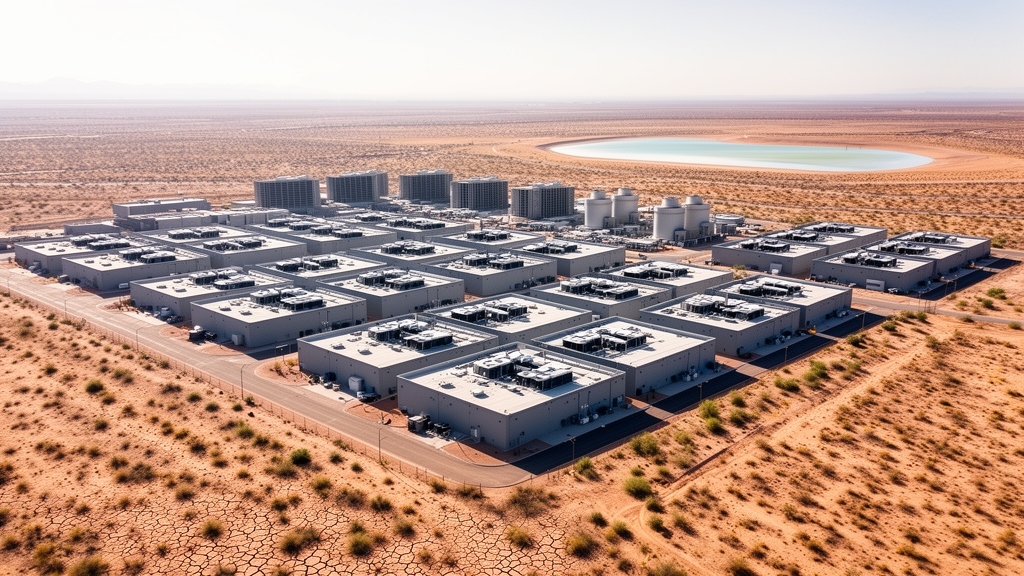
A global analysis of 9,347 operational data centers found that about 25% are located in areas where water demand exceeds supply for at least one month each year, according to the peer-reviewed study published in Environmental Science & Technology. Around 6% of the facilities are in areas stressed for most of the year. The researchers also estimated that 33% of today’s data centers could be in regions where demand will exceed supply under a future climate scenario.
Lead and corresponding author Lorenzo Rosa and colleagues mapped the locations of data centers against local water availability and demand from cities and municipalities, agriculture, manufacturing, and power generation. The analysis assessed where water use by existing users was already greater than available supply and examined how the balance could change in a modeled future climate. The researchers said the map was needed because, unlike electricity use, which is metered and reported, water scarcity is measured locally and often inconsistently or not at all.
The current analysis found that cities and municipalities were the largest water users near 41% of the data centers, while agriculture was the primary consumer near another 28%. Data centers use water to cool servers and prevent overheating, and they draw from the same local rivers, lakes, and aquifers used by nearby communities and industries. Rosa said the facilities were “landing on top of the water supply of cities and farms,” rather than being situated in landscapes without existing water use.
For the future projection, the researchers used several climate models representing average global temperatures 3 degrees Celsius, or 5.4 degrees Fahrenheit, warmer than in 1900. The authors described this scenario as representing a time frame from 10 to 40 years from now. Under those assumptions, the model estimated that 33% of today’s data centers could be located in regions where water demand will exceed supply. Most of the additional facilities potentially affected were in the United States, where 39% of the global data-center total was already located at the time of the analysis.
The findings indicate that data-center operations may add pressure to local water resources in places already experiencing, or projected to experience, water stress. The study does not establish what consequences would follow for particular water users, and the authors said future studies would be needed to determine whether projected scarcity translates into actual effects. They nevertheless argued that data-center planning should account for local water-management and infrastructure needs. The authors also disclosed that Saoradh Enterprise Partners LLC supported the work by providing access to the data-center dataset.
Subject of Research: Global analysis of water stress around operational data centers under current and future climate scenarios
Article Title: Many data centers are located where water resources are limited
Article References: Many data centers are located where water resources are limited. Original publication (Bibliographic details unavailable.)
Image Credits: AI Generated
DOI: Not provided
Keywords: data centers, water stress, water demand, water supply, climate models, global analysis, environmental science, infrastructure, Many, data, centers, located
Cite Scienmag News
Denise Maddox. (October 21, 2026). Global study finds 25% of 9,347 operational data centers in water-stressed areas. Scienmag. https://scienmag.com/global-study-finds-25-of-9347-operational-data-centers-in-water-stressed-areas/
Denise Maddox. "Global study finds 25% of 9,347 operational data centers in water-stressed areas." Scienmag, 21 October 2026, https://scienmag.com/global-study-finds-25-of-9347-operational-data-centers-in-water-stressed-areas/. Accessed 21 October 2026.
Denise Maddox. "Global study finds 25% of 9,347 operational data centers in water-stressed areas." Scienmag. October 21, 2026. https://scienmag.com/global-study-finds-25-of-9347-operational-data-centers-in-water-stressed-areas/


