


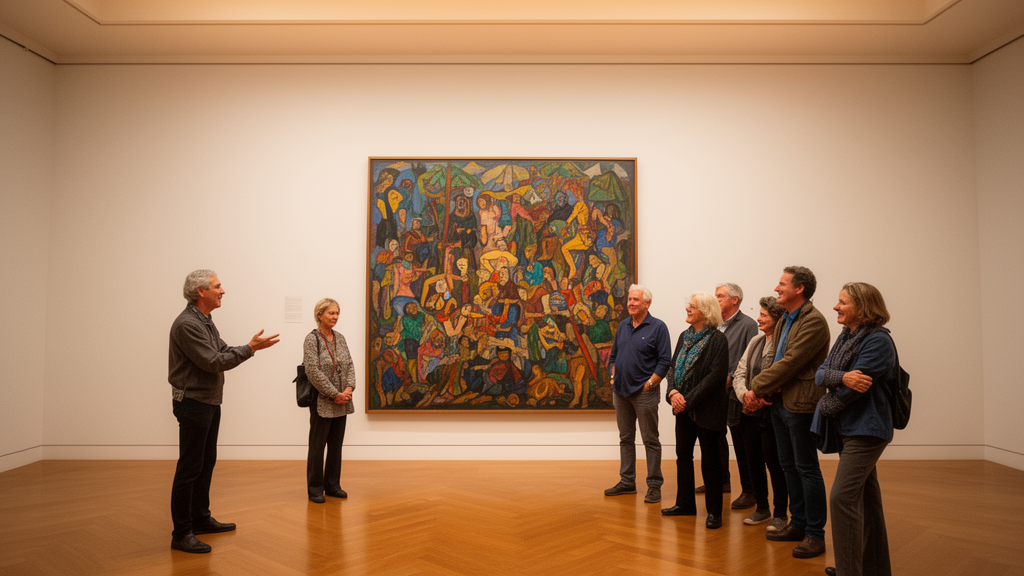
A non-randomised pre–post study of 135 adults attending two Milan museums found that visual thinking strategies sessions and conventional guided visits were each followed by short-term reductions in state anxiety and improvements in mood. The study did not include a non-museum comparison condition, so it could not determine whether the activities caused the observed changes. Eighty-five participants attended seven visual thinking strategies sessions, while 50 attended four guided visits.
Participants were allocated according to the session date they selected and were unaware of the activity assigned to that date. Each person attended only one session. The study was conducted as part of the ASBA project and evaluated two educational, non-therapeutic formats that were not designed specifically to treat anxiety or stress.
Visual thinking strategies, or VTS, involved a trained facilitator leading group observation and discussion of museum objects through open-ended prompts. Participants were asked what was happening in the object, what evidence supported their interpretations and what else they could find. The facilitator provided factual information only after the discussion.
The comparison condition was an approximately 90-minute curator-led tour delivered in a conventional expository format. Museum experts presented factual and contextual information about selected objects, and participants could ask questions. Before and immediately after each session, all 135 participants completed the 20-item State Anxiety Inventory, while available-case analyses of six visual analogue scales assessed mood, stress, clear-mindedness, contentment, calmness and restlessness.
Participants also provided brief written descriptions of their experiences. State anxiety was the study’s only confirmatory outcome; the remaining outcome comparisons, personality correlations and qualitative analyses were exploratory. Changes were evaluated with statistical models that included a random intercept for session.
Across the full sample, mean state anxiety fell from 35.07 to 29.53, a change of −5.54 points with a 95% confidence interval of −6.64 to −4.44 and an average-standardised effect of d_av = −0.81. Mood rose by 1.06 points on the 1–10 scale, with d_av = 0.72. Session-adjusted models produced similar estimates: state anxiety changed by −5.55 points, with a 95% confidence interval of −6.85 to −4.26, and mood changed by 1.07 points, with a 95% confidence interval of 0.74 to 1.40.
Stress, restlessness, calmness, contentment and clear-mindedness also changed in the expected direction, and all six visual analogue outcomes remained significant after Holm correction. Intraclass correlations were 0.01 for state-anxiety change and 0.04 for mood change, indicating little statistical dependence within sessions, although this does not exclude other session-level influences. Both conditions recorded anxiety reductions: −4.76 points for VTS and −6.86 points for the guided visit.
The raw guided-visit change occurred among participants with higher baseline anxiety. In a multilevel ANCOVA adjusted for baseline anxiety, there was no statistically detectable difference between the activities. The adjusted difference was 0.38 State Anxiety Inventory points for VTS relative to guided visits, with a 95% confidence interval of −2.67 to 3.42.
Neither museum nor the activity-by-museum interaction was significant. The results did not establish equivalence, and differences of approximately three points in either direction remained compatible with the data. A descriptive content analysis assigned each participant’s brief response to one of 10 categories and then grouped the dominant category into cognitive, emotional-aesthetic or social-relational routes.
After VTS, 50 of 85 participants, or 58.8%, had cognitive descriptions, 19 had social-relational descriptions and 16 had emotional-aesthetic descriptions. Following the guided visit, 29 of 50 participants, or 58.0%, had emotional-aesthetic descriptions and 21 had cognitive descriptions; no participant’s dominant response was classified as social-relational. The distributions differed between conditions by a permutation chi-square value of 27.37, p < 0.001, and Cramér’s V of 0.45.
These descriptive patterns may partly reflect the different tasks each activity asked participants to perform. Important limitations constrain the findings. The absence of a non-museum control means that group participation, expectations, demand characteristics, regression to the mean and other non-specific effects cannot be excluded.
Randomisation was not used, unmeasured confounding remains possible, and only 11 sessions were conducted. Each format was delivered by one professional, confounding activity format with facilitator. Outcomes were self-reported and measured immediately after the session, so the study provides no evidence about durability or clinical benefit.
The self-selected sample was 82.2% female, had a mean age of 44.86 years and included frequent museum visitors, limiting generalisability. Exploratory correlations between personality traits and outcome changes did not survive correction for multiple comparisons. The authors propose randomised controlled studies with non-museum comparison conditions, more sessions and facilitators, larger and more diverse samples, physiological measures and follow-up assessments.
Subject of Research: Short-term psychological wellbeing outcomes after two educational museum activities in adults
Article Title: Museum-based activities and psychological wellbeing: a pre–post study of visual thinking strategies and guided visits across two cultural settings
Article References: Lucchiari, C., Vanutelli, M. E., Ferrara, V., & Banzi, A. (2026). Museum-based activities and psychological wellbeing: a pre–post study of visual thinking strategies and guided visits across two cultural settings. Frontiers in Psychology, 17, Article 1904352. https://doi.org/10.3389/fpsyg.2026.1904352
Image Credits: AI Generated
DOI: 10.3389/fpsyg.2026.1904352
Keywords: museum activities, state anxiety, mood, visual thinking strategies, guided visits, pre–post study, psychological wellbeing, cultural heritage, Milan, Museum-based, activities, psychological
Cite Scienmag News
Glenn Wilkins. (October 21, 2026). Non-randomised Milan pre–post study links two museum activities with short-term anxiety and mood improvements. Scienmag. https://scienmag.com/non-randomised-milan-pre-post-study-links-two-museum-activities-with-short-term-anxiety-and-mood-improvements/
Glenn Wilkins. "Non-randomised Milan pre–post study links two museum activities with short-term anxiety and mood improvements." Scienmag, 21 October 2026, https://scienmag.com/non-randomised-milan-pre-post-study-links-two-museum-activities-with-short-term-anxiety-and-mood-improvements/. Accessed 21 October 2026.
Glenn Wilkins. "Non-randomised Milan pre–post study links two museum activities with short-term anxiety and mood improvements." Scienmag. October 21, 2026. https://scienmag.com/non-randomised-milan-pre-post-study-links-two-museum-activities-with-short-term-anxiety-and-mood-improvements/


