


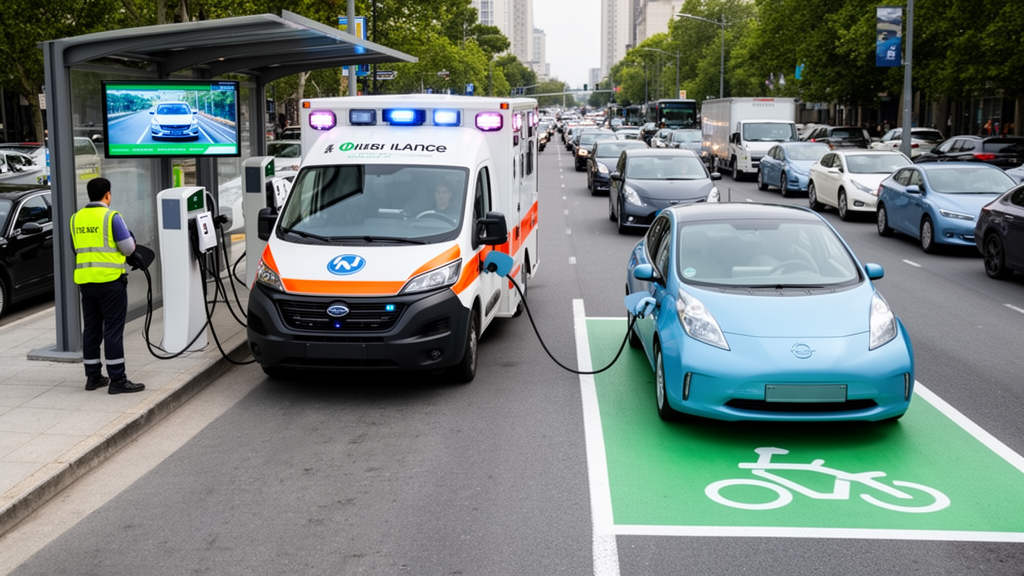
A simulated real-time charging system for electric vehicles reduced average waiting time by 70.3% compared with a nearest-station routing baseline while ensuring that emergency vehicles could begin charging without delay. The framework combines battery-range screening, live congestion pricing, three user-priority tiers and selective interruption of active charging sessions. In tests involving 300 simulated electric vehicles, the lowest-state-of-charge vehicles were all protected from stranding by the proposed algorithm, whereas all 20 were classified as failures under a naive routing approach. These findings come from a simulation study, not a field trial, and therefore do not yet establish how the system would perform in a live charging network.
The researchers modeled a network of three charging stations, each with two physical ports rated at 150 kW. Station A represented a high-demand urban location, Station B a medium-density residential area and Station C a corridor serving long-distance commuters. The simulated fleet combined commercially available vehicles capable of direct-current fast charging, with battery capacities from 40 to 100 kWh and maximum onboard charging powers from 26 to 147 kW. Arrival state of charge ranged from about 16% to 83%. Analysis of individual sessions used vehicle lookup records to retrieve battery capacity, energy consumption and charging limits, while a continuous 24-hour scheduling horizon and a congested 12-hour operating period were used to examine allocation performance.
Before presenting drivers with charging options, the algorithm performs a physical feasibility filter. For an incoming vehicle, it calculates the maximum distance that can be traveled from its current battery level, then compares that range with GPS-derived travel distances to every active station. Stations beyond the reachable range are removed rather than being offered as cheaper or more convenient choices. Energy demand is calculated from the difference between arrival and requested departure state of charge, multiplied by battery capacity. Expected charging duration then follows from that energy demand divided by the lower of the port’s output and the vehicle’s maximum acceptance rate. In the illustrated fleet, every displayed session was limited by the vehicle rather than the 150 kW station supply.
This filtering changes both safety and traffic distribution. In three vehicle-level cases, a car with a calculated maximum range of 60 km could see all three stations, a vehicle with 30 km of range was denied access to a station 45 km away, and a vehicle with 15 km of range was offered only a station 10 km away. A separate stress test selected the 20 vehicles with the lowest recorded arrival states of charge. The naive approach routed all 20 toward the geographically central station and classified every one as stranded. The proposed system rerouted 11 vehicles to a reachable peripheral station and issued a system rejection to nine others whose ranges could not cover even the nearest operational port. No on-road stranding event occurred under the proposed model, although vehicles that could not reach any station were still unable to charge.
For vehicles with viable options, the system estimates queue delay at each station by comparing the arrival time with the earliest estimated finish among active sessions. It then combines expected waiting time, driving time and financial cost into a weighted score and recommends the feasible station with the lowest composite value. Weights can reflect a driver’s priorities, with an urgent customer able to place more emphasis on waiting time. This mechanism differs from sending every driver to the geographically closest station. Under that nearest-feasible-station baseline, about 290 of 300 vehicles converged on Station A, leaving the other stations underused and creating a local bottleneck. The proposed method distributed approximately 100 vehicles to Station A while steering the remainder toward less congested options.
Congestion is communicated through a step-based electricity-price multiplier. The multiplier is 1.0 for an estimated wait of 10 minutes or less, 1.2 for waits between 10 and 30 minutes, and 1.5 when the wait exceeds 30 minutes. The displayed price also includes a priority fee for urgent users. The aim is not simply to maximize revenue but to shift price-sensitive demand toward stations with shorter queues, thereby spreading charging loads across the network. In the 12-hour Station A analysis, the nearest-station baseline produced a peak queue of 284 electric vehicles and a sustained average of 206. With the menu-based method, the maximum queue fell to 94 and the time-averaged queue was approximately 66. Across the full simulation, mean system waiting time fell from 2,129.5 minutes under the baseline to 631.7 minutes with the proposed algorithm.
The scheduler separates drivers into normal, urgent and emergency tiers. Normal users accept ordinary queue delays and congestion pricing. Urgent users can pay a priority fee to receive a better position in the queue, but they cannot interrupt a charging session already in progress. Emergency vehicles form the highest tier: if their selected station is occupied, the system identifies eligible active sessions, suspends one and starts the emergency vehicle at its physical arrival time. The interrupted driver is placed at the head of the queue for resumption, the congestion multiplier is waived and a 50% discount is applied to the base electricity rate for the remaining energy. In the reported fleet, average waits were 18.5 minutes for normal users, 4.2 minutes for urgent users and zero minutes for emergency vehicles.
Victim selection is designed to limit disruption and preserve the hierarchy. The algorithm first considers only active drivers at the lowest priority level present at the station. Among those candidates, it selects the session with the latest estimated finish time, allowing the emergency vehicle to take over a port that would remain occupied longest. A higher-priority urgent session is protected when lower-priority normal sessions are available. If every occupied port belongs to an emergency vehicle, however, no eligible lower-priority victim exists, and the protocol does not evict any session. In a separate case with four normal and two urgent sessions, the system chose a normal driver with a 45-minute remaining finish even though an urgent driver had a 60-minute finish. A demonstration scenario showed a normal session beginning at time zero, an emergency arrival displacing it at 15 minutes, and the original session returning at 27 minutes with its remaining 15 minutes of charging still required.
The results also indicate that physical capacity eventually constrains the emergency guarantee. Stress tests covering fleets from 50 to 3,000 electric vehicles maintained zero waiting time for emergency arrivals until the number of concurrent emergency requests approached the physical number of charging ports. Beyond that limit, emergency waits rose sharply. The authors describe this as graceful degradation rather than an algorithmic failure: the protocol cannot preempt an equal-priority emergency session, so additional emergency demand must wait when no legal target exists. Port utilization reached 100% during peak hours and 98.2% across the 12-hour study period, with the schedule preventing simultaneous assignments to the same port. The work was also limited by fixed fleet assumptions, trust in user-declared priority, the absence of real-time grid-condition constraints and limited assessment of how displaced drivers experience interruption. The authors propose authenticated emergency credentials, behavioral checks for questionable urgent claims, demand forecasting and more developed compensation as future work.
Subject of Research: Real-time electric-vehicle charging scheduling with range filtering, dynamic pricing and emergency preemption.
Article Title: An online menu based real time preemptive scheduling for electric vehicle charging with hierarchical priority management
Article References: Khan, S., Masud, F., & Aziz, T. (2026). An online menu based real time preemptive scheduling for electric vehicle charging with hierarchical priority management. Results in Engineering, 32, Article 113591. https://doi.org/10.1016/j.rineng.2026.113591
Image Credits: AI Generated
DOI: 10.1016/j.rineng.2026.113591
Keywords: electric vehicles, charging stations, charging scheduling, state of charge, congestion pricing, emergency preemption, queue management, simulation, charging infrastructure, route feasibility, online, menu
Cite Scienmag News
Denise Maddox. (October 21, 2026). Real-time EV charging scheduler prioritizes emergencies and avoids stranded cars. Scienmag. https://scienmag.com/real-time-ev-charging-scheduler-prioritizes-emergencies-and-avoids-stranded-cars/
Denise Maddox. "Real-time EV charging scheduler prioritizes emergencies and avoids stranded cars." Scienmag, 21 October 2026, https://scienmag.com/real-time-ev-charging-scheduler-prioritizes-emergencies-and-avoids-stranded-cars/. Accessed 21 October 2026.
Denise Maddox. "Real-time EV charging scheduler prioritizes emergencies and avoids stranded cars." Scienmag. October 21, 2026. https://scienmag.com/real-time-ev-charging-scheduler-prioritizes-emergencies-and-avoids-stranded-cars/


