


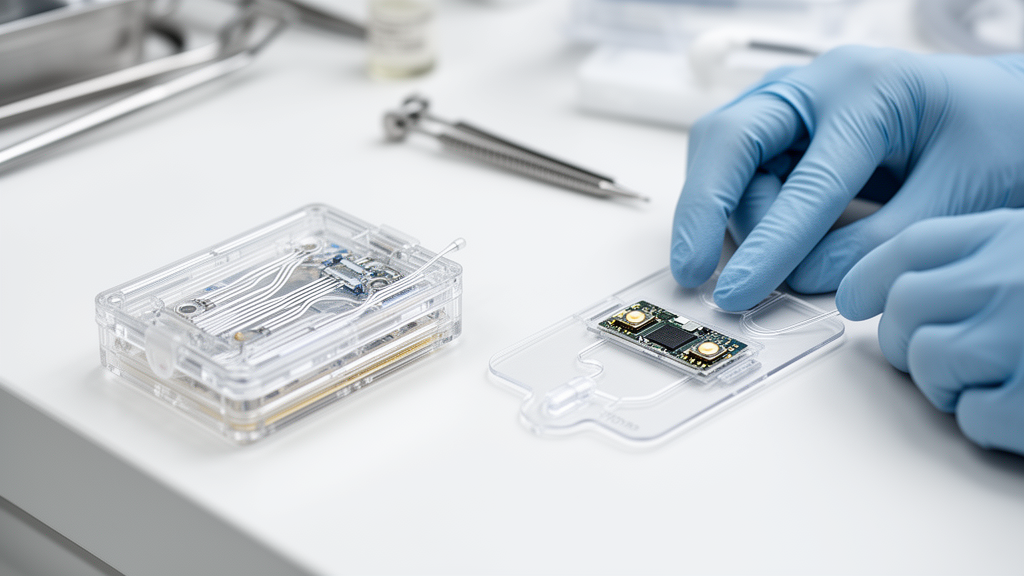
A review of microfluidics-enabled wearable and implantable medical technologies finds that miniature fluid handling, biosensing and artificial intelligence are converging into experimental systems for continuous, personalized monitoring. Microfluidic platforms can collect and analyze microliter- to nanoliter-scale samples of sweat, tears, interstitial fluid or blood, while AI can compensate for noisy readings, interpret time-series data and support closed-loop treatment. The hardware has already enabled experimental monitoring of glucose, lactate, hormones, pathogens and wound biomarkers, but most systems remain at the prototype stage.
Translation into routine care depends on rigorous clinical validation, stable biological interfaces, dependable power, interoperable data infrastructure, scalable manufacturing and protection against algorithmic bias. Microfluidics provides the physical link between a medical device and the small quantities of biological fluid available at the point of care. Channels scaled to biological reactions shorten the distance molecules must travel to reach a sensor, reducing assay time and reagent consumption.
Multiple channels and sensing zones can also operate in parallel, allowing one small sample to yield a combination of measurements rather than a single biomarker value. In a programmable epidermal system described by the review, individually controlled microheaters actuate thermoresponsive hydrogel valves to route and partition sweat for time-resolved analysis. Its glucose and lactate sensors produced linear relationships between measured current and target concentration, with R² values of 0.99 in the reported tests.
Integrating these fluid-handling capabilities with electronics creates additional engineering demands. A functional wearable or implantable system needs sensing, power and communication components that operate while conforming to skin or tissue. Polydimethylsiloxane, commonly known as PDMS, remains prominent in research prototypes because it is optically transparent, gas-permeable and compatible with soft lithography; parylene-C is used as a barrier coating for implantable microdevices.
Flexible circuits, serpentine interconnects and multilayer constructions help devices tolerate stretching, bending and twisting. One three-dimensional microfluidic-electronic sweat platform supported volumetric, colorimetric and electrochemical analysis, although repeated deformation can cause layer delamination, electronic fatigue, microchannel damage or leakage. The choice of biorecognition and transduction method determines which signals a device can measure.
Enzyme-based electrochemical patches have monitored glucose and lactate during exercise by converting analyte oxidation into electrical current. Aptamer-based systems have targeted female hormones, including estrogen and progesterone, at low physiological concentrations. Other wearable arrays have measured sodium, potassium, glucose and lactate in sweat, while multimodal patches have combined biochemical sensing with electrocardiography and corrected for variations in sweat pH and temperature.
One flexible glucose biosensor reported a sensitivity of 19.97 µA mM⁻¹ cm⁻² across a physiological range of 10 µM to 0.4 mM, while its dry electrophysiological electrodes recorded signal-to-noise ratios from 23.4 to 32.8 dB. Microfluidic assays can also compress infectious-disease and wound testing into small, rapid systems. A wrist-worn chip used recombinase polymerase amplification supported by body heat to detect HIV-1 DNA within 24 minutes.
The reported calibration was log-linear with a value of 0.98 across 10² to 10⁵ copies per milliliter. A separate wound dressing collected exudate and measured inflammatory mediators, including tumor necrosis factor-α, interleukin-6 and interleukin-8, together with Staphylococcus aureus, temperature and pH. This platform was demonstrated in a murine wound model and assessed with exudate from a patient with a venous leg ulcer.
That limited clinical observation did not constitute a broad trial of safety, accuracy or treatment benefit. Digital microfluidics extends the approach by manipulating discrete droplets across electrode arrays. Individual droplets can be routed, mixed and processed in parallel without conventional micro-pumps and valves.
One blood-based platform integrated plasma separation, fluid transport, an in-line enzyme-linked immunosorbent assay and chemiluminescent detection. Its automated 21-step protocol quantified IgG from finger-prick blood with a reported limit of detection of 1.9 IU/mL and limit of quantification of 3.6 IU/mL, both below the review’s stated immunity threshold of 10 IU/mL. Another miniaturized device combined bacterial culture with electrochemical monitoring over a range of 2 × 10⁴ to 1.1 × 10⁹ CFU/mL, using a laser-induced graphene heater and confirming metabolic activity with microbial fuel cells.
These demonstrations show analytical potential, not performance across broad patient populations. Artificial intelligence adds a computational layer to interpretation of the raw signals produced by these devices. In an AI-assisted tear sensor, convolutional and recurrent neural networks corrected colorimetric readings affected by pH and color temperature.
The reported one-dimensional model produced an R² of 0.998 for pH, while a three-dimensional model produced an R² of 0.994 for vitamin C, calcium and protein concentrations. In another laboratory study, a deep-learning network analyzed surface-enhanced Raman scattering spectra from exosomes captured in a microfluidic chip. The system achieved a maximum capture efficiency of 85% and distinguished three non-small-cell lung-cancer cell lines from regular cell lines with a reported overall accuracy of 97.88%.
These results demonstrate performance in the tested laboratory settings rather than established clinical benefit. More ambitious designs connect sensing, computation and intervention. A flexible neural probe only 40 µm thick integrated optical stimulation, electrophysiological recording and chemical delivery, with a microfluidic mixer allowing two fluids to be combined at the probe tip.
A wearable patch used electrocardiography and heart rate to trigger a thermopneumatic micropump when heart rate exceeded 120 beats per minute during its demonstration. Another programmable platform contained 16 reservoirs with capacities from 115 to 295 µL; heating expandable microspheres squeezed drug through microchannels and microneedles, while passive mixers combined liquids from different channels. These systems illustrate possible closed loops, but they remain experimental and do not establish safe dosing or clinical effectiveness in routine care.
The most demanding barriers concern how the devices behave over time and how much trust patients, clinicians and regulators can place in their outputs. On skin, accumulated sweat, dermatitis, micromotion and inflammation can alter sampling conditions and signal quality. Inside the body, nonspecific protein adsorption can obstruct channels, while enzymes and antibodies may deteriorate under changing pH, temperature and mechanical shear.
Implanted devices can also provoke a foreign-body response, including formation of a collagen-rich capsule that separates the sensor from surrounding tissue. Antifouling hydration layers, slippery liquid-infused surfaces, rounded geometries and engineered materials have been investigated as potential countermeasures. The review emphasizes that systematic evidence on long-term stability remains limited and that standardized reference methods and calibration protocols are still needed, especially for aptamer sensors in complex fluids.
Scale creates further constraints. Energy harvesting from body movement, thermal gradients and biochemical reactions is promising, but the review says no approach yet supplies stable power for continuous sampling, computation and wireless communication across all real-world conditions at scale. Manufacturing must reproduce micron-scale channels, maintain sensor-to-sensor calibration consistency and control costs.
At the system level, continuous streams of multiple biomarkers do not fit electronic health records designed mainly for episodic clinical encounters. Secure, interoperable pipelines must compress raw readings into actionable trends without overwhelming clinicians. Regulation must also address software updates, cybersecurity, liability and algorithm safety.
The FDA’s Predetermined Change Control Plan offers one route for pre-specifying permitted modifications to an approved device, including algorithmic updates intended to compensate for sensor drift or physiological change. AI introduces risks that cannot be solved solely by improving the sensor. Training data may inadequately represent differences in age, sex, ethnicity, comorbidity, biofluid composition and individual physiology.
In low-amplitude, noisy measurements, a biased model may classify normal variation as disease or miss important signals in underrepresented groups. The review therefore calls for multicenter prospective validation, reproducible datasets, uncertainty estimates, post-hoc explanations and hardware-software safeguards that can stop autonomous systems when readings leave their validated range. Hybrid edge-cloud designs may combine privacy with rapid response, while local adaptation could compensate for sensor aging, but model changes must remain controlled and reviewable.
Whether the convergence of microfluidics and AI becomes routine care will ultimately depend on evidence that the complete ecosystem is safe, equitable, interoperable and reproducible beyond small prototype studies.
Subject of Research: Translational barriers and AI challenges in microfluidics-enabled wearable and implantable medical systems for personalized medicine
Article Title: Translational Barriers and AI‐Driven Challenges of Microfluidics‐Enabled Wearables and Implantable Systems in Personalized Medicine
Article References: Huang, K., Fong, C. Y., Huang, X., & Khoo, B. L. (2026). Translational Barriers and AI‐Driven Challenges of Microfluidics‐Enabled Wearables and Implantable Systems in Personalized Medicine. Advanced Science, 13(58), Article e77296. https://doi.org/10.1002/advs.77296
Image Credits: AI Generated
DOI: 10.1002/advs.77296
Keywords: microfluidic wearables, implantable biosensors, artificial intelligence, personalized medicine, biofluid sensing, closed-loop therapy, algorithmic bias, clinical validation, digital health, biocompatibility, Translational, Barriers
Cite Scienmag News
Eric Holt. (October 21, 2026). Research report: Translational Barriers and AI‐Driven Challenges of Microfluidics‐Enabled Wearables and Implantable Systems in Personalized Medicine. Scienmag. https://scienmag.com/research-report-translational-barriers-and-ai%e2%80%90driven-challenges-of-microfluidics%e2%80%90enabled-wearables-and-implantable-systems-in-personalized-medicine/
Eric Holt. "Research report: Translational Barriers and AI‐Driven Challenges of Microfluidics‐Enabled Wearables and Implantable Systems in Personalized Medicine." Scienmag, 21 October 2026, https://scienmag.com/research-report-translational-barriers-and-ai%e2%80%90driven-challenges-of-microfluidics%e2%80%90enabled-wearables-and-implantable-systems-in-personalized-medicine/. Accessed 21 October 2026.
Eric Holt. "Research report: Translational Barriers and AI‐Driven Challenges of Microfluidics‐Enabled Wearables and Implantable Systems in Personalized Medicine." Scienmag. October 21, 2026. https://scienmag.com/research-report-translational-barriers-and-ai%e2%80%90driven-challenges-of-microfluidics%e2%80%90enabled-wearables-and-implantable-systems-in-personalized-medicine/


