


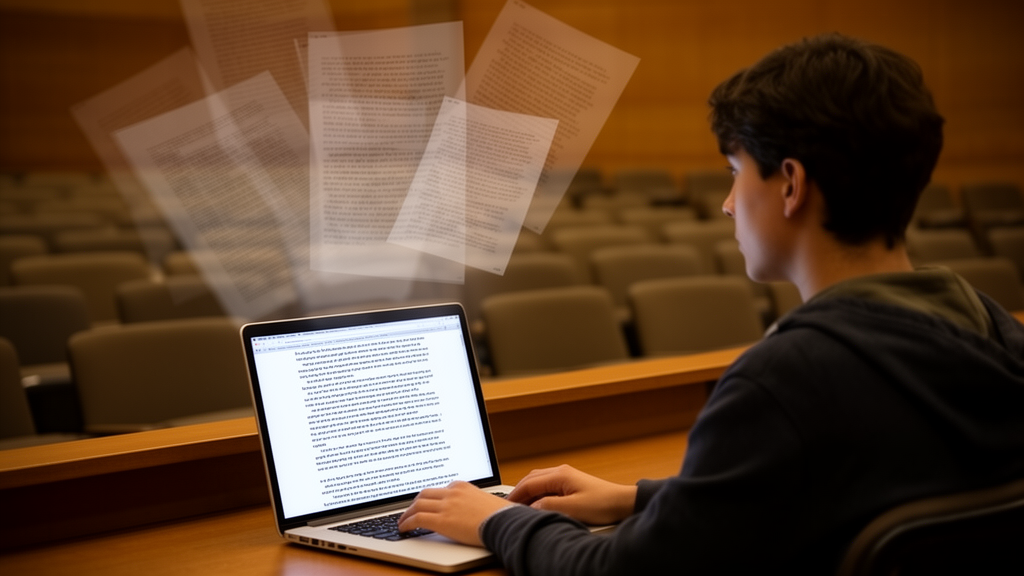
Generative artificial intelligence has moved from novelty to infrastructure in higher education, and a new conceptual study argues that the most serious risk it poses is not cheating or factual error but something subtler: the quiet substitution of plausibility for knowledge. Writing in SN Social Sciences, Fabrizio Maturo of Universitas Mercatorum, Alessandra Micozzi, and Annamaria Porreca of San Raffaele University in Rome examine how AI-generated outputs that merely look and sound like knowledge can be mistaken for knowledge itself, and what that mistake does to teaching, research, peer review, and the public standing of universities.
The study, published on 27 August 2026, is explicitly conceptual rather than empirical. The authors do not claim to have validated a new psychometric construct, nor do they assert that plausibility effects, fluency, authority bias, automation bias, or epistemic dependence are new phenomena invented by AI. Instead, they define what they call epistemic plausibility bias more narrowly, as a recurring validation-level distortion in which the perceived quality of a knowledge-like output is allowed to stand in for an adequately calibrated assessment of the warrant supporting it. In plain terms, a text that reads well, cites convincingly, and sounds authoritative can pass through the checkpoints that universities use to certify knowledge, even when nothing underneath has been verified.
The theoretical machinery behind this claim draws on decades of cognitive science. Research on processing fluency has shown that statements that are easier to read are judged more likely to be true, a metacognitive shortcut that Alter and Oppenheimer described as uniting the tribes of fluency into a metacognitive nation. Work by Connell and Keane on plausibility judgments showed that conceptual coherence and distributional word coherence both shape how plausible a statement feels, independently of whether it is correct. Large language models are, in effect, industrial-scale producers of both kinds of coherence: they are trained to generate text whose internal statistics match the distribution of human writing, which is precisely the property that makes them feel plausible. The authors argue that this is where the danger lies, because the very features that make AI output convincing are orthogonal to whether it is warranted.
What distinguishes the new concept from existing ones, the authors insist, is its focus on the epistemic transition from plausibility cues to attributed warrant, and, when outputs enter academic procedures, to institutional validation. Existing concepts such as confirmation bias, automation bias, and cognitive offloading explain important antecedents of the distortion, but they do not capture the specific moment at which a plausible-sounding output acquires the social status of validated knowledge. Automation bias, documented extensively in human factors research by Lee and See and by Parasuraman and Manzey, describes the tendency to over-rely on automated systems; epistemic dependence, analyzed by Hardwig and by Goldberg, describes the way knowers must rely on others they cannot fully verify. The new analysis connects these threads to show how a plausibility cue generated by a machine can be laundered into institutional warrant when a student submits it, a researcher cites it, or a reviewer endorses it.
A crucial part of the argument concerns what AI actually is in this framework. The authors treat AI as a cognitive condition only as shorthand for a socio-technical condition of academic cognition: AI reorganizes the environments in which academic search, synthesis, writing, assessment, verification, and judgment are delegated, accelerated, and institutionally normalized. They explicitly reject the idea that this expression competes with established frameworks such as technological mediation, distributed cognition, extended cognition, or cognitive offloading. The point is not that minds have literally expanded into machines, in the spirit of Clark and Chalmers’s extended mind thesis, but that the institutional scaffolding around cognition has changed so thoroughly that the default path from question to answer now runs through systems optimized for plausibility rather than truth.
The implications for teaching are direct. If students can produce fluent, well-structured, citation-rich text on demand, then the traditional proxy signals of learning, such as the polished essay, lose their diagnostic power. The authors argue that higher education should respond not through simple prohibition or uncritical adoption, but through critical AI literacy, process-oriented assessment, preservation of critical time, and institutional governance of epistemic delegation. Process-oriented assessment means evaluating how students arrive at conclusions rather than only the conclusions themselves, making the warrant visible. Preservation of critical time means deliberately protecting the slow, effortful verification work that fluency tempts us to skip, since the economics of generative tools make fast output nearly free while careful checking remains expensive.
Research writing and peer review face a parallel version of the same distortion. The authors, who have previously published on the ethical and methodological challenges that AI poses to the peer review process, note that reviewers working under time pressure are exactly the population most vulnerable to automation bias and fluency effects. A manuscript polished by a language model can read better than a correct one, and a reviewer who delegates screening to AI tools inherits the model’s plausibility judgments without its accountability. The study also engages with the broader literature on critical generative AI literacy, including work by Rapanta and colleagues on postdigital configurations and by Roe and colleagues on metaphorical frameworks for AI literacy, positioning critical literacy not as a technical skill but as an epistemic capacity: the ability to ask what warrant stands behind a fluent sentence.
The analysis extends beyond the seminar room to cognitive inequality and the public role of universities. Because the ability to detect unwarranted plausibility depends on domain expertise, students and institutions with fewer resources may be least equipped to catch the distortions, deepening existing gaps in epistemic access. At the societal level, the authors argue that universities hold a distinctive responsibility: they are society’s certified producers of warrant, and if their validation procedures can be satisfied by plausibility alone, the public epistemic commons degrades. This connects the study to philosophical work on epistemic authority by Zagzebski and on trust in experts by Goldman, and to Floridi’s characterization of large language models as agency without intelligence, systems that can act competently in language without understanding it.
The authors are careful about the boundaries of their claim. They note that the study does not generate or analyze datasets, and that the expression epistemic plausibility bias is offered as a conceptual tool for locating a specific failure point in the knowledge pipeline, not as a rival to existing constructs. The contribution is diagnostic and normative rather than psychometric: it names the transition from cue to warrant to institution, and it assigns responsibility for policing that transition. In their framing, epistemic responsibility in the age of generative AI is not primarily about detecting fabricated citations or catching plagiarism, tasks that technical tools may increasingly handle, but about redesigning the procedures by which academic communities decide that something counts as known.
What emerges is a picture of higher education at an epistemic crossroads. The technology that makes knowledge-like text abundant also makes the verification of warrant scarce, and the institutions built to certify knowledge must now decide whether their seals of approval attach to fluency or to justification. The authors’ answer is neither panic nor embrace but governance: curricula that teach the difference between plausibility and warrant, assessments that reward visible reasoning, schedules that protect the time verification requires, and institutional rules that make epistemic delegation explicit and accountable. Whether universities can execute that agenda before plausibility becomes the default currency of academic knowledge is, on the authors’ own analysis, the defining question of the coming decade.
Subject of Research: How AI-generated plausibility becomes mistaken for knowledge in higher education and what epistemic responsibility requires in response
Article Title: AI-generated plausibility and epistemic responsibility in higher education: implications for knowledge, learning, and society
Article References: Maturo, F., Micozzi, A., & Porreca, A. (2026). AI-generated plausibility and epistemic responsibility in higher education: implications for knowledge, learning, and society. SN Social Sciences, 6(9), Article 386. https://doi.org/10.1007/s43545-026-01683-3
Image Credits: AI Generated
DOI: 10.1007/s43545-026-01683-3
Keywords: artificial intelligence, higher education, epistemic plausibility bias, epistemic responsibility, critical AI literacy, peer review, automation bias, cognitive offloading, assessment, large language models, academic integrity, knowledge validation
Cite Scienmag News
Courtney Benton. (October 19, 2026). When Plausible Is Not True: How AI-Generated Text Threatens the Epistemic Core of Higher Education. Scienmag. https://scienmag.com/when-plausible-is-not-true-how-ai-generated-text-threatens-the-epistemic-core-of-higher-education/
Courtney Benton. "When Plausible Is Not True: How AI-Generated Text Threatens the Epistemic Core of Higher Education." Scienmag, 19 October 2026, https://scienmag.com/when-plausible-is-not-true-how-ai-generated-text-threatens-the-epistemic-core-of-higher-education/. Accessed 19 October 2026.
Courtney Benton. "When Plausible Is Not True: How AI-Generated Text Threatens the Epistemic Core of Higher Education." Scienmag. October 19, 2026. https://scienmag.com/when-plausible-is-not-true-how-ai-generated-text-threatens-the-epistemic-core-of-higher-education/


