


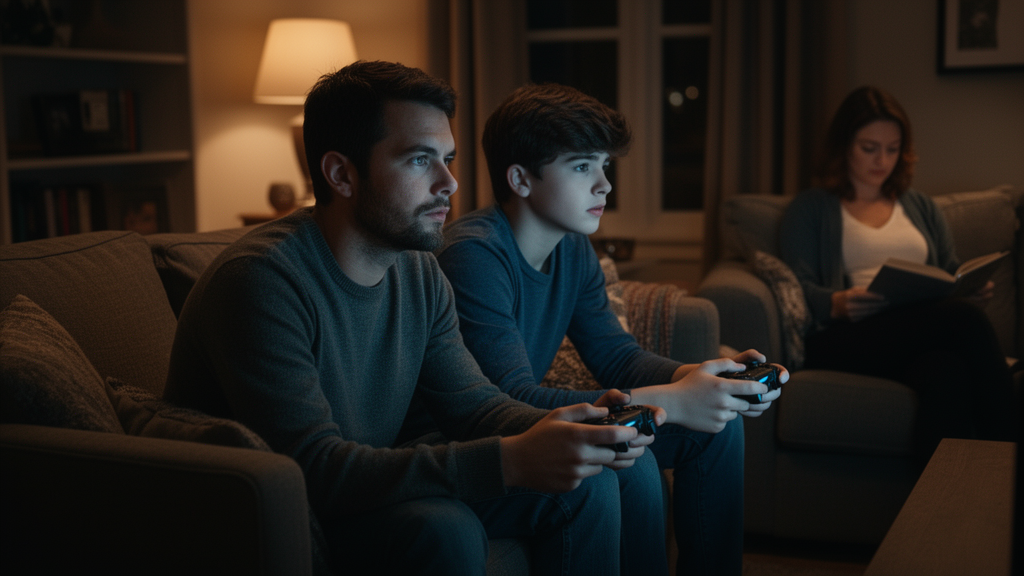
For millions of families, the nightly battle over the game console has become a familiar ritual. Now a large study of Chinese adolescents suggests that the outcome of that battle may depend less on rules and lectures than on something parents rarely consider: their own gaming habits and the expectations their children hold about what gaming does for them.
The study, published in BMC Psychiatry by researchers affiliated with Fudan University, The Chinese University of Hong Kong, Sun Yat-Sen University Cancer Center, Sichuan University, and Wenzhou Medical University, draws its data from a cross-sectional survey conducted in two Chinese cities between October 2019 and January 2020. With informed consent obtained from all participants, the research team recruited 1,039 students who self-perceived as having internet gaming disorder, a population chosen deliberately because adolescents who already sense problematic patterns in their own gaming are precisely the group that prevention efforts most need to reach. The survey and behavioral research ethics committee of the Chinese University of Hong Kong approved the project, which was conducted in accordance with the Declaration of Helsinki.
One of the most striking findings concerns how common the desire to cut back already is among this group. Overall, 68.6 percent of the sampled adolescents reported a behavioral intention to reduce their gaming time. That figure, however, differed sharply by self-perceived diagnostic status: among adolescents classified as probable IGD cases, 55.1 percent held such an intention, compared with 73.2 percent among those who did not meet the probable-case threshold, a difference that was statistically significant. The prevalence of probable IGD in this at-risk sample stood at 24.4 percent. The gap in intention between the two groups is counterintuitive at first glance, since one might expect those with the most severe symptoms to be the most motivated to change, but it also highlights a clinical reality: the adolescents deepest in problematic patterns are often the ones whose motivation has been most eroded, making them a priority target for intervention.
The theoretical scaffolding of the study comes from Social Cognitive Theory, a framework that treats behavior as the product of interactions among personal cognition, environmental influences, and the behavior itself. Within this framework, the researchers identified two environmental factors tied to the family sphere: adolescents’ perceptions of whether their parents themselves exhibited internet gaming disorder, and whether parents invited their children to co-play games with them. On the cognitive side, the study focused on positive outcome expectancy, meaning the beliefs adolescents hold about the benefits gaming delivers to them, such as enjoyment, stress relief, social connection, or a sense of achievement. The logic is straightforward: if a teenager believes gaming reliably produces desirable outcomes, the perceived cost of cutting back rises, and the intention to reduce gaming time weakens.
The statistical analysis bore out this logic in a consistent direction. Both parental gaming attributes and positive outcome expectancy were significantly and negatively associated with the intention to reduce gaming time. In other words, adolescents who perceived their parents as having gaming problems were less inclined to want to cut back, and the same held true for those whose parents invited them to play together. The more a teenager expected good things from gaming, the weaker the intention to reduce time spent playing. These associations held after the researchers tested the structural model, and the pattern of mediation proved particularly informative.
Mediation analysis revealed that positive outcome expectancy fully mediated the association between perceived parental IGD and the intention to reduce gaming time. Full mediation means that the direct path between the parental perception and the adolescent’s intention disappeared once the expectancy variable was accounted for; the entire effect of perceiving parental gaming problems on the child’s motivation flowed through the child’s own beliefs about gaming’s benefits. For parental invitations to co-play, the mediation was partial, with positive outcome expectancy accounting for 6.3 percent of the association. A partial mediation implies that some direct pathway remains, suggesting that co-play invitations may influence intention through additional mechanisms beyond shaping outcome expectancies, perhaps by normalizing gaming as a shared family activity or by altering the perceived social value of gaming sessions.
The researchers also examined whether these pathways differed between probable IGD cases and non-cases, using measurement invariance testing across the two groups. The structural and indirect paths proved largely invariant, meaning the model operated similarly regardless of diagnostic status. One exception stood out: the direct path from perceived parental IGD to the behavioral intention to reduce gaming time was stronger in the probable IGD group than in the non-IGD group. This suggests that for adolescents with more severe symptom profiles, parental gaming behavior exerts an additional direct influence on motivation beyond what is explained by outcome expectancies, a nuance that could matter when tailoring interventions to different levels of severity.
The authors frame their conclusions around two practical implications. First, the high prevalence of intention to reduce gaming time, at nearly seven in ten adolescents in this at-risk sample, signals substantial readiness for interventions built around gaming-time reduction. Motivation of this kind is a valuable resource in behavioral health, since programs that ask participants to change a behavior they already wish to change face fewer motivational barriers than those that must first cultivate the desire for change. Second, the findings suggest that such interventions may benefit from incorporating parental participation and from working to foster a more balanced set of expectations about what gaming can and cannot provide.
The parental dimension of the findings deserves particular attention in the context of adolescent prevention research. Family-based approaches to adolescent behavioral health have long recognized that parental modeling shapes child behavior, and this study extends that logic into the digital domain. When parents themselves game heavily, or when they actively draw their children into shared gaming sessions, they may inadvertently communicate that gaming is a normative and rewarding adult activity, which in turn shapes the adolescent’s outcome expectancies. Conversely, the mediation findings imply that changing parental behavior alone may not suffice if the adolescent’s cognitive beliefs about gaming remain untouched; the full mediation result for perceived parental IGD suggests that the expectancy variable is the proximal driver of intention, and interventions that target expectancies directly, for example by helping adolescents develop a realistic appraisal of gaming’s benefits and costs, may be an efficient lever for change.
It is worth situating the construct of internet gaming disorder in its diagnostic context. The term entered the Diagnostic and Statistical Manual of Mental Disorders, Fifth Edition, as a condition warranting further study, and it remains a contested and evolving construct in the psychiatric literature. Self-perceived IGD, the inclusion criterion for this study, is distinct from a clinical diagnosis; it captures adolescents’ own sense that their gaming has become problematic, which may or may not align with formal criteria. The researchers used the term probable IGD for cases meeting the study’s classification threshold, distinguishing them from non-cases within the same at-risk sample. This two-tier approach, recruiting adolescents who self-perceive problems and then differentiating by probable-case status, allows the analysis to speak both to the broader population of concerned gamers and to the more severely affected subgroup.
The methodological choices of the study also merit note. The researchers conducted exploratory factor analysis and confirmatory factor analysis to validate their measurement instruments, standard procedures for establishing that survey items capture the intended constructs. The cross-sectional design, however, imposes an important limitation: the data capture associations at a single point in time, and causal direction cannot be established. It is possible, for instance, that adolescents with weaker intentions to reduce gaming time become more attuned to their parents’ gaming habits, rather than the reverse, or that unmeasured factors influence both parental behavior and adolescent cognition. Longitudinal and experimental designs would be needed to confirm the causal pathways implied by the mediation model.
The timing of the data collection also deserves consideration. The survey was administered between October 2019 and January 2020, immediately before the COVID-19 pandemic reshaped patterns of screen use, schooling, and family life across China and the world. Adolescent gaming behavior, parental supervision, and family co-play dynamics all shifted substantially during the pandemic years, and it remains an open question whether the associations documented in this pre-pandemic sample would replicate under contemporary conditions. The article was published in September 2026, several years after data collection, as an open-access research paper that the publisher notes is citable and carries a permanent DOI, with a final version of record to follow.
For clinicians and prevention specialists, the study offers a framework for thinking about adolescent gaming that moves beyond simple restriction. The finding that positive outcome expectancy is the central cognitive mechanism suggests that motivational interviewing techniques, which aim to help individuals examine and reevaluate their beliefs about a behavior’s consequences, could be well suited to this population. Rather than disputing the pleasures adolescents derive from gaming, such approaches might acknowledge those pleasures while helping young people weigh them against other goals and develop more nuanced expectations about what gaming provides. The parental findings, meanwhile, suggest that family sessions addressing parents’ own screen habits and the messages conveyed by co-play invitations could complement individual-level work with adolescents.
The cultural context of the research is also relevant. China has implemented some of the world’s most stringent regulations on minor gaming, including time restrictions on online gaming for minors, and public concern about gaming addiction has been prominent in Chinese society. Against this backdrop, the finding that nearly seven in ten at-risk adolescents already intend to reduce their gaming time may reflect both genuine motivation and the salience of anti-gaming messaging in the environment. Whether such intentions translate into sustained behavior change is a question this study, by design, cannot answer, since behavioral intention is a precursor to action rather than action itself. The gap between intention and behavior is a well-documented phenomenon in health psychology, and future research tracking whether these intentions predict actual reductions in gaming time would strengthen the practical value of the findings.
The study’s authorship spans institutions in Shanghai, Hong Kong, Guangzhou, Chengdu, and Wenzhou, reflecting the collaborative network of public health and mental health researchers engaged with adolescent behavioral health in China. The corresponding author, Joseph T. F. Lau, holds affiliations with Wenzhou Medical University’s public mental health center and the Chinese University of Hong Kong’s school of public health, and the research team declares no competing interests. The work received no specific funding, according to the article’s declarations, and the supplementary material accompanying the publication provides additional methodological detail for readers seeking to evaluate the measurement and modeling decisions in depth.
Taken together, the study contributes a theoretically grounded, family-centered perspective on a problem that has often been framed in individual terms. By demonstrating that parental gaming attributes relate to adolescents’ motivation to reduce gaming time through the lens of outcome expectancy, the research points toward interventions that treat the household, rather than the adolescent alone, as the unit of change. For the families locked in nightly negotiations over the console, the message is subtle but significant: the conversations that matter may be less{
Subject of Research: How parental gaming attributes and outcome expectancies influence adolescents' intention to reduce gaming time
Article Title: The associations between parental gaming attributes and the behavioral intention to reduce gaming time among Chinese adolescents who self-perceived as having internet gaming disorder: mediations via positive outcome expectancy
Article References: Yu, Y., Ng, J. H.-Y., Li, J.-B., Zhang, J., & Lau, J. T. F. (2026). The associations between parental gaming attributes and the behavioral intention to reduce gaming time among Chinese adolescents who self-perceived as having internet gaming disorder: mediations via positive outcome expectancy. BMC Psychiatry. https://doi.org/10.1186/s12888-026-08585-x
Image Credits: AI Generated
DOI: 10.1186/s12888-026-08585-x
Keywords: internet gaming disorder, adolescents, parental influence, gaming time, outcome expectancy, social cognitive theory, China, behavioral intention, BMC Psychiatry, cross-sectional survey, co-play, prevention
Cite Scienmag News
Glenn Wilkins. (October 19, 2026). When Parents Game Too: Family Habits Shape Whether Teens Try to Cut Back on Gaming. Scienmag. https://scienmag.com/when-parents-game-too-family-habits-shape-whether-teens-try-to-cut-back-on-gaming/
Glenn Wilkins. "When Parents Game Too: Family Habits Shape Whether Teens Try to Cut Back on Gaming." Scienmag, 19 October 2026, https://scienmag.com/when-parents-game-too-family-habits-shape-whether-teens-try-to-cut-back-on-gaming/. Accessed 19 October 2026.
Glenn Wilkins. "When Parents Game Too: Family Habits Shape Whether Teens Try to Cut Back on Gaming." Scienmag. October 19, 2026. https://scienmag.com/when-parents-game-too-family-habits-shape-whether-teens-try-to-cut-back-on-gaming/


