


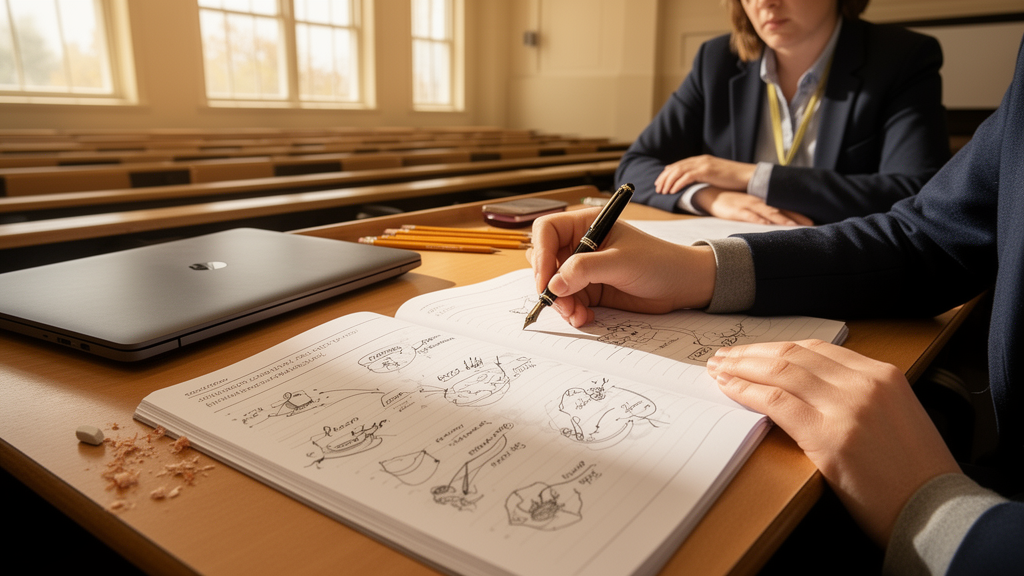
When ChatGPT can write a fluent essay in seconds, what does a polished assignment actually prove? That question has been gnawing at universities since generative AI went mainstream, and a new study from Oman offers a strikingly concrete answer: make students draw their understanding by hand, then defend it in front of their peers. The research, published in Discover Artificial Intelligence, describes an assessment sequence in which 76 undergraduates across three cohorts of an Educational Technology course brainstormed with AI, condensed their ideas into a single collaborative hand-drawn doodle, and then stood by that drawing during a structured gallery walk while classmates questioned and scored it. The result was what the researchers call visible evidence of reasoning — artefacts and live explanations that AI cannot quietly produce on a student’s behalf.
The study, led by Khalid Khamis Al Saadi of Qatar University together with Raja Maznah Hussain of Sultan Qaboos University and Gwo-Jen Hwang of National Taichung University of Education, is a qualitative multi-cohort case study spanning 23 student groups. Its starting point is blunt: post hoc AI detection, the automated scanning of submitted text for machine-generated patterns, has documented problems with instability, susceptibility to paraphrasing, and bias against multilingual authors. Rather than policing tools, the researchers argue, integrity should be built into the design of the assessment itself. They call this approach integrity-by-design, and it rests on a simple redistribution of evidential weight: AI is welcome at the ideation stage, but the core evidence of learning must come from human selection, synthesis, and public defence.
The sequence unfolded in four phases. First came bounded AI-supported ideation, in which students could use a generative AI system such as ChatGPT for early brainstorming, conceptual exploration, and illustrative examples, with full disclosure and a clear boundary: AI could open the conceptual space but could not substitute for later synthesis. Second, each group had to transform those preliminary ideas into one collaborative, hand-drawn conceptual doodle. This stage functioned as what the researchers term an analogue bottleneck — a checkpoint where automated prose is useless and students must actively select, condense, and organise ideas by hand. Third came the gallery-walk defence, where groups displayed their doodles, gave short explanations, answered peer questions, and were evaluated with explicit rubric criteria. Finally, each student completed an individual written reflection on what they learned and what tensions the process raised.
The technical logic of the doodling phase draws on generative learning theory, which holds that comprehension deepens when learners select pertinent information, establish relationships among ideas, and connect new material with prior knowledge through self-generated representations. Meta-analytic evidence on learning by drawing supports this: representational tasks enhance comprehension, transfer, and inferential reasoning when they require learners to build meaningful relations rather than replicate surface features. In this study, the doodle was conceptualised as a purposeful analogue externalisation — a materialised form of conceptual integration assessed not for artistic quality but for choices about inclusion, exclusion, spatial organisation, and relational clarity. The space limitation of paper forced deliberate prioritisation, shifting students from linguistic profusion to representational parsimony.
To analyse the artefacts systematically, the researchers developed a Visual Artefact Protocol and had two independent raters score all 23 group doodles on two dimensions: Conceptual Density, the count of distinct course concepts visualised, and Relational Explicitness, the clarity of connections established through arrows, spatial layout, and labels, each rated on a four-point scale. Initial inter-coder agreement reached 87 percent across the dataset, with remaining differences resolved through joint discussion. The pattern was clear: 19 of the 23 artefacts, or 83 percent, exhibited a paired visual structure in which groups that included high conceptual density systematically employed explicit visual connectors, using spatial grouping and directional arrows to establish logical flow. Visual constraints, in other words, prompted active conceptual organisation rather than random drawing.
Reflexive thematic analysis of peer evaluations, doodle artefacts, defence traces, and reflections revealed four interrelated themes. Analogue constraint as sense-making appeared strongly in 20 of 23 groups, with students reporting that doodling forced them to reduce long texts into key conceptual frameworks. One student described drawing the concept like a calendar, each day showing a picture that explains the idea; another recalled arguing about what symbol to use for collaboration — hands, circles, or people talking — until the doodle made them agree. AI as a scaffolder rather than a scribe was evident in 21 groups: students used AI to generate initial options but retained responsibility for filtering and modification. As one participant put it, ChatGPT suggested examples, but when we drew them, we had to simplify and make them ours.
Public explanation as accountability was documented in all 23 groups, making it the most universal theme. The gallery walk transformed static drawings into active defences of understanding. Students repeatedly cited it as the most useful part of the sequence, and peer questions exposed gaps in logic in ways written submissions never do. When someone asked why we linked policy to practice with one arrow, I realised I could not defend it, one student reflected. Another recalled the best part being when a peer challenged their metaphor, forcing the group to think fast and explain why it fit. These exchanges fostered what the researchers call the 4Cs: creativity in visual symbolism, critical thinking under questioning, communication through oral defence, and collaboration during group explanations.
The fourth theme, friction as pedagogy, surfaced in 18 groups and carried the study’s most counterintuitive finding: discomfort served as evidence of engagement. Students faced drawing anxiety, workload distribution challenges, and time constraints. Several felt insecure about their artistic skills, with one admitting the group ended up choosing the least bad drawing. Others preferred digital design tools for cleaner output. Notably, defence observations showed that groups relying heavily on digital preferences occasionally provided weaker verbal justifications during the gallery walk, describing visual components but struggling to explain underlying conceptual logic, while groups that wrestled directly with paper constraints articulated clearer justifications for their design choices. The researchers present this as a tentative observation rather than a systematically quantified comparison, but it suggests the productive friction of analogue work may itself strengthen reasoning.
The study also tracked a striking shift in AI attitudes across cohorts. In the first cohort, students treated AI tools with hesitation, often explaining their usage guardedly in reflections. By the third cohort, AI ideation had become an ordinary starting step, with hesitant framing confined to a minority of groups. Across all cohorts, however, the analogue doodling phase successfully shifted cognitive responsibility back to the students, requiring them to convert digital suggestions into defensible visual structures. The researchers argue that much of the assessment’s pedagogical value emerged from the analogue bottleneck and the public defence — elements they describe as resilient evaluation anchors as digital tools continue to evolve.
Theoretically, the work extends the established ICAP framework, which distinguishes Interactive, Constructive, Active, and Passive modes of cognitive engagement, by proposing visibility as a cross-cutting evidentiary condition rather than a fifth level. The researchers use the shorthand VICAP to capture this qualified reading: because modern generative AI can now simulate constructive outputs such as essays, summaries, and digital diagrams, instructors can no longer tell whether a digital artefact reflects genuine student effort. Hand-drawn doodling and live oral defence restore that verification, making constructive and interactive engagement physically observable again. Crucially, visibility does not depend on whether an artefact is handwritten or digitally produced; it resides in students’ capacity to respond to questions, clarify misunderstandings, and adapt explanations in real time. The authors acknowledge limitations, including the single-institution design, the 76-student qualitative sample, and the dual instructor-researcher role, and call for testing across other disciplines and for studies of long-term retention. But the core message stands: assessment integrity may rest not on monitoring digital tools, but on designing learning environments where human reasoning remains active, observable, and defensible.
Subject of Research: Artificial Intelligence
Article Title: AI supported doodling and gallery walk defence provide visible evidence of student reasoning in higher education assessment
Article References: Al Saadi, K. K., Hussain, R. M., & Hwang, G.-J. (2026). AI supported doodling and gallery walk defence provide visible evidence of student reasoning in higher education assessment. Discover Artificial Intelligence, 6(1), Article 1195. https://doi.org/10.1007/s44163-026-02234-8
Image Credits: AI Generated
DOI: 10.1007/s44163-026-02234-8
Keywords: generative AI, academic integrity, assessment, higher education, visible reasoning, gallery walk, doodling, integrity-by-design, supported, gallery, walk, defence
Cite Scienmag News
Denise Maddox. (October 19, 2026). Hand-drawn doodles and live defence may outsmart AI cheats in university assessment. Scienmag. https://scienmag.com/hand-drawn-doodles-and-live-defence-may-outsmart-ai-cheats-in-university-assessment/
Denise Maddox. "Hand-drawn doodles and live defence may outsmart AI cheats in university assessment." Scienmag, 19 October 2026, https://scienmag.com/hand-drawn-doodles-and-live-defence-may-outsmart-ai-cheats-in-university-assessment/. Accessed 19 October 2026.
Denise Maddox. "Hand-drawn doodles and live defence may outsmart AI cheats in university assessment." Scienmag. October 19, 2026. https://scienmag.com/hand-drawn-doodles-and-live-defence-may-outsmart-ai-cheats-in-university-assessment/


