


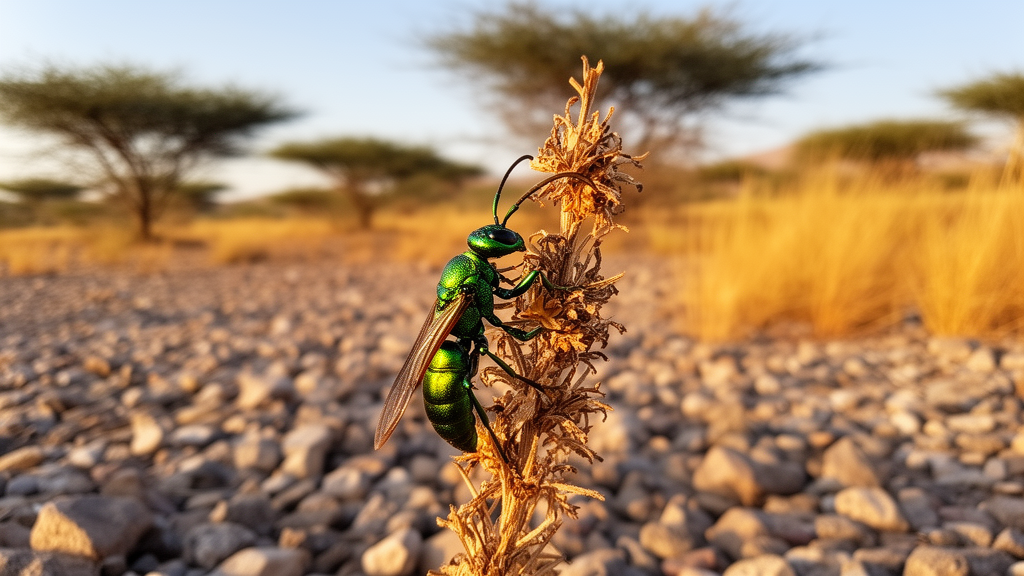
Deep in the limestone cuestas of central Saudi Arabia, a tiny black wasp has quietly rewritten the map of one of the world’s rarest insect genera. Researchers surveying the Ibex Protected Area south of Riyadh have discovered a previously unknown species of cuckoo wasp belonging to the genus Kimseya, a group so elusive that only a single species had ever been described anywhere on Earth. The new species, named Kimseya saudica in honor of the kingdom where it was found, is the first record of the genus in Saudi Arabia and only the second confirmed sighting in the entire Arabian Peninsula. The discovery, published in the Journal of Hymenoptera Research, transforms a genus once known from a handful of Central Asian specimens into a genuinely Middle Eastern story.
Cuckoo wasps, members of the family Chrysididae, are among the most dazzling insects in the animal kingdom, famous for their metallic, jewel-like bodies and their parasitic lifestyle. Like the birds that give them their name, they lay their eggs in the nests of other insects, typically solitary bees and wasps, letting the unwitting hosts raise their young. But Kimseya breaks the family mold in remarkable ways. Instead of glittering metallic colors, its body is dull black and non-metallic, covered with long, fine setae. Its fore wing veins and cells are almost completely reduced, its claws are simple rather than toothed, and its propodeum lacks the lateral teeth seen in many relatives. These unusual traits led the Russian entomologist Antropov to establish a separate tribe, Kimseyini, for the genus when he described the type species Kimseya boharti from Uzbekistan in 1995.
Antropov interpreted these characters as adaptations tied to a specialized way of life: hunting small-sized hosts and nesting in loose soil. He noted that numerous specimens of the tiny wasp genus Ammoplanellus were collected in the same sticky traps as Kimseya boharti, and suggested, by analogy with a similar association elsewhere, that Ammoplanellus might serve as its host. Because Kimseya was known only from a limited number of specimens representing a single species, its biology and ecology remain poorly known, making every new specimen a precious window into a hidden world.
The monotypic tribe did not survive scrutiny unchallenged. In a phylogenetic study, Carpenter questioned the validity of Kimseyini as a separate monobasic tribe, discussing the morphological similarity of Kimseya to the tribe Elampini and noting that the diagnostic differences proposed by Antropov were based largely on derived characters. Some of these characters, such as the non-metallic body and simple claws, are variable within Elampini. After examining the original type material, Rosa agreed with Carpenter’s interpretation and formally transferred Kimseya to Elampini. Rosa also reported the occurrence of undescribed species of Kimseya in the United Arab Emirates and suggested a close relationship between Kimseya and the genus Prochridium, though no further studies addressing this issue have been published to date.
The new discovery emerged from one of the Middle East’s most treasured natural landscapes. The Ibex Protected Area at Hawtat Bani Tamim covers approximately 1,867 square kilometers, about 180 kilometers south of Riyadh, and occupies a limestone cuesta in the central part of the Jabal Tuwayq escarpment. It is considered one of the few places in the Middle East where Arabian ibex and gazelles can be observed in their natural habitat, and it carries a long history of traditional conservation management that predates the establishment of the National Center of Wildlife. Under NCW management, regulated livestock grazing continues, and the reserve’s wildlife has been enriched through the reintroduction of idmi gazelles. The climate is generally arid, with extremely hot summers and cold winters, and although annual rainfall is low, runoff water accumulates in the wadi floors, where Acacia species dominate a relatively diverse plant community comprising approximately 265 plant species from 49 families.
It was here, among stands of desert thorn and milkweed beneath the Acacia canopy, that researchers deployed pitfall traps containing a 25 percent ethylene glycol solution. The traps were installed for three days during each of two consecutive months, May and June 2026, at four sites located outside and inside the core protected zone of the reserve. An additional female specimen turned up from Wadi Hanifah in Riyadh City, collected in December 2015 using the same method, extending the known range of the genus well beyond the reserve boundaries. All the collected material consisted of female specimens, and the male of the new species remains unknown.
The type material of Kimseya saudica is deposited in the King Saud University Museum of Arthropods in Riyadh. The holotype female was collected at site OUT-2 in the Ibex Protected Area on June 6, 2026, with paratypes from the same site and from sites OUT-4, IN-3, and OUT-3. To examine selected appendages, including the antennae, mandibles, wings, legs, and small sclerites such as the clypeus, a specimen was macerated in a 10 percent sodium hydroxide solution for approximately one hour, rinsed in distilled water, dehydrated through an ascending ethanol series, mounted on microscope slides, and dried in an incubator at 35 degrees Celsius for 24 hours prior to photography. Specimens were examined under a MEIJI EMZ-10 stereomicroscope at magnifications of up to 180 times, equipped with an ocular micrometer for measurements, and photographed using a Canon EOS 70D camera mounted on a LEICA MZ125 stereomicroscope, with image stacks generated using Helicon Focus software.
The new species closely resembles Kimseya boharti, the only previously described species of the genus, but can be distinguished by a combination of characters. The head and mesosoma of Kimseya saudica are covered with sparse short setae, whereas in Kimseya boharti the body is entirely covered with dense long fine setae. The clypeus of the new species is slightly trilobed apically, while that of Kimseya boharti is roundly to straightly truncate. The antennal sockets of the new species lack an interantennal tubercle, present in the Central Asian species, and the scape is 1.7 times as long as the pedicel, compared with 2.25 times in Kimseya boharti. The anal lobe of the hind wing is distinctly long and narrow, deeply incised at base, in contrast to the less developed, weakly incised anal lobe of Kimseya boharti. The third metasomal tergum is about one-third as long as the second, whereas in Kimseya boharti it is conspicuously short, only 0.07 to 0.15 times as long as the second tergum. The body length of the new species ranges from 1.25 to 1.40 millimeters, with a fore wing length of 1.00 to 1.15 millimeters, making it one of the tiniest wasps ever documented in the region.
In a crucial step for future research, DNA was extracted from two individual specimens at the Acarology Laboratory of King Saud University using the DNeasy Blood and Tissue Kit, following the manufacturer’s standard protocol with the exception that the specimens were initially immersed in lysis buffer containing proteinase K and incubated at 78 degrees Celsius for 72 hours. The cytochrome oxidase subunit I barcode fragment was amplified using the primers LCO1490 and HCO2198, and the PCR products were purified and sequenced at the Macrogen DNA sequencing facility in Seoul. The resulting sequences were compared against the NCBI-GenBank database using BLAST and deposited under accession numbers QB074708.1 and QB074709.1. These DNA sequences will facilitate future comparisons with other populations of the genus that may be discovered and provide molecular evidence for assessing morphological differences.
The discovery raises tantalizing questions about the true diversity and distribution of Kimseya. The undescribed species reported from the United Arab Emirates may represent a different undescribed taxon or could potentially be conspecific with the new species described here. With Kimseya now documented from Central Asia, the UAE, and Saudi Arabia, entomologists suspect that more species await discovery across the arid belt of the Middle East and Central Asia. The finding also underscores the value of protected areas such as the Ibex Reserve, where decades of conservation management have preserved the Acacia-dominated wadi ecosystems that harbor these minute wasps. For now, Kimseya saudica stands as a reminder that even in one of the most intensively studied insect orders, entire lineages can remain hidden beneath our feet, waiting for a pitfall trap in the right patch of desert to bring them into the light.
Subject of Research: Taxonomy and biogeography of the cuckoo wasp genus Kimseya in Saudi Arabia
Article Title: First record of the genus Kimseya Antropov, 1995 ( Hymenoptera , Chrysididae , Chrysidinae , Elampini ) in the Kingdom of Saudi Arabia, with the description of a new species
Article References: Soliman, A. M., Gadallah, N. S., & Al Dhafer, H. M. (2026). First record of the genus Kimseya Antropov, 1995 (Hymenoptera, Chrysididae, Chrysidinae, Elampini) in the Kingdom of Saudi Arabia, with the description of a new species. Journal of Hymenoptera Research, 99, 1137-1148. https://doi.org/10.3897/jhr.99.218111
Image Credits: AI Generated
Keywords: Kimseya, cuckoo wasps, Chrysididae, Hymenoptera, Saudi Arabia, Ibex Protected Area, new species, DNA barcoding, taxonomy, Arabian Peninsula, First, record
Cite Scienmag News
Margaret Porter. (October 19, 2026). New Cuckoo Wasp Species Discovered in Saudi Arabia’s Ibex Reserve. Scienmag. https://scienmag.com/new-cuckoo-wasp-species-discovered-in-saudi-arabias-ibex-reserve/
Margaret Porter. "New Cuckoo Wasp Species Discovered in Saudi Arabia’s Ibex Reserve." Scienmag, 19 October 2026, https://scienmag.com/new-cuckoo-wasp-species-discovered-in-saudi-arabias-ibex-reserve/. Accessed 19 October 2026.
Margaret Porter. "New Cuckoo Wasp Species Discovered in Saudi Arabia’s Ibex Reserve." Scienmag. October 19, 2026. https://scienmag.com/new-cuckoo-wasp-species-discovered-in-saudi-arabias-ibex-reserve/


