


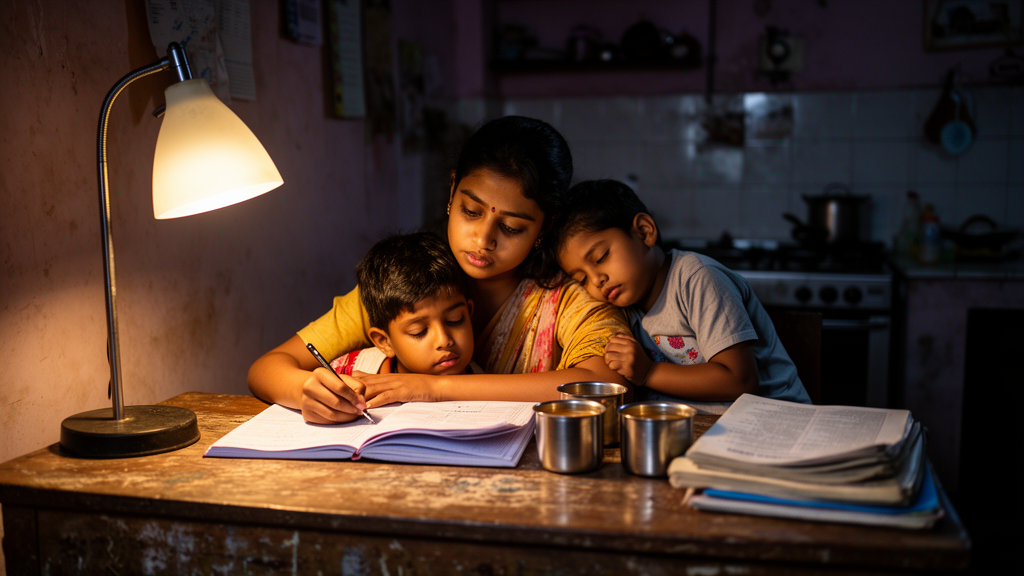
The eldest child in a family has long occupied a special place in psychological theory, from Alfred Adler’s early writings on birth order to modern debates about whether sibling position shapes personality at all. A new exploratory study from India adds a culturally specific twist to that conversation, suggesting that in Indian families the experience of being the firstborn is filtered through collectivist norms and sharply gendered expectations. The research, published in SN Social Sciences by Janet Fernandes of St. Xavier’s College in Goa and Meryl De Souza, examines what the authors call Eldest Child Syndrome as a multidimensional psychological construct, and its findings point to a striking dual pathway: the same family dynamics that burden eldest children with adult responsibilities may also forge unusual resilience, particularly in daughters.
The study surveyed 100 young adults aged 18 to 25, evenly split between 50 males and 50 females, drawn from urban and semi-urban backgrounds across India. Participants completed validated psychometric instruments measuring five psychological dimensions: parentification, perfectionism, self-sacrifice, self-esteem, and resilience. Parentification refers to a role reversal in which a child takes on caregiving or emotional responsibilities that ordinarily belong to parents, a phenomenon long described in family systems theory since Salvador Minuchin’s foundational work on family structure. Perfectionism was assessed as the tendency toward excessively high standards, self-sacrifice as the suppression of personal needs in favor of others, and the scales included the Rosenberg Self-Esteem Scale and the Brief Resilience Scale, which measures the ability to bounce back from adversity.
The most eye-catching result concerns gender. Eldest daughters reported significantly higher resilience scores than eldest sons, with a medium effect size of d = 0.45 and a p-value of .04. The authors interpret this through the lens of the culturally anticipated second-mother role, the expectation in many Indian households that the first daughter will help raise younger siblings, manage household tasks, and absorb family duties from an early age. Rather than simply crushing the daughters who carry this load, the data suggest that the role may cultivate adaptive, survival-oriented coping strategies. This aligns with a growing body of qualitative work on Indian elder daughters, including a 2025 study published in the International Journal of Indian Psychology that documented how role responsibilities shape mental health, and with research on South Asian adults showing that parentification can carry both costs and growth.
But the study is equally clear that this resilience comes at a price. Parentification emerged as a strong negative predictor of self-esteem, with a standardized coefficient of β = -1.12 and p = .01, and it also negatively predicted resilience, with β = .42 and p = .03. In plain terms, the more a young adult reported having been forced into a parental role as a child, the lower their self-worth and their capacity to recover from stress. The finding confirms what clinicians have long suspected: parentification is a psychological risk factor, not a benign rite of passage. Earlier research by Hooper and colleagues on the Parentification Inventory and on race, ethnicity, and gender in parentification had already hinted at these associations, but the present study grounds them in the specific context of Indian family expectations.
The statistical architecture of the study reveals an intricate web of relationships among the five dimensions. Resilience turned out to be the strongest positive predictor of self-esteem, with β = 2.45 and p = .001, functioning as a key buffer against family-induced stress and perfectionism. Perfectionism itself showed a marginally negative association with self-esteem, consistent with a large literature linking maladaptive perfectionism to depression and anxiety in children and adolescents. Meanwhile, parentification was significantly correlated with higher levels of self-sacrifice, with r = 0.36 and p = .001, indicating a systemic suppression of personal needs in favor of family welfare. The picture that emerges is of eldest children who internalize the family’s demands, sacrifice their own priorities, and then rely on hard-won resilience to protect whatever self-esteem survives the process.
The authors frame this as a dual pathway in which parentification operates as a risk factor and resilience operates as a protective factor simultaneously. This framing matters because it resists a simple narrative. Eldest children in collectivist cultures are neither purely victims of family structure nor purely beneficiaries of it. They are participants in a system that assigns them responsibility early, holds them to high standards, and then rewards them with a form of psychological toughness that may or may not compensate for the erosion of self-worth. The gender difference in resilience adds another layer: the second-mother role appears to train coping capacities that eldest sons, who face different and arguably lighter expectations, do not develop to the same degree.
The cultural context is essential to interpreting these numbers. In much of the birth-order literature, particularly large studies from Western samples, the effects of sibling position on personality are small or inconsistent, and some researchers have argued that birth order effects are largely statistical noise. The Indian case may be different because birth order is not merely a demographic variable but a social role with explicit duties attached. Sociological work on discrimination and development in Asia, and psychological research on the cultural notion of training in Chinese and other collectivist parenting traditions, suggest that firstborn status in such contexts carries normative weight that individualist frameworks do not capture. The present study’s finding that eldest daughters show higher resilience but also higher self-sacrifice fits this pattern precisely.
Perfectionism deserves particular attention in this framework. Previous research has shown that parental expectations and fear of negative evaluation among Indian emerging adults are mediated by maladaptive perfectionism, and that perfectionism is transmitted across generations through parents’ psychological control. The present study adds that perfectionism is woven into the eldest child’s experience alongside parentification and self-sacrifice, forming a cluster of family-driven pressures. The marginally negative association between perfectionism and self-esteem suggests that the drive to meet impossibly high standards, often instilled by family expectations about academic and personal achievement, quietly undermines the very self-worth that eldest children are expected to project.
The study’s limitations are worth noting, as the authors themselves position it as preliminary and exploratory. The sample of 100 participants is modest, the design is cross-sectional rather than longitudinal, and the reliance on self-report questionnaires means the findings capture perceptions rather than objectively observed family dynamics. The statistical coefficients, particularly the large negative β for parentification predicting self-esteem, should be interpreted with caution in a sample of this size. Nevertheless, the effect sizes for the gender difference in resilience and the correlation between parentification and self-sacrifice fall within conventional ranges for psychological research, and the use of validated instruments lends credibility to the pattern.
The practical implications point toward culturally sensitive, family-systems-informed interventions to support the psychological well-being of eldest children. Rather than treating parentification as pathology in isolation, or celebrating resilience without examining its costs, the authors argue that clinicians and educators should recognize how collectivist norms and gendered expectations shape the eldest child’s psychological landscape. For the millions of eldest daughters who have grown up as second mothers, the research offers both validation and warning: the strength they carry is real, but so is the quiet toll it exacts. Understanding that duality, the authors suggest, is the first step toward helping eldest children thrive without requiring them to disappear into their family roles.
Subject of Research: Gender differences in resilience, parentification, perfectionism, self-sacrifice, and self-esteem among eldest children in Indian families
Article Title: Gender and relational dynamics in eldest child syndrome: an exploratory multidimensional study from India
Article References: Fernandes, J., & De Souza, M. (2026). Gender and relational dynamics in eldest child syndrome: an exploratory multidimensional study from India. SN Social Sciences, 6(9), Article 387. https://doi.org/10.1007/s43545-026-01647-7
Image Credits: AI Generated
DOI: 10.1007/s43545-026-01647-7
Keywords: eldest child syndrome, parentification, resilience, self-esteem, perfectionism, self-sacrifice, birth order, gender differences, Indian families, collectivist culture, family systems, young adults
Cite Scienmag News
Glenn Wilkins. (October 19, 2026). Eldest Daughters in India Show Higher Resilience but Pay a Hidden Psychological Price. Scienmag. https://scienmag.com/eldest-daughters-in-india-show-higher-resilience-but-pay-a-hidden-psychological-price/
Glenn Wilkins. "Eldest Daughters in India Show Higher Resilience but Pay a Hidden Psychological Price." Scienmag, 19 October 2026, https://scienmag.com/eldest-daughters-in-india-show-higher-resilience-but-pay-a-hidden-psychological-price/. Accessed 19 October 2026.
Glenn Wilkins. "Eldest Daughters in India Show Higher Resilience but Pay a Hidden Psychological Price." Scienmag. October 19, 2026. https://scienmag.com/eldest-daughters-in-india-show-higher-resilience-but-pay-a-hidden-psychological-price/


