


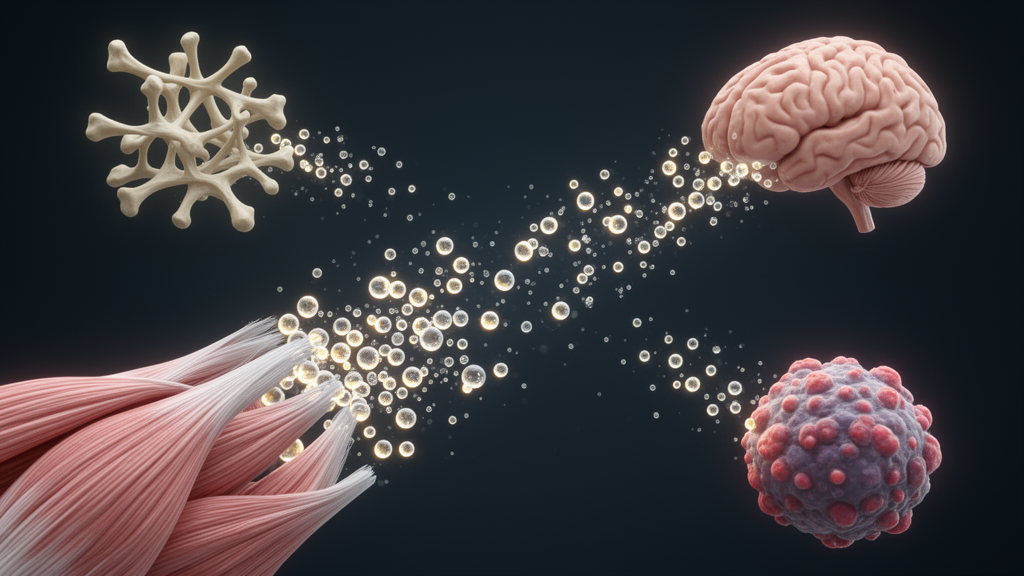
Skeletal muscle has long been appreciated as the body’s largest organ, essential for movement, metabolism, and overall physiological stability. But over the past decade, researchers have come to view muscle as something more: a secretory organ that talks to the rest of the body. A new review published in Aging Cell synthesizes a rapidly growing body of evidence showing that skeletal muscle packages molecular instructions into tiny membrane-bound particles called extracellular vesicles, or EVs, and ships them through the bloodstream to distant tissues. During aging, the authors argue, this vesicular communication system is progressively remodeled, and the consequences may reach far beyond the muscle itself, influencing bone loss, brain health, and even tumor growth.
Extracellular vesicles are small, membrane-delimited particles released by virtually all cell types. Unlike soluble signaling molecules such as myokines, which have traditionally dominated models of muscle-to-organ communication, EVs carry complex cargo: proteins, lipids, nucleic acids, and metabolites that reflect the physiological state of the cell that produced them. When a muscle cell releases an EV, it is effectively exporting a molecular snapshot of its own condition. Recipient cells can take up these vesicles and alter their behavior in response, making EVs a sophisticated channel for interorgan dialogue rather than a one-way broadcast of isolated chemical messengers.
The evidence that muscle EVs actually circulate is now solid. Using a myofiber-specific fluorescent reporter mouse, researchers demonstrated that vesicles released by skeletal muscle fibers reach the blood. Complementary work linked mechanical loading of muscle to the delivery of EV-associated microRNA-1 to white adipose tissue, where it promoted lipolysis. Within muscle itself, satellite cells, the resident stem cells responsible for repair, release vesicles that carry microRNA-206 to fibrogenic neighbors, restraining excessive scar tissue formation during muscle growth. These local interactions established the groundwork for asking whether muscle EVs could also act at a distance.
The clearest proof of concept for long-range EV signaling comes from the muscle-bone axis. In cell culture, vesicles from muscle cells were shown to promote osteogenic differentiation of bone precursor cells by delivering microRNA-27a-3p, which activates beta-catenin signaling. More strikingly, in vivo studies identified skeletal muscle-derived EVs that enter the circulation, home to bone, and are taken up by bone marrow stromal cells, where they deliver glycolytic enzymes such as lactate dehydrogenase A to boost energy metabolism and protect mice from disuse osteoporosis. Crucially, this communication channel is state-dependent: vesicles from atrophic muscle do the opposite, suppressing bone-forming activity in osteoblasts. Muscle-targeted blockade of EV generation in atrophic animals restored osteoblast function and alleviated bone loss, demonstrating that the same route can carry either supportive or destructive messages depending on the condition of the sending muscle.
The muscle-brain axis is younger but advancing quickly. In defined culture systems, vesicles from muscle cells enhanced survival and neurite outgrowth of motor neuron-like cells. An engineered neuromuscular tissue model showed that innervation and glutamate stimulation increase EV release from muscle and alter exosomal microRNA cargo, and that the resulting vesicles boost neuronal network activity, dendritic branching, and axonal transport in hippocampal cultures. In a separate injury model, preconditioning exercise increased exosomal microRNA-484, derived mainly from skeletal muscle, which reduced neuronal ferroptosis after ischemic brain injury by suppressing the ACSL4 pathway. Muscle-derived exosomes were tracked to the ischemic penumbra and taken up by neurons, and blocking muscle production of the microRNA weakened the neuroprotective effect of exercise. In an Alzheimer’s disease mouse model, exercise-induced muscle EVs were taken up by microglia, promoting a disease-associated state that enhanced amyloid-beta plaque clearance through microRNA-378a-3p-mediated regulation of lipid metabolism.
Tumor cells appear to be listening as well. In vitro, vesicles from differentiated muscle cells were taken up by lung carcinoma cells and reduced their viability, proliferation, and migration while increasing markers of apoptosis, with proteomic analysis identifying decorin as an enriched cargo candidate. More directly, recent work in Drosophila and mouse cancer models showed that healthy skeletal muscle releases vesicles with tumor-suppressive activity, partly mediated by microRNA-7a-5p inhibition of TEAD1 signaling in tumor cells. Muscle cell-derived vesicles have also been shown to dampen inflammatory gene expression in cultured macrophages by increasing IRG1 expression and itaconate production, hinting at an immunoregulatory dimension to the system, though whether this occurs in distal tissues during aging remains untested.
Aging, the review argues, remodels this entire communication network at three levels: vesicle production, cargo composition, and downstream effects on recipient cells. In human primary muscle cells, vesicles from older donors showed altered proteomic and biochemical signatures, including enrichment of proteins tied to oxidative stress and DNA and RNA mutagenesis, even when basic vesicle parameters looked normal. In the bone axis, age-related shifts are well documented: a muscle-associated circulating vesicle population carries increased microRNA-34a with age, promoting senescence in bone marrow stromal cells, while vesicles from aged or atrophic muscle deliver microRNA-125a-5p, which suppresses the Sirt7-Sp7 osteogenic axis in osteoblasts. In the tumor axis, sarcopenic muscle secretes fewer vesicles with altered cargo, losing the protective microRNA-7a-5p signal, a decline traced to an age-sensitive NOTCH-SDC2 pathway that governs muscle EV biogenesis.
Exercise emerges as the most promising physiological countermeasure. In the Alzheimer’s model, swimming-induced muscle vesicles enhanced microglial plaque clearance and improved cognition, and vesicles engineered to overexpress microRNA-378a reproduced the cognitive benefit when administered directly, a proof of principle that protective exercise signals can be mimicked. Resistance training in older adults increased several circulating EV-associated microRNAs toward youthful levels, while in aged mice exercise restored NOTCH-SDC2 signaling, boosted vesicle release and microRNA-7a-5p cargo, and reduced tumor growth. Metabolic state matters too: overexpression of PGC-1alpha in human myotubes enriched vesicles with antioxidant-related messenger RNAs that enhanced protective responses in cultured endothelial cells, suggesting that donor-cell metabolism shapes cargo and function. Additional mechanistic leads include EV-associated mitochondrial DNA engaging cGAS-STING signaling in recipient cells, and stress-driven unfolded protein response pathways in muscle altering vesicle cargo, both flagged as priorities for future investigation.
The therapeutic implications cut in two directions. Protective vesicular signals that decline with age could be restored or mimicked, as the microRNA-378a experiment demonstrates. Maladaptive signals from aged muscle could be selectively blocked, as shown by cargo-directed interventions that preserved bone formation. But the authors caution that broad suppression of EV production is risky, since the same vesicles can carry beneficial cargo for bone, brain, and tumor defense. Rigorous methodology is also essential: different isolation techniques recover different mixtures of vesicles and non-vesicular material, and confirming that vesicles truly originate from muscle, reach the proposed recipient cells, and account for observed effects remains the central challenge. As the field matures, skeletal muscle-derived extracellular vesicles may prove to be not just biomarkers of aging, but rational intervention targets for the multi-organ decline that accompanies it.
Subject of Research: Skeletal muscle-derived extracellular vesicles as mediators of interorgan communication during aging
Article Title: Skeletal Muscle‐Derived Extracellular Vesicles in Interorgan Communication During Aging
Article References: Jiang, W., Chua, K., Young, J., Tan, E. K., & Tang, H.-W. (2026). Skeletal Muscle‐Derived Extracellular Vesicles in Interorgan Communication During Aging. Aging Cell, 25(10), Article e70773. https://doi.org/10.1111/acel.70773
Image Credits: AI Generated
DOI: 10.1111/acel.70773
Keywords: extracellular vesicles, skeletal muscle, aging, sarcopenia, muscle-bone crosstalk, muscle-brain axis, tumor suppression, microRNA, exercise, osteoporosis, Alzheimer's disease, exosomes
Cite Scienmag News
Cassandra Pierce. (October 19, 2026). Aging Muscle Sends Molecular Messages Through Tiny Vesicles, Reshaping Bone, Brain, and Tumor Defenses. Scienmag. https://scienmag.com/aging-muscle-sends-molecular-messages-through-tiny-vesicles-reshaping-bone-brain-and-tumor-defenses/
Cassandra Pierce. "Aging Muscle Sends Molecular Messages Through Tiny Vesicles, Reshaping Bone, Brain, and Tumor Defenses." Scienmag, 19 October 2026, https://scienmag.com/aging-muscle-sends-molecular-messages-through-tiny-vesicles-reshaping-bone-brain-and-tumor-defenses/. Accessed 19 October 2026.
Cassandra Pierce. "Aging Muscle Sends Molecular Messages Through Tiny Vesicles, Reshaping Bone, Brain, and Tumor Defenses." Scienmag. October 19, 2026. https://scienmag.com/aging-muscle-sends-molecular-messages-through-tiny-vesicles-reshaping-bone-brain-and-tumor-defenses/


