


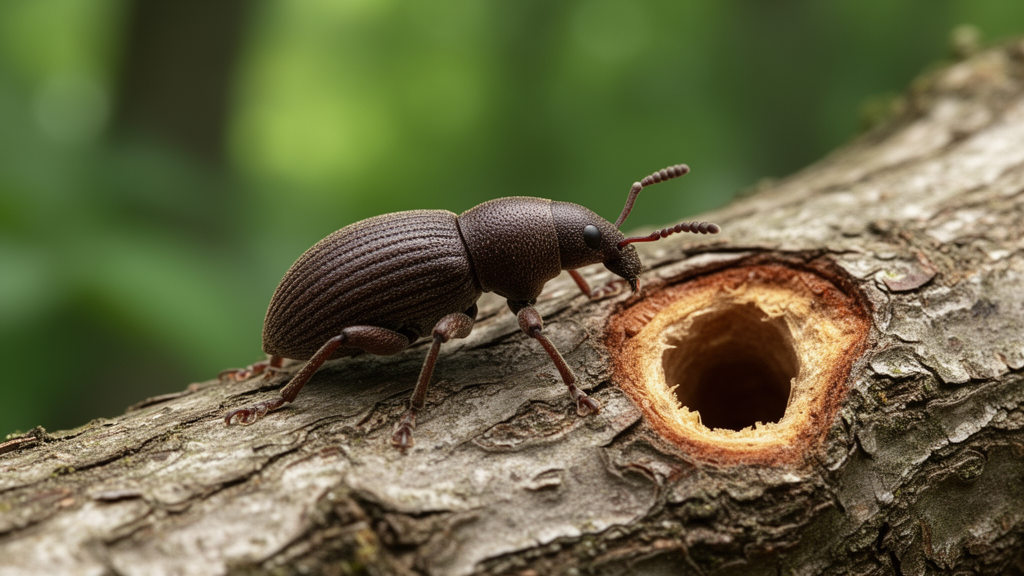
Deep in the forests of Africa and Madagascar lives a group of beetles so strange that early entomologists debated whether they even belonged among bark beetles at all. The Afrotropical genus Xyloctonus, a lineage of tiny weevils in the subfamily Scolytinae, has now received its first full modern treatment: a complete revision integrating taxonomy, field biology and Bayesian biogeography, published in the Deutsche Entomologische Zeitschrift. The study, led by Norwegian researcher Bjarte Jordal of the University Museum in Bergen, describes two new species, sinks two old names into synonymy, and leaves the genus at fifteen valid species. But the real headline is what the beetles themselves revealed: a peculiar body plan built for one purpose, surviving the most dangerous moment of a bark beetle’s life, mating in full view on the outside of a tree.
Xyloctonus belongs to the tribe Xyloctonini, a group of tropical bark beetles whose members look almost nothing like the average scolytine. The pronotum, the shield-like plate covering the first thoracic segment, is rounded and inflated like a sphere in both lateral and frontal view. The protibiae, the shins of the front legs, carry a deep groove on their anterior face into which the tarsi can be retracted completely. The metathorax bears impressed lateral sclerites that receive the flattened femur and tibiae of the hind legs, and the ventrites of the abdomen rise steeply to meet the elytra. Such extreme specialisation led some nineteenth and twentieth century authors to elevate these beetles to their own subfamily, Xyloctoninae, or even their own family, Xyloctonidae. Modern morphology places them firmly within Scolytinae, but their deviant body shape remains among the most specialised in the entire subfamily.
The reason for this armour-plated compactness became clear during field observations. Xyloctonus males run fast across the bark surface in search of females that are excavating new tunnel openings. Mating occurs at the tunnel entrance, with only the posterior part of the female exposed and the male guarding the opening against rival males. This is a highly exposed situation on the trunk or branch surface, where predatory ants and even insectivorous birds pose a constant threat. When disturbed, the beetles retract their tarsi into the deep tibial grooves, tuck their legs into the thoracic depressions, and fall off the log with impressive reaction speed. Every morphological oddity, from the spherical pronotum to the grooved tibiae and the split, trifid or plumose setae on the thoracic sclerites, reflects an adaptation to predator avoidance during these exposed phases of the life cycle.
The behavioural observations carried a further surprise. In every species where broods were dissected, both parents abandoned the nest under the bark at an early stage of progeny development. Males typically left before the eggs even hatched, and females departed later but usually well before the young teneral adults appeared. In Xyloctonus maculatus, males were seen establishing new nests on the same log after leaving a previous brood, suggesting that the early escape allows additional matings. The authors interpret this as a trade-off: the aggressive external mating carries a high predation risk, and the potential for multiple matings may compensate for it. Limited parental care also fits with the generally low brood sizes observed, ranging from about 12 to 50 larvae depending on the species, compared with the higher averages typical of other bark beetles.
Host preferences proved remarkably narrow. Most species have a clear preference for trees in the plant family Sapotaceae, the sapodilla family, and six of the ten species with known host records were taken from sapotaceous plants. Xyloctonus scolytoides, the only species collected frequently and broadly across tropical Africa, breeds in many hosts including Butyrospermum parkii, Madhuca latifolia and Mimusops caffra, all Sapotaceae, alongside occasional records from Olea, Garcinia and Acacia. Xyloctonus maculatus and X. pubifer were repeatedly collected from Sideroxylon inerme in South Africa, while X. biseriatus in Madagascar bred in thin Diospyros branches. This level of specialisation is typical for true bark beetles, in contrast to the broader host ranges of ambrosia beetles, and the repeated records from the same hosts across distant localities indicate that the pattern is real rather than an artefact of rare collecting.
The taxonomic work itself relied on type material from eleven major museum collections across Europe and North America, from London and Paris to Vienna, Berlin and Washington. Careful dissection of recently dead wood and lianas allowed reconstruction of family structures and brood size, with notes on whether egg tunnels ran parallel or transverse to the wood grain, a species-specific trait. Two new species entered the catalogue: Xyloctonus magnus, the largest species in the genus at 3.4 millimetres, from Madagascar, distinguished by a heart-shaped, densely pilose scutellar shield and dense fine trifid setae; and Xyloctonus genieri, a 1.6 millimetre black beetle from very dry bushland in Burkina Faso, named after coleopterist François Génier who collected the type in a Malaise trap. Two synonymies were proposed: X. striatus Eggers, 1939 falls under X. subcostatus Eggers, 1939, and X. latus Eggers, 1922 under X. scolytoides Eichhoff, 1872. An illustrated identification key with photographs of most species now allows reliable species determination.
The biogeographical analysis delivered the study’s most unexpected result. Using a time-calibrated phylogenetic tree built from mitochondrial COI and nuclear 28S and EF-1α sequences, with clade ages estimated in Beast and calibrated against an 18-gene analysis of Scolytinae, ancestral areas were reconstructed in RASP using one million iterations of the Bayesian Binary MCMC method. The outcome pointed to a possible origin of Xyloctonus in Madagascar in the early Eocene, roughly 52 to 45 million years ago, with subsequent colonisation of the southern African region no later than 31 million years ago in the late Eocene. This is the reverse of the pattern shown by the closely related xyloctonine genus Ctonoxylon, which revealed a Congolian ancestry some 64 to 47 million years ago and reached Madagascar multiple times, no earlier than about 13 to 16 million years ago during the late Miocene. The sister genus Glostatus, which never settled on Madagascar, showed a strongly supported Zambesian ancestry around 82 to 68 million years ago.
The direction of dispersal matters because prevailing trade winds blowing primarily eastward have long been invoked to explain colonisation of Madagascar by non-volant animals. Xyloctonus fits that eastward scenario neatly, colonising southern Africa from Madagascar in a pattern known from several other scolytine beetle groups. But Ctonoxylon demonstrates the opposite, reaching Madagascar from the African mainland three independent times, and the authors argue that insects are not influenced by historical trade winds to the same degree as non-flying animals. Windborne plant seeds show similar variability, suggesting that prevailing wind systems may have varied more than postulated. Not every insect group managed the crossing at all: Glostatus occupies rather similar ecological niches on the African continent yet never reached the island, a reminder that dispersal ability, not just wind direction, shapes these distributions.
Restricted host use goes hand in hand with limited geographical ranges and high endemism. Of the fifteen recognised species, only four have distributions spanning two or more biogeographical regions, and only one has trustworthy records from both western and eastern to southern Africa. The core distribution lies in the Zambesian region, with four species endemic to Madagascar and one, Xyloctonus mauritianus, confined to Mauritius. One limitation acknowledged in the study is that many older samples from the Zambesian region were unsuitable for DNA sequencing, constraining the biogeographical inference. Even so, the contrast between the two genera was unequivocal, and broader sampling is expected to further confirm a single ancient Eocene colonisation of Madagascar by Xyloctonus.
The revision also touched on a subtler puzzle: plastic dimorphism in a stridulatory apparatus. A stridulatory file, the pars stridens, is sometimes present on the upper frons or vertex of males, but its occurrence varies in size and distinctness. Menier reported the feature in male X. quadridens, yet none of the newly collected males had it, despite carrying a unique femoral spine. Multiple series of X. subcostatus showed that at least some males exhibit a pars stridens reported here for the first time, while X. aethiops has a partially developed and likely false version. The authors cannot exclude the possibility that cryptic species differing in their stridulatory apparatus exist, although identical morphology elsewhere argues against it. Testing that hypothesis, they note, will require DNA from multiple populations. For now, fifteen species, two new names, an ancient Malagasy origin and a body plan engineered for falling off trees stand as the definitive portrait of one of Africa’s most peculiar bark beetle lineages.
Subject of Research: Integrated taxonomy, biology and biogeography of the Afrotropical genus Xyloctonus (Coleoptera, Curculionidae, Scolytinae)
Article Title: Integrated taxonomy, biology and biogeography of the Afrotropical genus Xyloctonus ( Coleoptera , Curculionidae , Scolytinae )
Article References: Jordal, B. H. (2024). Integrated taxonomy, biology and biogeography of the Afrotropical genus Xyloctonus (Coleoptera, Curculionidae, Scolytinae). Deutsche Entomologische Zeitschrift, 71(1), 67-84. https://doi.org/10.3897/dez.71.116185
Image Credits: AI Generated
Keywords: Integrated, taxonomy, biology, biogeography, Afrotropical, genus, Xyloctonus, Coleoptera, Curculionidae, Scolytinae, scientific research
Cite Scienmag News
Gavin Prescott. (October 19, 2026). Integrated taxonomy, biology and biogeography of the Afrotropical genus Xyloctonus (Coleoptera, Curculionidae, Scolytinae). Scienmag. https://scienmag.com/integrated-taxonomy-biology-and-biogeography-of-the-afrotropical-genus-xyloctonus-coleoptera-curculionidae-scolytinae/
Gavin Prescott. "Integrated taxonomy, biology and biogeography of the Afrotropical genus Xyloctonus (Coleoptera, Curculionidae, Scolytinae)." Scienmag, 19 October 2026, https://scienmag.com/integrated-taxonomy-biology-and-biogeography-of-the-afrotropical-genus-xyloctonus-coleoptera-curculionidae-scolytinae/. Accessed 19 October 2026.
Gavin Prescott. "Integrated taxonomy, biology and biogeography of the Afrotropical genus Xyloctonus (Coleoptera, Curculionidae, Scolytinae)." Scienmag. October 19, 2026. https://scienmag.com/integrated-taxonomy-biology-and-biogeography-of-the-afrotropical-genus-xyloctonus-coleoptera-curculionidae-scolytinae/


