


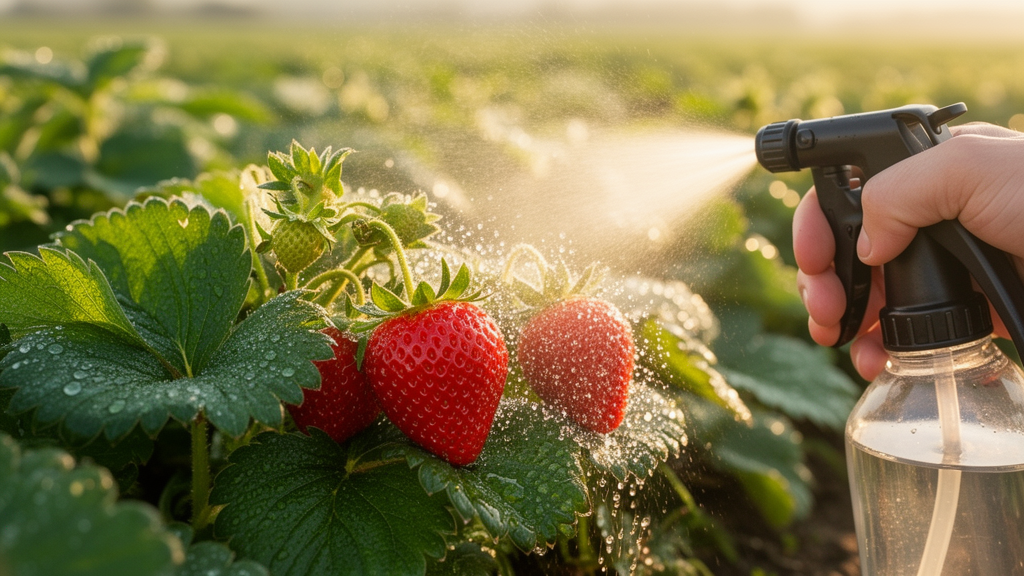
Strawberry growers facing tightening water supplies may soon have a new ally in an unexpected place: a small sulfur-containing molecule that plants already make on their own. A new study from Urmia University in Iran, published in BMC Plant Biology, reports that spraying strawberry plants with glutathione—a tripeptide best known in human nutrition circles as a master antioxidant—can substantially blunt the damage caused by deficit fertigation, the practice of deliberately supplying less water and nutrient solution than a crop would ideally receive. The findings arrive at a moment when greenhouse producers across arid regions are being pushed to reconcile high-value production with shrinking water budgets.
The research team, led by Parinaz Mohammadpour with colleagues Hamid Hassanpour and Karim Manda-Hakki from the Department of Horticultural Sciences, worked with the commercial strawberry cultivar Sabrina, a variety prized for its vigor and fruit quality. Their experimental design was deliberately straightforward but rigorous: a factorial completely randomized setup in which plants received either 160 or 200 milliliters of nutrient solution per plant every other day, crossed with foliar glutathione applications at zero, 500, or 1000 micromolar concentrations. The lower fertigation volume imposed the deficit condition, while the higher volume served as the full-fertigation control. This structure allowed the researchers to separate the effects of water limitation from the effects of the antioxidant treatment, and—crucially—to test whether the two interacted.
The results confirmed what deficit-irrigation growers already know from experience: cutting the fertigation volume significantly impaired plant performance. Water and nutrient scarcity constrains photosynthesis, and when the photosynthetic apparatus cannot dissipate absorbed light energy efficiently, electrons leak to oxygen and generate reactive oxygen species. These molecules—superoxide, hydrogen peroxide, and hydroxyl radicals among them—attack membranes, proteins, and DNA. One of the classic fingerprints of this assault is lipid peroxidation, the oxidative degradation of membrane lipids, which is routinely quantified by measuring malondialdehyde, or MDA, a degradation product that accumulates as peroxidation proceeds. In the deficit-treated plants, oxidative damage markers rose and yield-related attributes declined, exactly the pattern the team expected.
Glutathione treatment, however, changed the picture dramatically. When plants were sprayed with the tripeptide, their internal antioxidant machinery responded as if a signal had been sent to stand up the defenses. The activities of four key enzymes rose significantly: superoxide dismutase, which converts superoxide radicals into hydrogen peroxide; catalase, which breaks hydrogen peroxide down into water and oxygen; ascorbate peroxidase, which uses ascorbic acid to neutralize hydrogen peroxide inside the chloroplast and cytosol; and guaiacol peroxidase, a broad-spectrum peroxidase active in the cell wall and vacuole. At the same time, MDA accumulation dropped and polyphenol oxidase activity fell, both indicating that membranes were suffering less peroxidative damage and that oxidative browning reactions were being held in check.
The biochemical consequences extended beyond enzyme activities into the fruit itself. Glutathione application significantly increased total anthocyanin content—the pigments responsible for the deep red color of ripe strawberries and a major component of their nutritional appeal—along with ascorbic acid, the vitamin C that strawberries are famous for delivering. It also boosted DPPH scavenging activity, a laboratory measure of how effectively fruit extracts neutralize a stable synthetic free radical, which serves as a proxy for overall antioxidant capacity in the harvested product. Interestingly, not every antioxidant metric moved: total phenolics, total flavonoids, and FRAP values—another ferric-reducing antioxidant power assay—showed no significant response to glutathione. This selectivity suggests the tripeptide is not simply flooding the plant with generic reducing power but is instead steering specific branches of the phenylpropanoid and redox pathways.
Perhaps the most technically interesting aspect of the study is what the authors describe as concentration-dependent and non-linear effects. There was no single glutathione dose that won across the board. Yield and MDA reduction responded best to 500 micromolar glutathione under full fertigation at 200 milliliters. DPPH scavenging activity peaked at 500 micromolar under the deficit regime at 160 milliliters. Total anthocyanin content reached its maximum at 1000 micromolar under deficit conditions, while ascorbic acid was highest at 1000 micromolar under full fertigation. In other words, the optimal treatment depended on which trait a grower cared about most and how much water was actually available—a nuance that complicates any simple prescription but also opens the door to precision-targeted applications.
This trait-specificity has real implications for how the findings translate to the field. A producer whose priority is maximizing marketable yield under full irrigation would choose a different glutathione regimen than one growing under water restrictions who wants to preserve fruit color and antioxidant content. The non-linear dose response also hints at the underlying biology: glutathione is not merely a passive antioxidant sponge but a redox-active signaling molecule that participates in the glutathione-ascorbate cycle, in S-glutathionylation of proteins, and in the regulation of transcription factors that orchestrate stress responses. At moderate concentrations it appears to prime these systems optimally; at higher concentrations the benefits shift toward specific quality attributes rather than broad physiological performance, suggesting that excess glutathione may perturb the very redox balance it is meant to stabilize.
The study also fills a gap in the literature on redox-active compounds under deficit fertigation. While glutathione has been studied extensively as a stress mitigator in model plants and in a range of crops under drought, salinity, and heavy metal stress, its role specifically under controlled greenhouse fertigation regimes—where water and nutrients are delivered together in precise volumes—had remained insufficiently characterized. Fertigation is the backbone of modern protected agriculture, from soilless strawberry gutters in commercial greenhouses to substrate culture in vertical farming systems, so understanding how antioxidant supplements interact with fertigation volume is directly relevant to the industry’s most common production method.
For growers, the practical takeaway is that a relatively inexpensive, commercially available molecule applied as a foliar spray can preserve both the physiological performance and the nutritional quality of strawberries when water is scarce. For researchers, the study raises questions about the mechanisms driving the non-linear responses—whether they reflect saturation of glutathione transporters, feedback inhibition of glutathione biosynthesis, or shifts in how the plant allocates reducing equivalents between growth and defense. Either way, the work adds strawberries to the growing list of horticultural crops where exogenous glutathione has demonstrated tangible benefits under water-limited conditions, and it provides a quantitative framework—specific concentrations paired with specific fertigation volumes—that future trials can build on.
As climate variability intensifies and competition for freshwater resources grows, strategies that let crops maintain productivity and quality with less water will only become more valuable. This study suggests that one such strategy may be as simple as spraying plants with a molecule they already possess, at the right dose, at the right moment. The strawberry, already one of the world’s most beloved fruits, may owe its resilience in the greenhouses of tomorrow to a tripeptide that has been quietly defending cells since the dawn of aerobic life.
Subject of Research: Plant Biology
Article Title: Exogenous glutathione enhances antioxidant defense, physiological performance and fruit quality of strawberry under deficit fertigation
Article References: Mohammadpour, P., Hassanpour, H., & Manda-Hakki, K. (2026). Exogenous glutathione enhances antioxidant defense, physiological performance and fruit quality of strawberry under deficit fertigation. BMC Plant Biology. https://doi.org/10.1186/s12870-026-10166-9
Image Credits: AI Generated
DOI: 10.1186/s12870-026-10166-9
Keywords: strawberry, glutathione, deficit fertigation, antioxidant enzymes, reactive oxygen species, anthocyanin, ascorbic acid, lipid peroxidation, plant stress, horticulture, BMC Plant Biology, water stress
Cite Scienmag News
Alan Morgan. (October 18, 2026). Glutathione Spray Shields Strawberries From Water Stress and Boosts Fruit Quality. Scienmag. https://scienmag.com/glutathione-spray-shields-strawberries-from-water-stress-and-boosts-fruit-quality/
Alan Morgan. "Glutathione Spray Shields Strawberries From Water Stress and Boosts Fruit Quality." Scienmag, 18 October 2026, https://scienmag.com/glutathione-spray-shields-strawberries-from-water-stress-and-boosts-fruit-quality/. Accessed 18 October 2026.
Alan Morgan. "Glutathione Spray Shields Strawberries From Water Stress and Boosts Fruit Quality." Scienmag. October 18, 2026. https://scienmag.com/glutathione-spray-shields-strawberries-from-water-stress-and-boosts-fruit-quality/


