


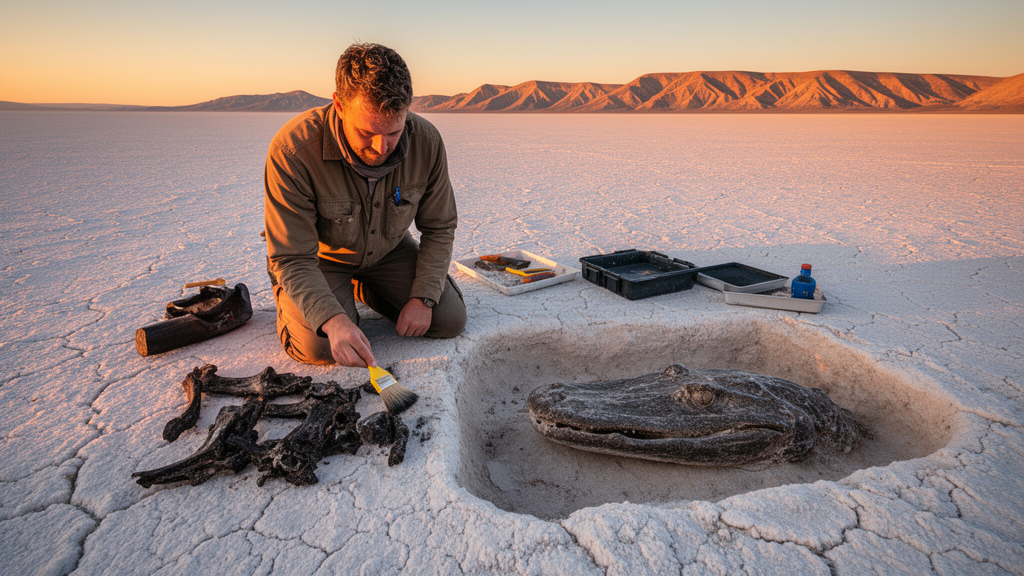
Some of the most dramatic evolutionary surprises come not from spectacular new excavations but from forgotten drawers in museum collections. A new study published in Fossil Record reports exactly that kind of surprise: a re-examination of fragmentary amphibian fossils from the Grabfeld Formation of southern Germany has revealed an unexpectedly rich community of temnospondyls living in one of the Triassic’s most hostile environments. Among the specimens are bones of Metoposaurus, the flat-skulled, two-to-four-metre predatory amphibian that dominated Late Triassic waterways. The discovery pushes the first appearance of the family Metoposauridae back by roughly five million years, into the earliest Carnian, and forces a rethink of how these giant amphibians spread across the supercontinent Pangea.
The Grabfeld Formation, a late Ladinian to early Carnian rock sequence sandwiched between the Erfurt and Stuttgart formations in the Central European Basin, was never an obvious place to look for thriving amphibian faunas. It formed under a generally arid climate dominated by alternating sabkha and playa conditions, where ephemeral brackish to saline lakes repeatedly expanded and evaporated. The classic sedimentary cycle, or cyclothem, consists of a claystone-dolomite horizon marking an ephemeral lake or marine ingression phase, followed by an evaporitic sulphate horizon representing the playa phase, and capped by a nodular sulphate claystone representing ancient palaeosols. Fossils are scarce, restricted largely to conchostracans, bivalves and rare fish remains that track rapid salinity swings. Temnospondyls, otherwise the most abundant tetrapod group in the German Triassic, were long considered notoriously rare here, and their taxonomy had remained elusive for decades.
The new review, led by Raphael Moreno of the State Museum of Natural History Stuttgart together with Sanjukta Chakravorti, Samuel L. A. Cooper and Rainer Schoch, assembles a total of eight specimens from Baden-Württemberg and Bavaria, all recovered from the upper part of the sequence known as the ‘Estherienschichten’. Four distinct temnospondyl taxa are now recognised: Metoposaurus sp., an indeterminate capitosaur, Gerrothorax sp. and Plagiosternum sp. The metoposaurid material includes an isolated angular bone found near Affaltrach in 1935 by a student named G. Buck, a fragmentary clavicle from Altheim originally described by Rupert Wild in 1974 but subsequently overlooked or rejected by later reviews, and a newly described fragmentary interclavicle from a field near Neustadt an der Aisch.
The key to identifying these broken bones lies in their surface sculpture. Temnospondyl dermal bones carry distinctive ornamental patterns of ridges, grooves and pits that differ between major groups. The Affaltrach angular, about 82 millimetres long, bears sinuously folded ridges radiating from its posteroventral margin, transitioning into neat, straight, striated ridges further forward, a pattern consistent with Metoposaurus and clearly different from the heavy reticulated network of Mastodonsaurus. The clavicle and interclavicle share a diagnostic combination of small, shallow polygonal pits confined to a narrow zone of the bone surface, with slender, evenly spaced radiating ridges that occasionally bifurcate in a Y-shape. In capitosauroids, by contrast, the polygonal pits are much deeper and wider, bordered by taller, steeper ridges. The absence of pustules rules out the plagiosaurids, which also occur in the formation.
Precisely dating the fossil-bearing horizons was essential to the study’s most striking conclusion. The Ladinian-Carnian boundary in the basin is marked by the bivalve index fossil Myophoria kefersteini okeni in the Bleiglanzbank of the middle Grabfeld Formation, while the base of the early Carnian Cordevolian substage falls within the Estherienschichten, indicated by the spinicaudatan Laxitextella multireticulata. The Anatinenbank, which yielded the Affaltrach angular, is exceptionally rich in Laxitextella taxitexta, an index for the upper Cordevolian, and palynological evidence supports this age. Milankovitch cyclicity analysis of the fossil-bearing horizons places the base of the Carnian at around 237 million years ago. The metoposaurid bones therefore predate the Carnian Pluvial Event, whose onset recent zircon dating places at about 234 million years ago in the Northwest Tethys region and as late as 231 million years ago in the Central European Basin’s Schilfsandstein.
This chronology rewrites the family’s history. Previously, the oldest metoposaurids in Central Europe came from the Stuttgart Formation, dated to about 231 million years ago, with the family’s global record beginning in the middle Carnian. Metoposaurids were nonetheless considered valuable tools for correlating terrestrial Triassic strata because they combined a near-global distribution with a short stratigraphic range. Outside Europe, the group is known from the Carnian of Morocco, where the Argana Basin has yielded the diverse assemblage of Dutuitosaurus, Almasaurus and Arganasaurus, from Madagascar and India with Panthasaurus maleriensis, and from North America, where metoposaurids enjoyed their longest run from the middle Carnian to the Rhaetian with genera including Anaschisma, Buettnererpeton and Apachesaurus. Indeterminate material even extends the family’s survivors into the late Norian of Zimbabwe, around 209 million years ago, more than ten million years past their last known record in India.
With the German specimens firmly placed in the Cordevolian and Julian 1 substages, the authors propose a three-wave dispersal scenario across Pangea. Metoposauridae, they suggest, first appeared in the Central European Basin around the Ladinian-Carnian boundary, a hypothesis supported by the earlier presence of Callistomordax kugleri, the sister taxon to Metoposauridae, in the underlying Erfurt Formation. A first radiation then coincided with the onset of the Carnian Pluvial Event near the Julian-Tuvalian boundary, with dispersal along aquatic pathways connecting southern Europe to northern Africa and onward to India and Madagascar, where emerging endemism developed under diverging climatic conditions. A second wave carried the group from Europe or northern Africa into North America, where early late Carnian occurrences of Buettnererpeton and Anaschisma across the Newark Supergroup and Wyoming point to widespread connected waterways. A third, later dispersal, emerging from India or Madagascar, may explain the high-palaeolatitude Zimbabwean record.
Equally provocative is what the bones suggest about metoposaurid physiology. The family has traditionally been interpreted as an inhabitant of strictly freshwater fluvial and lacustrine environments, and earlier claims of marine migration, based on the Moroccan Argana assemblage, were rejected when inland connections and the group’s absence from marine strata were demonstrated. Yet the Anatinenbank that produced one Metoposaurus specimen shows clear marine influence, containing the euryhaline sauropterygian Nothosaurus and invertebrates whose salinity has been described as equivalent to regular seawater. The condition of the temnospondyl bones, with clean fractures and minimal abrasion, suggests they were not transported far and may even be autochthonous, matching the preservation of the Nothosaurus material in the same layer. One metoposaurid interclavicle also comes from the palaeosol phase of the cyclothems, the most freshwater-restricted and terrestrial-influenced interval.
Taken together, these occurrences argue that metoposaurids tolerated a far wider range of salinities than previously credited, a conclusion echoed by other German deposits such as the Lehrberg lakes, whose salinity has been reconstructed as ranging from freshwater to euhaline, and by the playa-like settings of the upper Timezgadiouine Formation in Morocco. The plagiosaurid finds reinforce the picture: Gerrothorax has been characterised as a tolerant pioneer taxon coping with broad environmental gradients, while Plagiosternum, previously known from shallow marine, coastal and lagoonal settings of the Ladinian, now extends its stratigraphic range into the Late Triassic. The capitosaur intercentrum from Westheim, meanwhile, documents that group’s presence in the basin facies rather than only the marginal channel sands near the Vindelician Highlands, where the historically first German temnospondyl, Capitosaurus arenaceus, was found in 1836.
The study also raises the possibility that temnospondyls were never as rare in the Grabfeld Formation as assumed, and that decades of insufficient sampling simply concealed a regular faunal component of this harsh ecosystem. Fragmentary though the material is, its geographic and stratigraphic spread across the upper formation demonstrates that salinity-tolerant amphibians persisted through repeated environmental crises, from hypersaline playas to brackish incursions carrying Tethyan marine reptiles. Whether metoposaurids were genuine euryhaline wanderers capable of bridging marine corridors between continents, or merely hardy residents of fluctuating inland lakes, the early Carnian Germans of the Grabfeld playa now stand as the world’s oldest known members of one of the Triassic’s most successful amphibian dynasties, and theories of salt tolerance in the group can no longer be dismissed.
Subject of Research: Early Carnian temnospondyl diversity in the German Grabfeld Formation and the palaeogeography of metoposaurids
Article Title: Unexpected temnospondyl diversity in the early Carnian Grabfeld Formation (Germany) and the palaeogeography of metoposaurids
Article References: Moreno, R., Chakravorti, S., Cooper, S. L. A., & Schoch, R. R. (2024). Unexpected temnospondyl diversity in the early Carnian Grabfeld Formation (Germany) and the palaeogeography of metoposaurids. Fossil Record, 27(3), 381-400. https://doi.org/10.3897/fr.27.121996
Image Credits: AI Generated
DOI: 10.3897/fr.27.121996
Keywords: temnospondyls, Metoposaurus, metoposaurids, Grabfeld Formation, Triassic, Carnian, palaeogeography, Germany, Carnian Pluvial Event, Central European Basin, Gerrothorax, Plagiosternum
Cite Scienmag News
Gavin Prescott. (October 18, 2026). Fossil Fragments in Ancient Salt Flats Push Back the Origin of Giant Metoposaur Amphibians. Scienmag. https://scienmag.com/fossil-fragments-in-ancient-salt-flats-push-back-the-origin-of-giant-metoposaur-amphibians/
Gavin Prescott. "Fossil Fragments in Ancient Salt Flats Push Back the Origin of Giant Metoposaur Amphibians." Scienmag, 18 October 2026, https://scienmag.com/fossil-fragments-in-ancient-salt-flats-push-back-the-origin-of-giant-metoposaur-amphibians/. Accessed 18 October 2026.
Gavin Prescott. "Fossil Fragments in Ancient Salt Flats Push Back the Origin of Giant Metoposaur Amphibians." Scienmag. October 18, 2026. https://scienmag.com/fossil-fragments-in-ancient-salt-flats-push-back-the-origin-of-giant-metoposaur-amphibians/


