


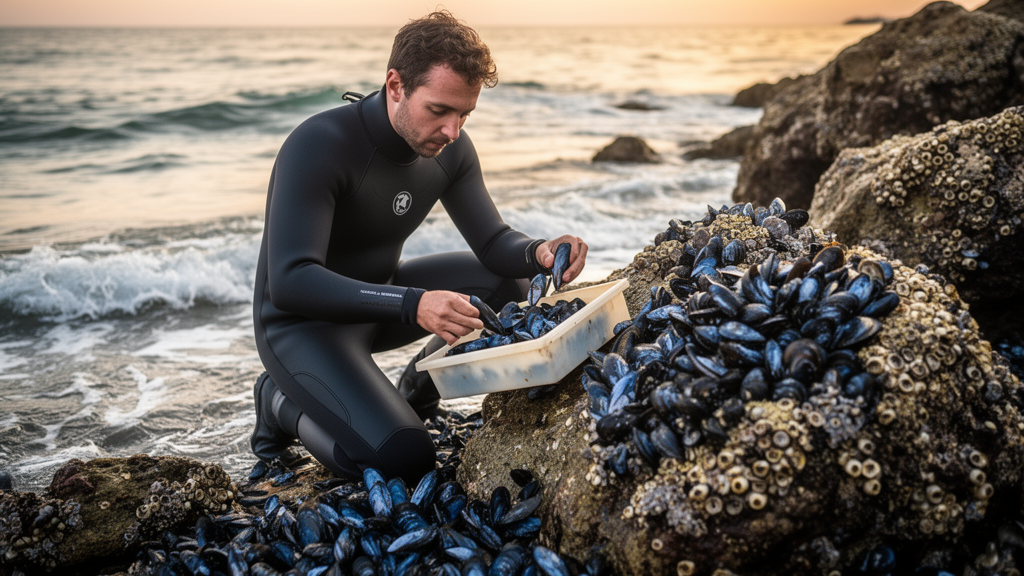
Along the rocky shallows of the Bulgarian Black Sea coast, the Mediterranean mussel Mytilus galloprovincialis spends its entire adult life anchored to the same spot, filtering seawater around the clock. That sedentary lifestyle makes the species an ideal biological recorder of everything the sea throws at it, from summer tourist crowds to river-borne pollutants. A new study published in the journal BioRisk has now delivered the first comprehensive picture of how the antioxidant defenses of these mussels shift between early summer and early autumn, and the results reveal a coastline divided: mussels from the northern and southern stretches of the Bulgarian coast respond to seasonal pressures in strikingly different ways.
The research team hand-gathered mussels from sublittoral rocks and other hard substrates at depths of one to six meters, sampling sixteen sites along the coast in June and September across 2017 and 2018. Back in the laboratory, the animals were dissected and three organs were analyzed separately: the gills, the digestive gland and the foot. Each organ was frozen in liquid nitrogen and stored at minus 80 degrees Celsius before being homogenized in potassium phosphate buffer under strictly controlled cold conditions. The team then measured a battery of biochemical indicators spectrophotometrically, including lipid peroxidation, glutathione levels, and the activities of six key antioxidant enzymes: catalase, superoxide dismutase, glutathione peroxidase, glutathione reductase, glucose-6-phosphate dehydrogenase and glutathione-S-transferase.
The logic behind the study rests on a well-established concept in ecotoxicology: oxidative stress. When marine organisms encounter metals, polycyclic aromatic hydrocarbons or the effects of eutrophication, their cells generate reactive oxygen species that can damage lipids, proteins and DNA. In response, a suite of antioxidant enzymes and molecules mobilizes to neutralize these threats. Because this cellular alarm system reacts before damage becomes visible at the level of whole organisms or populations, oxidative stress biomarkers are regarded as an early warning of environmental deterioration. Mussels, as sessile filter-feeders, integrate the chemical history of their surroundings in their tissues, which is why they are increasingly deployed in environmental monitoring and conservation programs worldwide.
The researchers hypothesized that the intensified environmental pressure of summer, driven by a combination of biogenic, abiogenic and anthropogenic factors, would weaken the antioxidant protection of mussels by the beginning of autumn. What they actually found was far more nuanced. The response of the mussels proved to be highly specific to the organ examined and to the type of biomarker measured, and the seasonal patterns frequently ran in opposite directions at northern versus southern locations along the coast.
Lipid peroxidation, a classic marker of oxidative damage to cell membranes, showed remarkably few seasonal differences overall. The sole significant exception came from mussels collected near the quay on the western side of St. Ivan Island, where September samples displayed higher lipid peroxidation than June samples. The authors attribute this anomaly to intense boat traffic or a momentary pollution event at that particular spot, a reminder that local human activity can leave a biochemical fingerprint even when the broader seasonal picture remains stable.
The clearest seasonal signals emerged in the glutathione system. Glutathione is a small but abundant cellular molecule capable of neutralizing a wide range of reactive oxygen species, including singlet oxygen, hydroxyl radicals, superoxide and hydrogen peroxide, and it also serves as a co-substrate for the enzymes glutathione peroxidase and glutathione-S-transferase. In the digestive gland, glutathione concentrations were significantly higher in autumn samples at almost every location, with exceptions only at Kavarna in the north and at Sozopol port and the Sozopol coastal rocks in the south. Meanwhile, glutathione-S-transferase activity, which participates in binding xenobiotic compounds, rose significantly in autumn across the foot tissue of mussels from all coastal locations and in the gills and digestive gland of mussels from all southern sites. The researchers suggest this autumn surge reflects the cumulative pollution pressure of the summer tourist season, when intensified visitor flows and municipal wastewater discharges activate the detoxification machinery of the mussels.
Glutathione peroxidase told an even more revealing story of geographic divergence. In mussels from all northern locations, the activity of this enzyme in September was significantly lower than in June, in the gills and digestive gland alike, while in mussels from the southern locations the opposite pattern held, with autumn activity generally exceeding summer levels. Glutathione reductase followed a similar split: foot tissue from northern mussels showed significantly increased activity in September, whereas southern mussels displayed a significant autumn decrease in both gills and digestive gland. Glucose-6-phosphate dehydrogenase, which supplies the reducing power that keeps glutathione in its active form, dropped significantly in the gills and digestive gland of all northern September samples but showed no significant seasonal change in southern animals. The authors propose that these opposing north-south trajectories may stem from multiple stressor effects, including the pollutant inflow carried by the Danube River into the northwestern Black Sea.
Superoxide dismutase and catalase, the front-line enzymes that dismantle superoxide radicals and hydrogen peroxide respectively, showed more restrained seasonal behavior. Superoxide dismutase activity remained largely stable between seasons in the foot and gills, with a single exception at cape Chervenka, but the digestive gland told a different tale: all northern locations showed significant seasonal differences in this organ, while in the south only the mussels from St. Ivan Island west and the Sozopol coastal rocks did. Catalase activity in the foot declined from June to September at five locations spanning both regions, yet in the digestive gland of southern mussels the enzyme actually rose in September, while northern digestive glands showed no seasonal shift at all. The digestive gland, which constantly receives substances from the environment including various xenobiotics, proved to be the most responsive organ overall, with statistically significant seasonal differences present in every biomarker measured there.
To make sense of this dense matrix of measurements, the team applied multidimensional scaling, a statistical technique that projects complex multivariate data onto an interpretable two-dimensional plane. The analysis confirmed what the raw numbers suggested: mussels from the northern locations clustered separately from those in the south along the first dimension, demonstrating genuine dissimilarities in pro/antioxidant status between the two coastal regions. Along the second dimension, samples with elevated glutathione and related detoxification enzymes grouped apart from samples characterized by higher lipid peroxidation and activated catalase, indicating distinct physiological states of antioxidant mobilization versus oxidative damage.
The study’s authors conclude that the mussel’s reaction to seasonal abiotic, biotic and anthropogenic stress factors is specific to the target organ and the type of biomarker, and that the animals continuously respond to local fluctuations in temperature, hypoxia, the hydrological cycle and their own metabolic condition. For the growing field of biomonitoring, the message is clear: a single-season, single-organ snapshot risks misreading the health of a coastal ecosystem. Seasonal baselines must be established for each locality before oxidative stress biomarkers can be interpreted with confidence. The researchers emphasize that further work is needed to confirm these findings and to build a complete picture of seasonal and spatial variation in the antioxidant defenses of Bulgarian Black Sea mussels, so that this hardy filter-feeder can serve as a reliable sentinel for one of Europe’s most environmentally pressured semi-enclosed seas.
Subject of Research: Seasonal variation in oxidative stress biomarkers of mussels from Bulgarian Black Sea coastal habitats
Article Title: Seasonal changes in the pro/antioxidant status of mussels Mytilus galloprovincialis (Lamarck, 1819) from Bulgarian Black Sea coastal habitats
Article References: Tsvetanova, E., Georgieva, A., Chipev, N., & Alexandrova, A. (2022). Seasonal changes in the pro/antioxidant status of mussels Mytilus galloprovincialis (Lamarck, 1819) from Bulgarian Black Sea coastal habitats. BioRisk, 17, 241-251. https://doi.org/10.3897/biorisk.17.77279
Image Credits: AI Generated
Keywords: Mytilus galloprovincialis, oxidative stress, antioxidant enzymes, Black Sea, biomonitoring, glutathione, lipid peroxidation, marine bivalves, environmental monitoring, Bulgarian coast, digestive gland, seasonal variation
Cite Scienmag News
Margaret Porter. (October 18, 2026). Mussels Reveal Seasonal Stress Patterns Along Bulgaria’s Black Sea Coast. Scienmag. https://scienmag.com/mussels-reveal-seasonal-stress-patterns-along-bulgarias-black-sea-coast/
Margaret Porter. "Mussels Reveal Seasonal Stress Patterns Along Bulgaria’s Black Sea Coast." Scienmag, 18 October 2026, https://scienmag.com/mussels-reveal-seasonal-stress-patterns-along-bulgarias-black-sea-coast/. Accessed 18 October 2026.
Margaret Porter. "Mussels Reveal Seasonal Stress Patterns Along Bulgaria’s Black Sea Coast." Scienmag. October 18, 2026. https://scienmag.com/mussels-reveal-seasonal-stress-patterns-along-bulgarias-black-sea-coast/


