


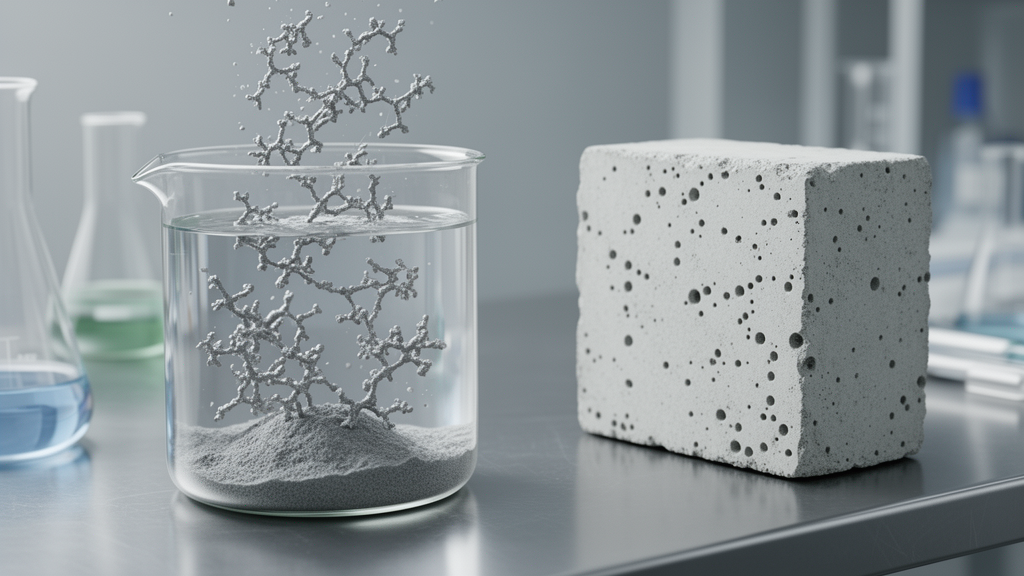
China’s alumina industry has quietly accumulated one of the world’s largest industrial waste problems: more than 1.5 billion tonnes of red mud, the highly alkaline residue left behind when aluminum is extracted from bauxite ore. New stockpiles grow every year, threatening soil, water, and safety near storage facilities. A new study published in Case Studies in Construction Materials offers a detailed look at how this stubborn waste could be transformed into a valuable building material, and reveals that the secret to making it strong lies in an unexpected property of its microscopic pore network: its fractal geometry.
Red mud is chemically rich in silicon, aluminum, iron, and calcium, which in principle makes it an attractive candidate for cementitious materials. In practice, its high alkalinity, complex mineral assemblage, and low intrinsic reactivity have limited its usefulness. Researchers led by Jiawei Zhang and Guochao Yan tackled this problem by embedding red mud in a composite system containing coal gangue powder and ordinary Portland cement, then comparing three different activation pathways designed to wake up the material’s latent chemistry: alkali activation with sodium silicate solution, thermal activation by calcination at temperatures from 500 to 900 degrees Celsius, and sulfate activation using flue gas desulfurization gypsum, itself an industrial byproduct of coal-fired power plants.
The thermal route depended on a delicate balance. Thermogravimetric analysis showed that heating red mud drives off bound water and triggers the dehydroxylation of gibbsite and goethite, converting stable crystalline phases into a disordered, more reactive state. X-ray diffraction confirmed that gibbsite and goethite disappeared upon calcination while hematite reflections intensified, and infrared spectroscopy documented the loss of hydroxyl and carbonate bands. But calcination also coarsened the particles, with the mean size growing from 5.7 micrometers in raw red mud to 15.66 micrometers at 900 degrees Celsius as recrystallization and sintering took over. The result was a clear optimum: red mud calcined at 800 degrees Celsius produced the strongest thermal-activation samples, while the 900-degree material was weaker.
The mechanical results were striking. Unactivated control mixtures reached only 3.60 megapascals of compressive strength at 28 days, relying almost entirely on Portland cement hydration. Alkali activation with 4 percent sodium silicate lifted that figure to 5.56 megapascals, a 54 percent improvement, by raising pore-solution alkalinity and supplying soluble silicate that promoted the dissolution and repolymerization of aluminosilicate species. Thermal activation at 800 degrees Celsius delivered 6.08 megapascals, a 69 percent gain. But the champion was sulfate activation: mixtures containing 4 percent flue gas desulfurization gypsum achieved 7.33 megapascals, more than double the control, with early strength gains of up to 262 percent at three days.
Why did gypsum work so well? Microscopic and crystallographic evidence pointed to ettringite, a needle-like calcium sulfoaluminate mineral. X-ray diffraction of the sulfate-activated samples showed distinct ettringite reflections, and energy-dispersive spectroscopy revealed locally high calcium and sulfur contents. Scanning electron microscopy showed these sulfate-bearing crystals intergrowing into dense, honeycomb-like frameworks with few large voids, bridging gel phases into a connected load-bearing network. By contrast, the alkali-activated samples displayed spider-like networks of sodium-rich aluminosilicate gel around residual particles, while the thermally activated samples formed cotton-like flocculent products weaving a relatively continuous matrix.
The study’s most novel contribution came from applying fractal analysis to the pore structure. Conventional measures such as specific surface area, pore volume, and pore-size distribution describe how much void space exists and how large the pores are, but they say little about the geometric irregularity of pore surfaces. Using the Frenkel-Halsey-Hill model applied to nitrogen adsorption data, the researchers calculated a fractal dimension for each 28-day sample. All values fell between 2 and 3, as expected for rough surfaces, and increased in a precise order: untreated, then alkali-activated, then thermally activated, then sulfate-activated. That ranking exactly matched the compressive strength ranking, suggesting that the roughness and heterogeneity of pore surfaces are tightly linked to how well the material carries load.
The pore-volume data told a subtler story. Thermal activation produced the lowest total accessible pore volume, 0.1271 cubic centimeters per gram, yet did not yield the highest strength. The sulfate-activated material retained a slightly higher pore volume of 0.1324 but was substantially stronger. Total porosity alone, in other words, could not explain the mechanical differences; the geometric complexity captured by the fractal dimension could. This finding echoes earlier work showing that larger pores disproportionately harm strength, and adds a new layer: the texture of the remaining pore space matters as much as its quantity.
Energy dissipation broke the pattern entirely. By integrating stress-strain curves from uniaxial compression tests and partitioning the input energy into stored elastic strain energy and dissipated energy, the team tracked how each mixture absorbed and released mechanical work as damage accumulated. All samples followed the same broad sequence, with energy stored elastically before the peak and dissipated rapidly as microcracks initiated and coalesced. But the final dissipated energy densities ranked differently: alkali-activated samples led at 0.058 megajoules per cubic meter, followed by sulfate-activated at 0.052, thermally activated at 0.044, and untreated at 0.038. The strongest material was not the toughest one.
The explanation lay in how each material fails. Stress-strain curves showed that thermally and alkali-activated specimens softened gradually after the peak, retaining residual stress as damage progressed incrementally, while sulfate-activated specimens dropped steeply, failing more abruptly. The alkali-activated material’s connected gel network appears to promote progressive microcracking that soaks up energy, whereas the rigid crystalline ettringite framework that gives the sulfate system its strength also channels damage into a faster, more brittle failure. Ductility and strength, the results imply, are governed by partly independent microstructural features.
For a waste stream measured in billions of tonnes, these distinctions have practical weight. Choosing an activation strategy is no longer just a matter of maximizing compressive strength; engineers must weigh load-bearing requirements against energy absorption and damage tolerance, particularly for applications such as mine backfill where both properties matter. The work also demonstrates that fractal pore characterization can serve as a sensitive diagnostic tool, predicting strength trends that conventional porosity measurements miss. As the construction industry searches for low-carbon binders made from industrial residues, the humble geometry of red mud’s pores may prove to be one of the most informative fingerprints of performance, guiding the conversion of an environmental liability into infrastructure.
Subject of Research: Fractal pore structure and energy dissipation in activated red mud-based cementitious materials
Article Title: Pore structure fractality affects strength and energy dissipation behavior in red mud-based cementitious materials under different activation pathways
Article References: Zhang, J., Kong, S., Ren, K., Li, G., Chen, L., Zong, B., Wang, Y., Yan, G., & Liu, H. (2026). Pore structure fractality affects strength and energy dissipation behavior in red mud-based cementitious materials under different activation pathways. Case Studies in Construction Materials, 25, Article e06635. https://doi.org/10.1016/j.cscm.2026.e06635
Image Credits: AI Generated
DOI: 10.1016/j.cscm.2026.e06635
Keywords: red mud, cementitious materials, fractal dimension, pore structure, alkali activation, thermal activation, sulfate activation, energy dissipation, compressive strength, coal gangue, ettringite, industrial waste
Cite Scienmag News
Denise Maddox. (October 18, 2026). Fractal Pores Hold the Key to Turning Aluminum Waste into Stronger Cement. Scienmag. https://scienmag.com/fractal-pores-hold-the-key-to-turning-aluminum-waste-into-stronger-cement/
Denise Maddox. "Fractal Pores Hold the Key to Turning Aluminum Waste into Stronger Cement." Scienmag, 18 October 2026, https://scienmag.com/fractal-pores-hold-the-key-to-turning-aluminum-waste-into-stronger-cement/. Accessed 18 October 2026.
Denise Maddox. "Fractal Pores Hold the Key to Turning Aluminum Waste into Stronger Cement." Scienmag. October 18, 2026. https://scienmag.com/fractal-pores-hold-the-key-to-turning-aluminum-waste-into-stronger-cement/


