


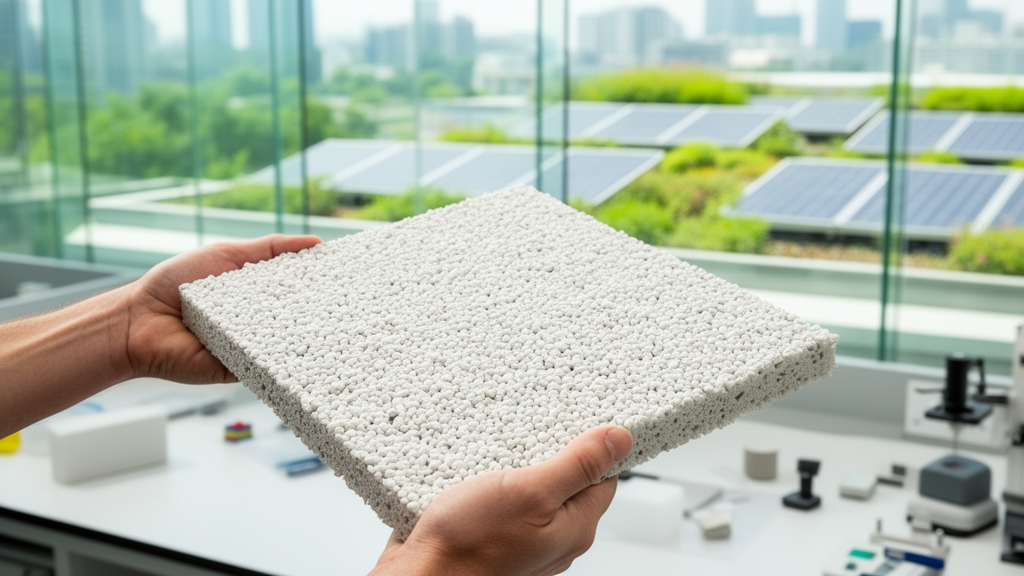
The relentless expansion of global urban centers has placed unprecedented pressure on the construction industry to develop materials that are not only structurally sound but also environmentally responsible. As smart city initiatives gain momentum, the demand for lightweight, energy-efficient building components has surged, prompting researchers to look beyond traditional concrete for solutions that reduce both material consumption and carbon footprints. A new study published in Discover Sustainability offers a promising avenue for this transition by investigating the potential of expanded perlite composites as a resource-efficient alternative for non-load-bearing applications in modern infrastructure. The research highlights how specific mineral aggregates can be engineered to meet the dual demands of sustainability and performance in the evolving landscape of urban development.
Expanded perlite is a lightweight mineral aggregate created by heating perlite, a volcanic glass, until it expands into a porous, low-density material. While its natural lightness makes it an attractive candidate for reducing the overall weight of building structures, its high porosity presents a significant engineering challenge. The inherent voids within the perlite particles create a trade-off between density and mechanical strength, a dilemma that has historically limited its application in construction. The study conducted by researchers from Hamad Bin Khalifa University in Qatar and Al-Isra University in Jordan aims to resolve this tension by systematically evaluating how different processing variables influence the final properties of cementitious composites incorporating this material.
The experimental design of the study was rigorous, involving the production of eighteen distinct formulations to map out the complex relationship between particle size, matrix composition, and conditioning protocols. The researchers utilized three series of expanded perlite particle sizes, designated as S1 with a diameter of 4.0 mm, S2 at 2.0 mm, and S3 at 0.8 mm. Each particle size series was combined with six different matrix formulations, labeled a through f, to create a comprehensive matrix of test specimens. This extensive combinatorial approach allowed the team to isolate the effects of specific variables on the mechanical behavior of the resulting composites, providing a detailed dataset for optimizing material performance.
To assess the long-term stability and practical viability of these materials, the specimens were subjected to two different conditioning regimes over a 28-day period. One group was maintained under standard ambient conditions, simulating typical curing environments found in many construction sites. The second group underwent a modified protocol, involving seven days of conditioning at an elevated temperature of 45 degrees Celsius, followed by 21 days under ambient conditions. This low-temperature post-demoulding conditioning was explored as a potential method to enhance material properties without the high energy costs associated with conventional high-temperature curing processes, aligning with the broader goal of resource efficiency in sustainable construction.
The results of the mechanical testing revealed significant variations in performance across the different formulations. Under ambient conditioning, the formulation designated as S3d, which utilized the smallest 0.8 mm perlite particles, emerged as the top performer in terms of compressive strength. This specific composite achieved a compressive strength of 1.904 MPa, with a bulk density of 720 kg/m³ and a peak load capacity of 4.76 kN. These figures indicate that finer particle sizes can contribute to a denser, stronger matrix by allowing for better packing and interlocking of particles within the cementitious binder, thereby improving the overall structural integrity of the composite.
Conversely, the study identified that formulations S3c and S2d provided the lowest-density alternatives among the tested samples. While these options may not match the peak strength of S3d, their reduced mass makes them highly suitable for applications where weight reduction is a primary design constraint, such as in the construction of upper-story partitions or lightweight roofing systems. The overall density range across all eighteen formulations spanned from 528 to 752 kg/m³, demonstrating the material’s versatility in achieving various weight targets depending on the specific requirements of a construction project.
The introduction of the 45-degree-Celsius conditioning protocol yielded nuanced results that challenge the assumption that higher temperatures always improve material performance. While the elevated temperature conditioning generally resulted in a reduction in bulk density, it also led to a decrease in compressive strength and post-peak deformation capabilities. This finding suggests that the thermal treatment may have altered the hydration kinetics of the cement matrix or the microstructure of the perlite particles in a way that compromised their mechanical robustness. The formulation S1d, which used the largest 4.0 mm particles, was identified as the highest-efficiency option after this specific conditioning process, highlighting the complex interplay between particle size and thermal history.
The concept of strength-density efficiency, which measures the mechanical output relative to the material’s mass, proved to be a critical metric in evaluating the composites. The study found that no single formulation was optimal across all performance objectives, with S3d excelling under ambient conditions and S1d showing superior efficiency after 45-degree-Celsius conditioning. This lack of a universal best performer underscores the importance of tailoring material specifications to specific application scenarios. For architects and engineers designing sustainable buildings, this data provides a valuable framework for selecting the appropriate perlite composite based on the specific environmental and structural demands of a project.
The implications of these findings extend beyond individual building components to the broader context of smart urban infrastructure. By developing resource-efficient, non-load-bearing building materials, the construction industry can reduce the demand for heavy, energy-intensive traditional concrete, thereby lowering the embodied carbon of new developments. The lightweight nature of these composites also facilitates easier transportation and installation, potentially reducing construction time and labor costs. As cities strive to meet stringent environmental targets and improve the resilience of their infrastructure, the adoption of such innovative materials could play a pivotal role in achieving sustainable urban growth.
Despite the promising results, the researchers emphasize that further investigation is required to fully validate the contribution of these composites to sustainable urban development. Future studies need to explore the thermal performance, long-term durability, and comprehensive environmental impacts of expanded perlite composites. Understanding how these materials behave under varying climatic conditions and over extended periods will be crucial for their widespread adoption in critical infrastructure. Nevertheless, this study establishes a solid experimental basis for the continued development of lightweight construction materials, offering a clear path toward more sustainable and efficient building practices in the era of smart cities.
Subject of Research: Experimental evaluation of expanded perlite cementitious composites for sustainable construction
Article Title: Development and performance evaluation of resource-efficient expanded perlite composites for sustainable building and smart urban infrastructure
Article References: Ashraf, U., Basha, O., Hzami, A., Khattab, T., & Abu-Rayash, A. (2026). Development and performance evaluation of resource-efficient expanded perlite composites for sustainable building and smart urban infrastructure. Discover Sustainability. https://doi.org/10.1007/s43621-026-05013-8
Image Credits: AI Generated
DOI: 10.1007/s43621-026-05013-8
Keywords: expanded perlite, lightweight concrete, sustainable construction, smart cities, cementitious composites, building materials, resource efficiency, urban infrastructure, mechanical properties, green building, Development, performance
Cite Scienmag News
Violet Maxwell. (October 18, 2026). Lightweight Perlite Composites Offer Sustainable Path for Smart Cities. Scienmag. https://scienmag.com/lightweight-perlite-composites-offer-sustainable-path-for-smart-cities/
Violet Maxwell. "Lightweight Perlite Composites Offer Sustainable Path for Smart Cities." Scienmag, 18 October 2026, https://scienmag.com/lightweight-perlite-composites-offer-sustainable-path-for-smart-cities/. Accessed 18 October 2026.
Violet Maxwell. "Lightweight Perlite Composites Offer Sustainable Path for Smart Cities." Scienmag. October 18, 2026. https://scienmag.com/lightweight-perlite-composites-offer-sustainable-path-for-smart-cities/


