


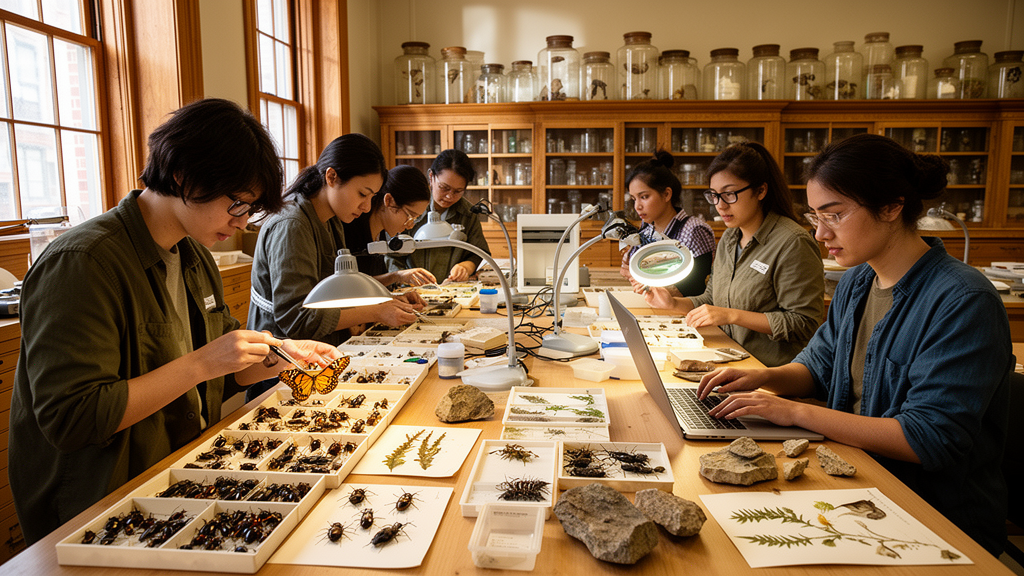
Across the globe, thousands of scientific institutions house nearly three billion specimens and associated metadata, forming a vast repository of biodiversity data that is increasingly vital for modern research. Natural history collections, with their broad taxonomic, geographic, and temporal scope, offer unparalleled resources that contribute significantly to both science and society. In the first two decades of the twenty-first century, there has been a rapid rise in the mobilization of digital biodiversity data, driven by initiatives such as the National Science Foundation’s facilitation of the digitization of over 140 million biodiversity specimens in the United States. This digitization has greatly enhanced the use of herbarium data in scientific research, impacting diverse fields including biodiversity informatics, global change biology, and analyses using next-generation sequencing technologies. As these collections become more digitally accessible, they are uniquely poised to broaden access and create new opportunities for public engagement, transforming passive spectators into active stewards of natural history.
At the Field Museum of Natural History in Chicago, this transformation is being driven by volunteer-led programs such as WeDigBio and the Collections Club. These initiatives aim to deepen the public’s connection with scientific collections, enhance participatory science, and improve the data associated with natural history specimens. The WeDigBio events, which began in 2015, are part of a global effort to digitize biocollections, while the Collections Club was established shortly after to accommodate volunteers who wished to contribute more frequently than the annual events allowed. The Collections Club typically meets quarterly and includes members who may not be able to commit to the minimum four hours per week required for regular volunteering. Together, these programs have created a robust infrastructure for public participation, expanding over time to include ad hoc events and collaborations with high school groups and corporate partners.
Since 2015, the impact of these volunteer-driven programs has been substantial. Over a thousand community scientists have contributed to the inventorying, collection care, curation, databasing, or transcription of 286,071 specimens, objects, or records. In total, 3,846 volunteers participated in on-site and off-site activities, logging 13,549 hours of work. This equates to approximately 4.45 years of full-time work on-site and 3.62 years off-site, assuming a standard work week. The activities have ranged from barcoding and curation to inventorying and transcription, with volunteers processing nearly 260,000 items. Notably, in 2022 and 2023, volunteers applied barcodes to over 15,000 flowering plant specimens from Africa, demonstrating the global reach and scientific value of these local efforts.
The shift to virtual participation during the COVID-19 pandemic marked a significant turning point for these programs. In 2020 and 2021, off-site participation increased markedly as on-site events were suspended. Surveys conducted during this period revealed that 95% of participants expressed interest in attending future virtual events, highlighting the potential of digital platforms to reduce barriers such as transportation and distance. Although in-person events have recovered since 2022, virtual participation remains strong, suggesting a hybrid model that can sustain engagement. The pandemic also accelerated the adoption of digital tools and platforms, allowing for broader and more diverse participation in participatory science activities.
Surveys conducted from 2015 through 2021 provide insights into the motivations and satisfaction of participants. Over time, there has been a notable shift towards more altruistic motivations, with an increased emphasis on supporting the Field Museum and contributing to the scientific community. For instance, the percentage of respondents who cited “Help Field Museum” as a motivation increased from 12% to 41%, while those who chose “Help the scientific community” rose from 18% to 39%. This trend indicates a deepening commitment to the mission of these programs. Additionally, at least 92% of respondents agreed that the events were well-organized and worth their time, with a high percentage expressing willingness to continue participating in similar activities in the future.
Quality control and accuracy are critical components of these participatory science programs. Different transcription platforms employ various mechanisms to ensure data integrity. For example, Symbiota uses a two-step process where one volunteer transcribes and another validates the transcription, while Notes from Nature requires three volunteers to transcribe a specimen, with the results reconciled to derive a final output. These methods have generally yielded high levels of accuracy, although the specific approach is tailored to the audience, project goals, and time constraints. For hands-on activities, project leaders provide immediate feedback and evaluate the quality of work, ensuring that volunteers maintain high standards. In some cases, volunteers have become so skilled and engaged that they have taken on co-management roles in subsequent events, further enhancing the sustainability and quality of the programs.
The educational impact of these programs extends beyond data collection, fostering a deeper understanding of biodiversity and the importance of natural history collections. Surveys indicate that participants’ awareness of the number, kinds, and value of biodiversity specimens has increased significantly, with at least 70% reporting higher awareness after participating in the events. Moreover, over 90% of respondents agreed that biodiversity research collections merit public funding, suggesting that these programs may help shift public perception and support for scientific research. The inclusion of lectures by collections experts and behind-the-scenes tours has also been highly valued, with 82% and 88% of participants, respectively, responding positively to these components. This educational aspect not only enhances the scientific value of the collections but also promotes science literacy and community support for bio-collections.
Looking ahead, the Field Museum and other institutions are focused on expanding outreach and inclusivity to ensure a broader representation of society in participatory science projects. Partnerships with high schools, colleges, and local communities aim to engage diverse audiences and address gaps in STEM education, particularly for historically under-represented groups. The Mobile Museum, initiated by two fifth graders inspired by their participation in WeDigBio and the Collections Club, exemplifies the potential for these programs to inspire the next generation of scientists. By leveraging creative teaching tools and digital outreach, such initiatives can spark curiosity and discovery among learners of all ages. As digital participatory science projects become more common, continued evaluation and adaptation of public programming strategies will be essential to maximize their impact and sustainability.
In conclusion, volunteer-driven public programs focused on natural history collections are transforming the way the public engages with science. By harnessing enthusiasm and deepening connections, these initiatives not only accelerate scientific discovery but also foster a stronger sense of community and stewardship. The success of programs like WeDigBio and the Collections Club demonstrates the potential of participatory science to contribute meaningfully to the preservation, digitization, and understanding of biodiversity collections. As institutions continue to innovate and expand their outreach, the role of volunteers in shaping the future of natural history research will only grow, ensuring that these invaluable resources remain accessible and relevant for generations to come.
Subject of Research: From spectators to stewards: Transforming public involvement in natural history collections
Article Title: From spectators to stewards: Transforming public involvement in natural history collections
Article References: von Konrat, M., Rodriguez, Y., Bailey, C., Gwilliam III, G. F., Christian, C., Aguero, B., Ahn, J., Albion, Z., Allen, J. R., Bailey, C., Blake, E., Blake, W., Blake, G., Briscoe, L., Budke, J. M., Campbell, T., Chansler, M., Clark, D., Delapena, R., … Zwingelberg, M. (2024). From spectators to stewards: Transforming public involvement in natural history collections. Natural History Collections and Museomics, 1, 1-33. https://doi.org/10.3897/nhcm.1.138247
Image Credits: AI Generated
Keywords: spectators, stewards, Transforming, public, involvement, natural, history, collections, scientific research
Cite Scienmag News
Margaret Porter. (October 18, 2026). Volunteers Transform Natural History Collections Through Participatory Science. Scienmag. https://scienmag.com/volunteers-transform-natural-history-collections-through-participatory-science/
Margaret Porter. "Volunteers Transform Natural History Collections Through Participatory Science." Scienmag, 18 October 2026, https://scienmag.com/volunteers-transform-natural-history-collections-through-participatory-science/. Accessed 18 October 2026.
Margaret Porter. "Volunteers Transform Natural History Collections Through Participatory Science." Scienmag. October 18, 2026. https://scienmag.com/volunteers-transform-natural-history-collections-through-participatory-science/


