


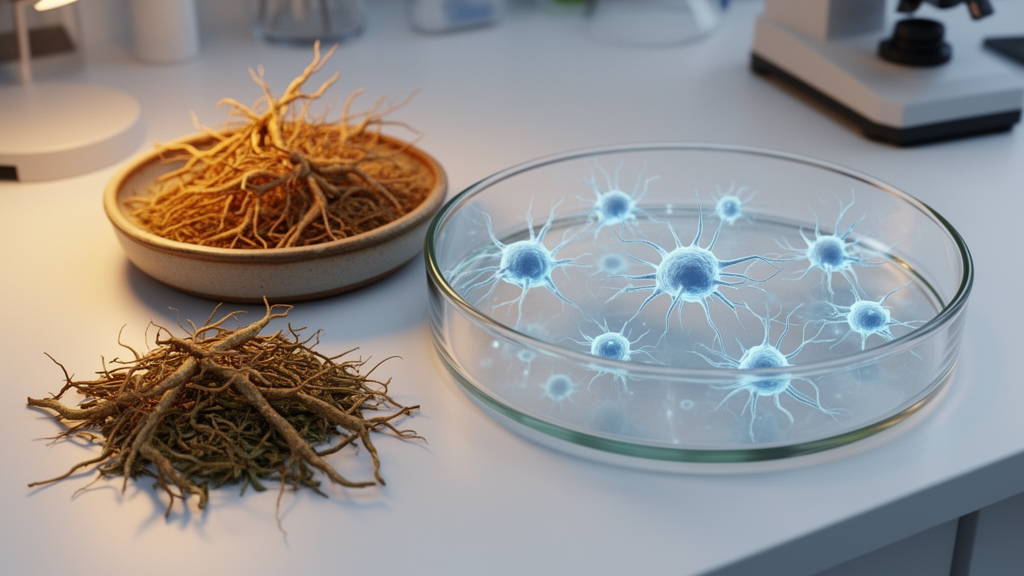
When researchers brew medicinal herbs into teas and tinctures, the leftover plant material usually ends up as waste. A new study suggests that this discarded biomass may be anything but spent. Working with Angelica gigas Nakai, a Korean medicinal plant prized for its anti-inflammatory and neuroprotective reputation, a team at the Korea Institute of Oriental Medicine found that the residue remaining after conventional water extraction still harbors substantial amounts of pyranocoumarins, the plant’s signature bioactive compounds. Recovering them with a follow-up ethanol wash produced an extract that suppressed a key inflammatory machine in the brain, the NLRP3 inflammasome, in both microglial cells and living mice. The findings, published in Molecular Biology Reports, position extraction leftovers as an underutilized and potentially sustainable source of phytochemicals with real pharmacological activity.
The NLRP3 inflammasome is a multiprotein sensor that sits at the crossroads of innate immunity and neurodegeneration. When activated, it assembles into a complex that processes pro-caspase-1 into active caspase-1, which in turn cleaves pro-interleukin-1β into its mature, pro-inflammatory form. In the central nervous system, this cascade drives microglial activation, the inflammatory state of the brain’s resident immune cells that has been implicated in Alzheimer’s disease, Parkinson’s disease, and other neurodegenerative conditions. Because NLRP3-driven neuroinflammation can amplify neuronal damage, pharmacologically damping this pathway has become a major therapeutic goal, and the search for inhibitors has intensified in recent years.
To explore whether Angelica gigas could contribute to that effort, the researchers prepared three different preparations: a conventional water extract, an ethanol extract, and a residue-derived ethanol extract obtained from the biomass left behind after aqueous extraction. Chemical profiling showed that despite the prior water treatment, the residual material retained meaningful levels of pyranocoumarins, and the subsequent ethanol extraction yielded the residue extract with the highest concentrations of two key compounds, decursin and decursinol angelate. This result challenges the assumption that water extraction strips a plant of its most valuable chemistry, and it suggests that a second, solvent-based pass over the same biomass can recover bioactive molecules that would otherwise be discarded.
The team then tested the three preparations in BV2 microglial cells, a widely used model of brain-resident immune cells, stimulated with lipopolysaccharide, a bacterial molecule that reliably triggers inflammatory signaling. The residue-derived ethanol extract significantly reduced the expression of NLRP3, the adaptor protein ASC, cleaved caspase-1, and mature interleukin-1β. In other words, the extract did not merely blunt a single downstream marker; it suppressed the inflammasome at multiple points along its activation axis. The effect was more pronounced with the residue extract than with the conventional preparations, consistent with its enriched pyranocoumarin content.
To move beyond cell culture, the researchers turned to a mouse model of LPS-induced neuroinflammation. Animals treated with the residue extract showed reduced microglial activation in the brain, indicating that the anti-inflammatory activity observed in vitro translates to living tissue. This in vivo confirmation matters because many compounds that look promising in isolated cells fail to reproduce their effects in whole organisms, where absorption, metabolism, and tissue distribution complicate the picture.
Seeking a molecular explanation for the activity, the researchers focused on decursin, one of the two dominant pyranocoumarins in the residue extract. Using molecular docking, they predicted that decursin could bind directly to the NLRP3 protein. They then confirmed measurable binding experimentally with surface plasmon resonance, a technique that detects physical association between a small molecule and its protein target in real time. Decursin treatment also reduced NLRP3 expression and interleukin-1β production in the cell model, supporting a direct functional link between the compound and the inflammasome pathway.
To validate that NLRP3 was the relevant target rather than an incidental binding partner, the researchers used MCC950, a well-characterized selective NLRP3 inhibitor, as an intervention tool. The comparison with MCC950 helped clarify the association between decursin and NLRP3 signaling, reinforcing the conclusion that the residue extract’s anti-neuroinflammatory activity operates through this specific inflammasome rather than through a generic anti-inflammatory effect. This kind of target validation is important because many natural products show broad anti-inflammatory activity, and pinpointing the actual molecular mechanism distinguishes a true pharmacological lead from a nonspecific suppressant.
The study’s broader significance lies in its approach to resource valorization. Herbal medicine production generates enormous quantities of extraction residue worldwide, and recent reviews have highlighted the environmental and economic costs of discarding this biomass. The Angelica gigas findings suggest that a simple sequential extraction strategy, water first and ethanol second, can convert what would be waste into a standardized, bioactive extract. Because the residue extract outperformed the conventional preparations in pyranocoumarin content and inflammasome suppression, the sequential approach may actually improve on traditional single-pass extraction rather than merely recover leftovers.
Angelica gigas has a long history in traditional Korean medicine, and previous research has documented its anti-inflammatory, neuroprotective, and cognitive-enhancing properties. Decursin and decursinol angelate have been studied for their molecular mechanisms in inflammatory diseases, and pyranocoumarins from the plant have shown neuroprotective potential against glutamate-induced hippocampal cell death. The current work adds a specific inflammasome mechanism to this pharmacological profile, connecting the plant’s traditional use to a contemporary molecular target that is actively being pursued by pharmaceutical researchers.
For now, the findings remain at the preclinical stage, and the researchers note that further work would be needed to establish dosing, safety, and efficacy in humans. But the study offers a concrete example of how a circular approach to medicinal plant processing can yield both environmental and pharmacological dividends. By treating extraction residue as a resource rather than a byproduct, the researchers have identified a sustainable source of NLRP3-targeting compounds and demonstrated that the chemistry left behind after conventional processing may be more valuable than the chemistry that is taken out first.
Subject of Research: Angelica gigas residue extracts suppress NLRP3 inflammasome activation and neuroinflammation
Article Title: Pyranocoumarin-enriched residue extracts of Angelica gigas suppress NLRP3 inflammasome activation and neuroinflammation
Article References: Lim, H.-S., Seo, C.-S., Kim, D.-S., Son, E., Jeon, W.-Y., Jin, S. E., Jang, J.-H., & Park, G. (2026). Pyranocoumarin-enriched residue extracts of Angelica gigas suppress NLRP3 inflammasome activation and neuroinflammation. Molecular Biology Reports, 53(1), Article 1732. https://doi.org/10.1007/s11033-026-12951-z
Image Credits: AI Generated
DOI: 10.1007/s11033-026-12951-z
Keywords: Pyranocoumarin-enriched, residue, extracts, Angelica, gigas, suppress, NLRP3, inflammasome, activation, neuroinflammation, scientific research
Cite Scienmag News
Cassandra Pierce. (October 18, 2026). Leftover Roots of a Korean Medicinal Herb Quiet a Brain Inflammation Trigger. Scienmag. https://scienmag.com/leftover-roots-of-a-korean-medicinal-herb-quiet-a-brain-inflammation-trigger/
Cassandra Pierce. "Leftover Roots of a Korean Medicinal Herb Quiet a Brain Inflammation Trigger." Scienmag, 18 October 2026, https://scienmag.com/leftover-roots-of-a-korean-medicinal-herb-quiet-a-brain-inflammation-trigger/. Accessed 18 October 2026.
Cassandra Pierce. "Leftover Roots of a Korean Medicinal Herb Quiet a Brain Inflammation Trigger." Scienmag. October 18, 2026. https://scienmag.com/leftover-roots-of-a-korean-medicinal-herb-quiet-a-brain-inflammation-trigger/


