


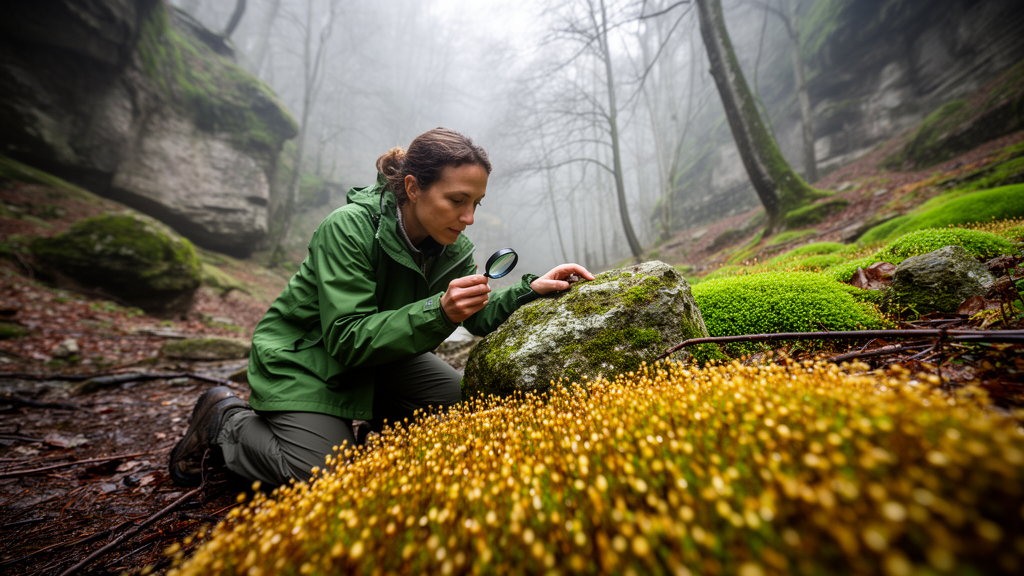
Deep in the mountains and valleys of Molise, one of Italy’s smallest and least explored regions, a quiet botanical revolution has just taken place. A recent bryological survey has documented 88 species of mosses and liverworts across the region, including 23 species never before recorded there and 3 additional species whose presence has now been confirmed. The findings, published in the journal Italian Botanist, dramatically expand our understanding of a region that has long been a blank spot on Italy’s bryological map.
Molise, together with Basilicata, has been identified as the least bryologically known administrative region in Italy. According to the most recent checklist of the Italian Bryological Flora, only 157 species of mosses and 25 species of liverworts and hornworts were previously known from Molise, a negligible increase compared to checklists published at the end of the last century. For comparison, the Italian bryological flora consists of 1,220 species in total, of which 301 are liverworts and hornworts and 919 are moss species, excluding subspecies and varieties. This means that Molise’s documented bryophyte diversity represented barely a fraction of what the region actually harbors.
The survey was conducted through a series of bryological excursions across ten sites in Molise, spanning a remarkable range of habitats and geological substrates. The collection sites included Collemeluccio, a forest with a prevalence of silver fir mixed with turkey oak and beech on schistose sandstones, limestones, marls and clays of Miocene age. In the surroundings of Carpinone, hills, ravines and waterfalls along the Carpino stream and its tributaries provided habitat on scaly Cretaceous limestones and marls, Eocene-Oligocene calcarenites and breccias, and Eocene-Miocene marls and flint limestones. Mount Capraro near the Garden of the Apennine Flora of Capracotta offered beech forests, shrubs, pastures and rocks on organogenic limestones and calcareous marls.
Further sites included Montedimezzo, a forest dominated by turkey oak and beech with local silver fir plantations on Oligocene scaly limestones, marls and clays. The coastal sand dunes of Petacciato Marina on Pleistocene sands represented a completely different environment, while the surroundings of the Abbey of San Vincenzo al Volturno near the sources of the Volturno river offered travertines and Quaternary deposits. The archaeological sites of Saepinum-Altilia, a Roman settlement at the foot of the Matese Massif on Quaternary fluvial-lacustrine deposits, and the Samnite sanctuary of Pietrabbondante, built with limestone blocks on Miocene micaceous sandstones, added further diversity. The urban center of Venafro and the beech forests and pastures of Valle Fiorita in the Le Mainarde mountains on Jurassic dolomitic and calcareous substrates completed the survey.
All specimens were collected and identified by the author and are preserved in his personal herbarium. Nomenclature and regional distribution are consistent with the checklist of the Italian Bryological Flora. The 88 species found comprise 13 liverworts and 75 mosses. Of these, 23 are new to the flora of Molise: Marchantia quadrata, Porella arboris-vitae, Cryphaea heteromalla, Dialytrichia mucronata, Eurhynchium striatum, Fabronia pusilla, Gymnostomum aeruginosum, Isothecium myosuroides, Leptodon smithii, Lewinskya speciosa, Neckera pumila, Nogopterium gracile, Oxyrrhinchium hians, Plagiomnium rostratum, Plagiothecium nemorale, Plasteurhynchium striatulum, Schistidium crassipilum, Scleropodium touretii, Scorpiurium circinatum, Syntrichia papillosa, Syntrichia virescens, Thuidium tamariscinum, and Tortella flavovirens var. flavovirens. Three additional species are confirmed for the region: Frullania tamarisci, Antitrichia curtipendula, and Fontinalis antipyretica.
Among the most noteworthy findings are two species linked to mature or even old-growth forests: Antitrichia curtipendula and Neckera pumila. Antitrichia curtipendula is an indicator species of forest continuity and is therefore typical of old-growth forests even in the Mediterranean environment. Neckera pumila is a rare species associated with well-preserved forest environments. Both are locally abundant in the two Natural Reserves of Collemeluccio and Montedimezzo, suggesting that these protected areas harbor forest ecosystems of considerable maturity. Neckera pumila occurs in southern Italy only in Abruzzo, Campania, Apulia, Calabria and the major islands, making its presence in Molise particularly significant for understanding the biogeography of this species in the central Apennines.
Several other new records are of considerable biogeographic interest. Porella arboris-vitae, Isothecium myosuroides and Syntrichia virescens are less common and missing from many southern Italian regions. Porella arboris-vitae occurs in most Italian regions but is less widespread in the South, being absent in Apulia and Basilicata, with no recent confirmation in Calabria and Sicily. Isothecium myosuroides is an uncommon and localized species, absent in Abruzzo and Basilicata. Syntrichia virescens is an epiphytic species with a very irregular distribution in Italy, recorded only for Abruzzo, Apulia, Sardinia and Sicily in southern Italy. Cryphaea heteromalla is uncommon in central-southern Italy, absent or not confirmed in Umbria, Marche, Apulia and Basilicata. Plagiothecium nemorale is very common in northern Italy but occurs in the South only in Campania, Calabria, Sardinia and Sicily. Thuidium tamariscinum is becoming increasingly rare southwards, where it is confirmed only for Abruzzo, and is not confirmed in Campania, Apulia or Calabria.
The survey also documented species with highly specialized ecological requirements. Tortella flavovirens var. flavovirens is a psammophilous species widespread on coastal dunes and recorded for all coastal regions, found at Petacciato Marina. Fontinalis antipyretica is a typically rheophilous species, occurring in all Italian regions but not confirmed for Campania and Basilicata in southern Italy, found in streams at Collemeluccio and Venafro. Fabronia pusilla is an epiphytic species recorded for all southern Italian regions except Molise and not recently confirmed in Apulia, found on elm bark at San Donato and on holm oak bark at Venafro. Syntrichia papillosa becomes progressively rarer in southern Italy, where it occurs only in Abruzzo, Basilicata, Calabria and Sicily. Gymnostomum aeruginosum is a lithophilous species quite common in northern Italy but absent or not confirmed for Umbria, Lazio, Campania and Basilicata in central-southern Italy. Schistidium crassipilum has an Italian distribution not yet fully known, although it occurs in all southern regions.
From a conservation perspective, all observed species are classified as Least Concern in the European Red List and in the Italian Red Lists of liverworts and mosses. In most cases, these species are widely distributed in other regions of central-southern Italy. However, the presence of forest continuity indicators such as Antitrichia curtipendula and the rare Neckera pumila in the Natural Reserves of Collemeluccio and Montedimezzo underscores the importance of these protected areas as refugia for mature forest bryophyte communities. The results suggest that Molise’s bryophyte flora, far from being impoverished, simply had not been adequately surveyed, and that further exploration of the region’s diverse habitats, from mountain beech forests to coastal dunes, from travertine formations to archaeological sites, will likely yield many more species records in the future.
Subject of Research: Molise bryophyte survey records 88 species, 23 new to the region
Article Title: Contribution to the knowledge of the bryological flora of Molise (Southern Italy)
Article References: Scortegagna, S. (2024). Contribution to the knowledge of the bryological flora of Molise (Southern Italy). Italian Botanist, 18, 259-270. https://doi.org/10.3897/italianbotanist.18.143357
Image Credits: AI Generated
DOI: 10.3897/italianbotanist.18.143357
Keywords: Contribution, knowledge, bryological, flora, Molise, Southern, Italy, scientific research
Cite Scienmag News
Margaret Porter. (October 18, 2026). Hidden Moss Kingdom Revealed in Italy’s Least Explored Region. Scienmag. https://scienmag.com/hidden-moss-kingdom-revealed-in-italys-least-explored-region/
Margaret Porter. "Hidden Moss Kingdom Revealed in Italy’s Least Explored Region." Scienmag, 18 October 2026, https://scienmag.com/hidden-moss-kingdom-revealed-in-italys-least-explored-region/. Accessed 18 October 2026.
Margaret Porter. "Hidden Moss Kingdom Revealed in Italy’s Least Explored Region." Scienmag. October 18, 2026. https://scienmag.com/hidden-moss-kingdom-revealed-in-italys-least-explored-region/


