


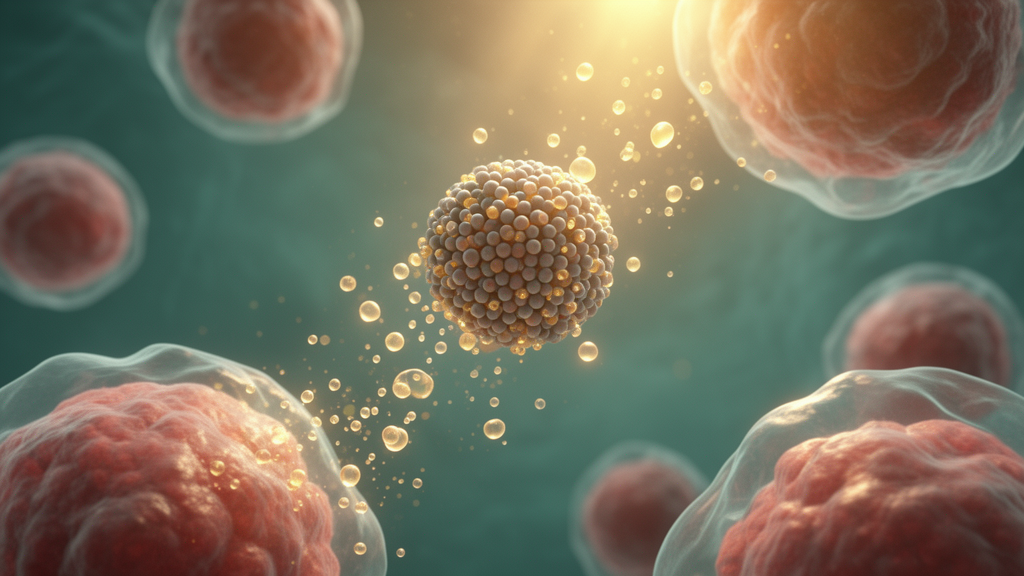
Triple-negative breast cancer has long been the most stubborn enemy in oncology. It lacks the three molecular handles—estrogen receptor, progesterone receptor, and HER2—that make other breast cancers vulnerable to targeted drugs, leaving chemotherapy as the mainstay and immunotherapy effective in only a minority of patients. Now, a research team in China has unveiled a strikingly elegant solution: a tiny, self-assembling nanomedicine built almost entirely from the therapeutic molecules themselves, which rewires the tumor’s fat metabolism to make it exquisitely vulnerable to light-triggered cell death. The work, published in Materials Today Bio, could point the way toward a new generation of metabolism-guided cancer therapeutics.
The strategy hinges on a biological vulnerability that has largely escaped clinical exploitation. Triple-negative breast cancer cells are voracious manufacturers of fat, driven by high levels of fatty acid synthase, or FASN, the rate-limiting enzyme of de novo lipogenesis. This is not merely a metabolic quirk. The saturated fatty acids churned out by FASN lack the unsaturated double bonds that make lipids susceptible to peroxidation—the chain reaction of oxidative damage that underlies ferroptosis, an iron-dependent form of regulated cell death. In effect, the tumor’s own fat factory builds a peroxidation-resistant membrane armor that shields it from ferroptosis and blunts the oxidative assault of photodynamic therapy. The researchers confirmed this link by analyzing transcriptomic data from a public TNBC cohort, finding that FASN expression rose in lockstep with GPX4, a ferroptosis suppressor, and fell in inverse relation to ACSL4, a ferroptosis driver.
Enter orlistat, the FDA-approved weight-loss drug, which doubles as a potent FASN inhibitor. The team’s hypothesis was deceptively simple: co-deliver orlistat with a photosensitizer so that metabolic disruption and light-triggered oxidative stress arrive in the same package. FASN inhibition would strip away the peroxidation-resistant saturated lipids, while photodynamic therapy would flood the cell with reactive oxygen species, or ROS. Together, these effects should push tumor cells over the ferroptotic threshold and, crucially, make their death highly immunogenic—releasing danger signals that rally the immune system against the tumor.
The technical challenge was formidable. Orlistat is a hydrophobic molecule with long alkyl chains, while chlorin e6 (Ce6), the photosensitizer, is a conjugated porphyrin macrocycle. Rather than encapsulating both drugs in an inert carrier matrix, the team exploited their complementary physicochemical properties to drive spontaneous co-assembly. Ce6’s porphyrin rings stack through π-π interactions, orlistat’s alkyl chains associate hydrophobically, and hydrogen bonds between the two molecules knit the structure together. Molecular dynamics simulations showed that initially dispersed molecules coalesced into compact supramolecular aggregates within 100 nanoseconds. The resulting nanoassemblies, roughly 166 nanometers in diameter, achieved remarkable drug loadings of over 34 percent for each molecule—far exceeding what conventional carriers can manage.
To sharpen the tumor-homing ability, the researchers decorated the nanoparticle surface with DSPE-PEG2000-cRGD, a ligand that targets integrin αvβ3, a receptor frequently overexpressed in triple-negative breast cancer cells. The final formulation, termed OC@cRGD, measured about 172 nanometers across and maintained excellent colloidal stability over 14 days of storage and in physiologically relevant media. Intriguingly, the nanoplatform proved stimuli-responsive: under 660-nanometer laser irradiation, excited Ce6 generates ROS that destabilize the supramolecular microenvironment, loosening the noncovalent interactions and accelerating the release of both drugs on demand.
In laboratory experiments with 4T1 triple-negative breast cancer cells, the combination proved devastating. After laser irradiation, OC@cRGD produced the strongest intracellular ROS surge, the highest accumulation of labile ferrous iron, and the most severe lipid peroxidation among all tested groups. Transmission electron microscopy revealed the hallmark ferroptotic signature: shrunken mitochondria with increased membrane density and disintegrating cristae. At the molecular level, the treatment simultaneously downregulated GPX4, dismantling the cell’s primary antioxidant barrier, and FASN, cutting off the supply of peroxidation-resistant saturated fatty acids. When cells were pretreated with ferrostatin-1, a ferroptosis inhibitor, viability partially recovered—a rescue effect that intensified after laser exposure, confirming ferroptosis as the dominant death mechanism.
What elevates this work beyond a simple combination therapy is the immunogenic character of the resulting cell death. Photodynamic therapy is known to induce immunogenic cell death, or ICD, but the danger signaling is often insufficient for robust systemic immunity. The team measured three classical ICD markers—release of HMGB1, exposure of calreticulin on the cell surface, and secretion of ATP. While Ce6 plus laser produced a moderate ICD response, OC@cRGD plus laser generated the highest levels of all three damage-associated molecular patterns. When these treated tumor cells were co-cultured with immature dendritic cells, the OC@cRGD plus laser group drove the most robust dendritic cell maturation, marked by CD80 and CD86 expression. Ferroptosis sensitization, in other words, acts as an amplifier for the immunogenic fallout of photodynamic tumor destruction.
In an orthotopic 4T1 mouse model, the targeted nanoplatform demonstrated superior tumor accumulation, with fluorescence signal persisting clearly at 24 hours after injection. Over the treatment period, tumors in mice receiving OC@cRGD plus laser grew at the slowest rate, yielding the smallest tumors and lowest terminal tumor weights among all seven experimental groups. Histological analysis confirmed extensive necrosis, widespread apoptosis, and reduced Ki67-positive proliferating cells, alongside simultaneous downregulation of GPX4 and FASN in tumor tissue. Importantly, biosafety evaluations—including histology of major organs and hematological analysis—showed no apparent systemic toxicity, suggesting a favorable profile for this self-assembled nanomedicine.
Flow cytometric profiling of tumor tissues and tumor-draining lymph nodes revealed a coordinated immune cascade. Mature dendritic cells rose to approximately 54.9 percent in the tumor microenvironment and 49.7 percent in draining lymph nodes. Cytotoxic CD8-positive T cells accounted for 45.2 percent of tumor-infiltrating T cells, and proinflammatory M1-like macrophage polarization reached 53.4 percent—effectively reversing the naturally immunosuppressive state of the triple-negative breast cancer microenvironment. Transcriptomic sequencing of treated tumors corroborated these findings at the whole-tumor level, showing enrichment of T cell activation, ferroptosis, and lipid localization pathways, along with differentially expressed genes governing immune activation and oxidative stress.
The study’s translational implications are considerable. By targeting lipid metabolism to lower the ferroptosis threshold, the approach overcomes the antioxidant barriers—particularly the glutathione network—that restrict conventional photodynamic therapy. The carrier-free self-assembly strategy maximizes active drug payload while minimizing excipient-associated toxicity, and the cRGD decoration provides active targeting that proved more decisive in vivo than in two-dimensional cell culture. The researchers acknowledge that the therapeutic outcome manifested mainly as tumor growth delay rather than marked regression, reflecting intrinsic limitations of photodynamic therapy in hypoxic, poorly penetrated solid tumors. Nevertheless, the work demonstrates that a supramolecular nanoplatform integrating metabolic intervention with photoimmunotherapy can convert local tumor ablation into sustained systemic T cell-mediated immune surveillance—offering a blueprint for next-generation self-assembled nanotherapeutics against one of medicine’s most lethal cancers.
Subject of Research: Biotechnology & Nanomedicine
Article Title: Supramolecular self-assembled nanomedicine targeting fatty acid metabolism to potentiate ferroptosis-enhanced photoimmunotherapy in triple-negative breast cancer
Article References: Li, F., Wu, J., Hao, X., Xu, W., Wang, J., Zhang, J., Wei, X., Feng, N., Liu, F., & Liao, D. (2026). Supramolecular self-assembled nanomedicine targeting fatty acid metabolism to potentiate ferroptosis-enhanced photoimmunotherapy in triple-negative breast cancer. Materials Today Bio, 41, Article 103748. https://doi.org/10.1016/j.mtbio.2026.103748
Image Credits: AI Generated
DOI: 10.1016/j.mtbio.2026.103748
Keywords: Supramolecular, self-assembled, nanomedicine, targeting, fatty, acid, metabolism, potentiate, ferroptosis-enhanced, photoimmunotherapy, triple-negative, breast
Cite Scienmag News
Nathaniel Bowman. (October 18, 2026). Self-assembled nanomedicine starves tumors of fat to supercharge light-based cancer therapy. Scienmag. https://scienmag.com/self-assembled-nanomedicine-starves-tumors-of-fat-to-supercharge-light-based-cancer-therapy/
Nathaniel Bowman. "Self-assembled nanomedicine starves tumors of fat to supercharge light-based cancer therapy." Scienmag, 18 October 2026, https://scienmag.com/self-assembled-nanomedicine-starves-tumors-of-fat-to-supercharge-light-based-cancer-therapy/. Accessed 18 October 2026.
Nathaniel Bowman. "Self-assembled nanomedicine starves tumors of fat to supercharge light-based cancer therapy." Scienmag. October 18, 2026. https://scienmag.com/self-assembled-nanomedicine-starves-tumors-of-fat-to-supercharge-light-based-cancer-therapy/


