


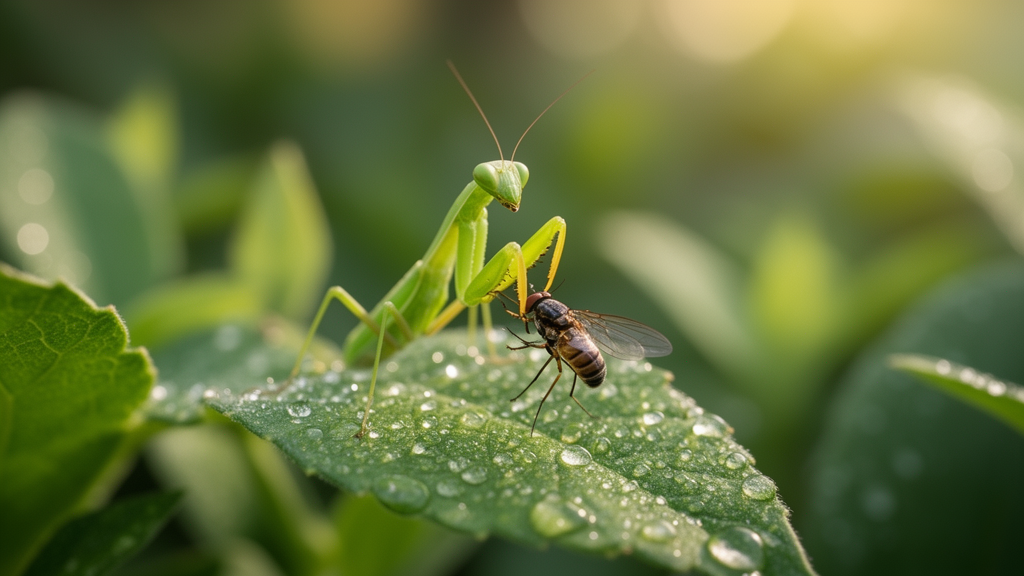
What a predator eats matters, but so does what its prey ate before it became dinner. A new study published in the Journal of Orthoptera Research reveals that the nutritional quality of prey can dramatically shape the survival and development of young mantises, with effects that ripple through the earliest and most vulnerable stages of a predator’s life. The research, led by an independent researcher working with mantis cultures in Colorado, examined how fruit flies fed either a standard or an enriched diet influenced the performance of hatchling nymphs of two mantis species from different families: Creobroter apicalis (Hymenopodidae) and Tenodera sinensis (Mantidae). The findings suggest that prey nutrition is not a trivial detail in food web dynamics but a factor that can determine whether a young predator lives or dies.
The study was motivated by a long-standing bias in the literature on predator-prey nutrition. Most experiments on how prey diet affects predator fitness have focused on later life stages, when prey-size limitations are less restrictive and larger prey items can be offered. But insect fitness is shaped by nutrition during every life stage, and for mantises the earliest instars are the most dangerous. Previous work has shown that the first two to three instars account for up to 90% of total mortality across the mantis life cycle. Understanding what limits survival during this window is therefore essential for understanding the forces that structure ecosystems, since mantises are a ubiquitous trophic guild with demonstrable effects on ecosystem functioning.
The logic behind the experiment rests on a simple ecological insight: hatchling mantises are tiny, and their small size substantially limits the range of prey they can capture. Because early-instar nymphs are satiated on fewer prey items than later ones, any given meal should have a greater effect on development than a meal at a later stage. The researcher hypothesized that if the flies available to young mantises had recently fed on a nutritionally complete food source, the nymphs would develop faster and survive better than nymphs offered flies that had not. This is a plausible ecological scenario: adult flies in nature may be unable to access a nutritionally rich resource before becoming prey, or may be encountered by a predator before they have had a chance to feed. Habitat richness, the presence of competitors, and other factors can all influence what food a prey item has access to before it is consumed.
To test this, the researcher maintained cultures of Drosophila hydei fruit flies on Repashy Superfly medium, a standard diet derived from yeasts, seaweeds, and fruits that allowed the flies to complete their life cycle. For the enriched treatment, flies were offered Pangea apricot crested gecko diet, a commercially formulated food designed by scientists to mimic rotting fruits and plant matter that detritivores would encounter in nature. The enriched diet contained fruits, fungal extracts, and insect proteins, and was notably higher in fat (4.7% versus 0.8%) and fiber (8% versus 2%) than the standard medium. Flies were allowed to feed on the enriched diet for 12 hours, representing roughly 7% of an adult fruit fly’s lifespan, before being offered to the mantis nymphs. No flies were starved in either treatment.
The results were striking for Creobroter apicalis. Survival to the second instar was 100% in nymphs fed enriched-diet flies, compared to 87% in the control group, a statistically significant difference. Survival to the third instar was also higher in the enriched group (96% versus 80%), though this difference was only marginally significant. Development time was shorter across both instars: nymphs fed enriched-diet flies spent an average of 16.2 days in the first instar versus 17.4 days in the control group, and 12.7 days in the second instar versus 14.3 days. The total time to reach the third instar was 29.0 days in the enriched group versus 32.0 days in the control group, a difference of nearly 3 days that was highly significant. Sex ratios did not differ between treatment groups, ruling out sex-biased survival as a confounding factor.
For Tenodera sinensis, the pattern was less clear-cut. Survival to the second instar was 95% in the enriched group versus 100% in the control group, with no significant difference. Survival to the third instar was higher in the enriched group (68% versus 53%), though only marginally so. First instar duration was significantly shorter in the enriched group (11.8 days versus 12.3 days), but second instar duration did not differ significantly between treatments. Total time to third instar was 25.4 days in the enriched group versus 28.0 days in the control group, a difference that was only marginally significant. The researcher notes that T. sinensis nymphs are about four times the size of C. apicalis nymphs at the same instar, and despite needing to add more biomass per instar, they still passed through their stages more rapidly, suggesting that the biomass conversion of T. sinensis is more efficient than that of C. apicalis.
The differential response between the two species is one of the most intriguing aspects of the study. The researcher postulates that T. sinensis, the world’s second most widespread mantis having invaded much of the temperate world except Antarctica, may have better compensatory mechanisms to cope with nutritional deficits, or may be more efficient at converting prey biomass to its own biomass. Life history differences may also play a role: C. apicalis females live 5 to 6 months after their final molt and can deposit upwards of 12 oothecae, each containing 50 to 90 eggs, while T. sinensis females deposit only 1 or 2 oothecae, each containing 250 or more eggs. It is possible that biomass allocation essential to reproduction occurs at different ontogenetic stages between these species, and that the thermal optima for digestive enzymes of the tropical C. apicalis are narrower than those for the temperate T. sinensis.
The nutritional profile of the enriched diet may account for the observed effects, though the researcher cautions that other dietary differences could also be at play. In spiders, the protein content of prey diet has been shown to not significantly affect predator performance, while lipid content does. The flies fed the enriched diet had a fat content nearly six times higher than those fed the standard medium, and a fiber content four times higher. The enriched diet may have provided a more complete nutritional profile overall. Previous work on other predators supports the importance of prey nutrition: wolf spiders fed well-fed crickets extracted 15% more available lipids than those fed starved crickets, and the spined soldier bug reared on caterpillars fed higher protein diets was 2% to 5% heavier at adulthood than those reared on lower protein diets.
The implications of this research extend beyond mantis husbandry. Because the earliest stages of mantis development are the most vulnerable to mortality, the early performance of such predators can dictate their role in food webs at later stages of the life cycle. By understanding what factors limit the abundance of this trophic level, researchers can gain insight into the forces that dictate interactions between organisms in ecosystems. The finding that different species respond differently to prey nutritional status suggests that tropical and temperate food webs may differ fundamentally, and that a consideration of how a consumer’s food assimilation affects its dietary breadth is required. More rapid development may also be associated with passing through vulnerable early instars more quickly and a quickening of the ability to consume a greater diet breadth, which is positively correlated with improved performance in other predatory species.
The researcher acknowledges that more study is needed. The underlying mechanisms for why the performance measures of these two mantis species were not parallel remain unknown, and differences in how these species metabolize their food may indicate differences in life-cycle strategies. Additional mantis species should be examined to obtain a clearer picture of how mantises respond to prey nutritional status. For now, the study stands as a compelling demonstration that the quality of a predator’s prey is not just a matter of what the prey is, but of what the prey itself has eaten, and that this hidden layer of nutrition can shape the survival and development of young predators in ways that are only beginning to be understood.
Subject of Research: Prey nutrition and early-instar mantis performance
Article Title: An enriched prey diet increases survival and growth rate in the early instars of two mantises
Article References: Baranowski, A. (2025). An enriched prey diet increases survival and growth rate in the early instars of two mantises. Journal of Orthoptera Research, 34(2), 181-185. https://doi.org/10.3897/jor.34.134957
Image Credits: AI Generated
Keywords: mantises, prey diet, Drosophila hydei, Creobroter apicalis, Tenodera sinensis, insect nutrition, enriched, prey, diet, increases, survival, growth
Cite Scienmag News
Daisy Hatcher. (October 18, 2026). Enriched Prey Diet Boosts Survival and Growth in Young Mantises. Scienmag. https://scienmag.com/enriched-prey-diet-boosts-survival-and-growth-in-young-mantises/
Daisy Hatcher. "Enriched Prey Diet Boosts Survival and Growth in Young Mantises." Scienmag, 18 October 2026, https://scienmag.com/enriched-prey-diet-boosts-survival-and-growth-in-young-mantises/. Accessed 18 October 2026.
Daisy Hatcher. "Enriched Prey Diet Boosts Survival and Growth in Young Mantises." Scienmag. October 18, 2026. https://scienmag.com/enriched-prey-diet-boosts-survival-and-growth-in-young-mantises/


