


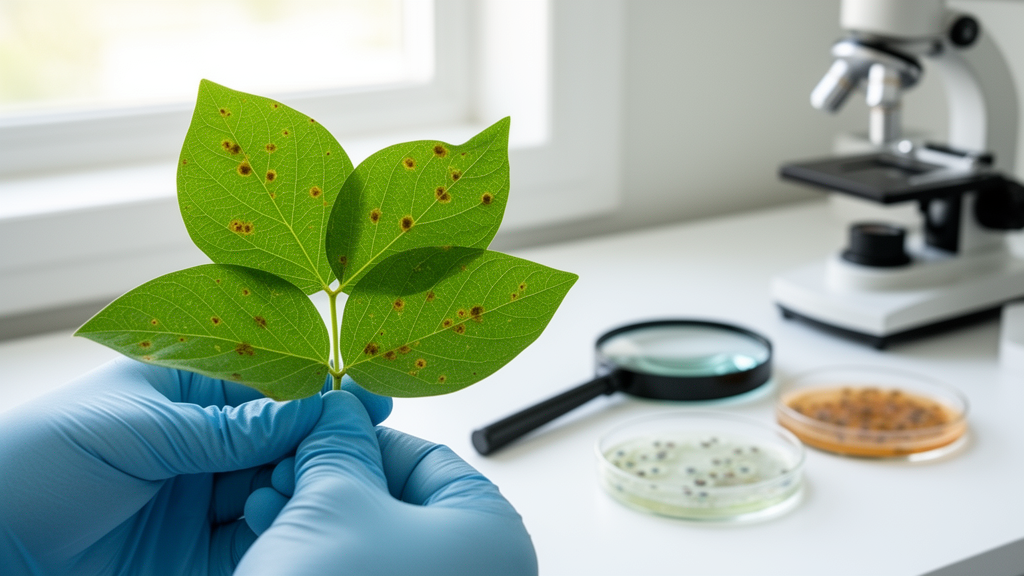
On the surface, a diseased cowpea leaf in Hainan Province, China, looks like an agricultural nuisance. But for a team of mycologists, those symptomatic leaves turned out to be hiding something far more interesting: two fungal species that no one had ever described before. Writing in the journal MycoKeys, researchers S.X. Zhou and J.X. Deng report the discovery of Alternaria unguiculatae sp. nov. and Alternaria hainanensis sp. nov., two novel members of one of the most taxonomically notorious genera in the entire fungal kingdom. The finding, published on August 18, 2026, expands the known diversity of fungi associated with one of the world’s most important legume crops.
Alternaria is a genus of dematiaceous fungi — darkly pigmented molds — that currently comprises more than 790 species epithets and over 360 accepted species distributed among 30 sections. Members of the genus occupy remarkably diverse ecological niches: some live as endophytes inside healthy plant tissues, others as saprobes decomposing dead organic matter, and still others as aggressive pathogens attacking economically important crops. This ecological versatility, combined with extraordinary morphological similarity between closely related taxa, has made Alternaria a persistent headache for taxonomists trying to draw species boundaries.
The core problem lies in what mycologists call small-spored taxa. Traditionally, Alternaria species were divided into large-spored and small-spored groups based on conidial shape, septation, beak morphology, and conidial catenation. But these features overlap so frequently between closely related species that morphology alone often fails to distinguish them. The situation is particularly acute in Alternaria sect. Alternaria, where multilocus and genomic analyses supported only 11 phylogenetic species and one species complex, while 35 morphospecies delimited on morphological grounds were synonymized under A. alternata. In other words, what had been treated as 36 separate species turned out to be essentially one.
This is why the discovery of two genuinely novel species from cowpea leaves is significant. The research team collected diseased cowpea (Vigna unguiculata) leaves exhibiting leaf spot symptoms from Haikou, Hainan Province, China, in 2024. Small tissue segments containing both diseased and healthy tissues were excised from the margins of typical lesions, surface sterilized in 75% ethanol and 2% sodium hypochlorite, rinsed with sterile distilled water, and placed on potato dextrose agar. After incubation at 25°C for five to seven days, single-spore isolates were obtained. From a total of 105 pure fungal cultures provisionally assigned to 20 genera, 36 cultures belonged to Alternaria. Four focal cultures — representing two putative species that could not be confidently assigned to any described species — were selected for detailed taxonomic assessment.
The researchers characterized the isolates using a five-locus phylogenetic approach targeting GAPDH, RPB2, Alt a 1, EndoPG, and OPA10-2 gene regions. These loci were selected because single-gene datasets often lack sufficient resolution to delineate species boundaries across all sections of the genus, particularly in small-spored groups. PCR amplification was performed using established primer pairs, and the resulting sequences were compared with reference strains from recent publications. After alignment trimming, the individual datasets comprised between 44 and 67 sequences and between 447 and 627 characters per locus. The best-fit nucleotide substitution models were selected under the Bayesian information criterion, and maximum likelihood and Bayesian inference analyses were conducted using IQ-TREE and MrBayes, respectively.
The phylogenetic results were unambiguous. The four strains examined in this study were all placed within Alternaria sect. Alternaria and clustered into two distinct, well-supported clades. Strains YzU 241428 and YzU 241429 formed a monophyletic clade with strong statistical support (BS/PP = 98.1/1.00), recovered as sister to Alternaria jacinthicola. Strains YzU 241394 and YzU 241395 grouped as a separate clade, supported by high nodal values (BS/PP = 95.3/1.00), and were resolved as closely related to Alternaria zeae. The clear phylogenetic separation of these two lineages from their closest relatives, together with their strong support values in the concatenated analyses, indicated that they represent two novel species within Alternaria sect. Alternaria.
Morphological comparison reinforced the molecular evidence. Alternaria hainanensis produces obclavate to long-obclavate conidia measuring 24–53 × 10–18 µm on potato carrot agar, with 3–6 transverse septa and cylindrical to filiform beaks measuring 7–33 × 3–5 µm. Conidia are formed in chains of 4–7 units — notably longer than the 2–4 conidia per chain produced by its closest relative A. zeae. The new species is further distinguished by longer conidia, longer swollen-tipped apical beaks, and orange-red pigment deposition on potato dextrose agar, a trait absent in A. zeae colonies. Comparative sequence analyses revealed seven nucleotide differences across the sequenced gene regions between strain YzU 241394 and A. zeae, including three base pairs in GAPDH and four base pairs in RPB2.
Alternaria unguiculatae, the second new species, presents a different morphological profile. Its conidia are ovate to narrowly obclavate, measuring 30–55 × 10–19 µm on potato carrot agar, with 2–5 transverse and 0–1 longitudinal or oblique septa. The median transverse septum is often constricted and slightly thickened, and some conidia bear a cylindrical beak or pseudobeak continuous with the conidial body, occasionally slightly swollen at the tip, measuring 11–21 × 3–4 µm. On V8 juice agar, conidial chains are longer, with 4–5 conidia per chain and slightly increased septation. Phylogenetically, strain YzU 241429 differed from all three included cultures of A. jacinthicola at two positions in Alt a 1 and one position in RPB2, while no nucleotide differences were detected in GAPDH or EndoPG. Morphologically, A. unguiculatae produces considerably longer conidia than A. jacinthicola, which reportedly measures 9–28(–32) × 12–15 µm on the same medium.
Cowpea is an important leguminous crop widely cultivated in tropical and subtropical regions, with a global harvested area exceeding 15 million hectares and an annual dry grain production of approximately 9 million metric tons. Several Alternaria taxa have been reported from cowpea and related cultivated forms of Vigna unguiculata, including A. vignae from China, A. cassiae from South Africa, A. malorum from Iran, and A. alternata from yardlong bean in India. However, the currently known records of Alternaria on cowpea remain limited, and the species-level taxonomy of the associated isolates is still poorly resolved. The two new species described in this study provide genomic data for cowpea-associated Alternaria and expand the known diversity of the genus associated with Fabaceae in China.
The researchers emphasize that the recognition of the two new taxa is supported not by any single morphological character alone but by the congruence between multilocus phylogenetic placement and comparative morphology. These substitutions are interpreted as lineage-associated character-state differences rather than as a numerical threshold sufficient on its own for species delimitation. The study reinforces the value of combining detailed morphological comparison with multilocus phylogenetic evidence for delimiting closely related species in small-spored Alternaria, and suggests that host-associated diversity within Alternaria sect. Alternaria remains insufficiently documented even within a relatively stable phylogenetic framework. As host-focused surveys continue across particular crops, regions, and agricultural systems, further unrecognized diversity of small-spored Alternaria taxa is likely to emerge.
Subject of Research: Mycology
Article Title: Two novel species of Alternaria ( Pleosporales , Pleosporaceae ) from cowpea ( Fabaceae ) in China
Article References: Zhou, S.-X., Huang, J.-H., Chen, S.-Q., Deng, Q., Shi, C.-H., Wen, Q.-Z., Yan, P.-P., & Deng, J.-X. (2026). Two novel species of Alternaria (Pleosporales, Pleosporaceae) from cowpea (Fabaceae) in China. MycoKeys, 138, 329-344. https://doi.org/10.3897/mycokeys.138.205866
Image Credits: AI Generated
DOI: 10.3897/mycokeys.138.205866
Keywords: Alternaria, cowpea, fungi, Hainan, China, taxonomy, phylogenetics, plant pathology, MycoKeys, new species, novel, species
Cite Scienmag News
Roger Howard. (October 18, 2026). Two New Fungal Species Hidden in Cowpea Leaves Uncovered in China. Scienmag. https://scienmag.com/two-new-fungal-species-hidden-in-cowpea-leaves-uncovered-in-china/
Roger Howard. "Two New Fungal Species Hidden in Cowpea Leaves Uncovered in China." Scienmag, 18 October 2026, https://scienmag.com/two-new-fungal-species-hidden-in-cowpea-leaves-uncovered-in-china/. Accessed 18 October 2026.
Roger Howard. "Two New Fungal Species Hidden in Cowpea Leaves Uncovered in China." Scienmag. October 18, 2026. https://scienmag.com/two-new-fungal-species-hidden-in-cowpea-leaves-uncovered-in-china/


