


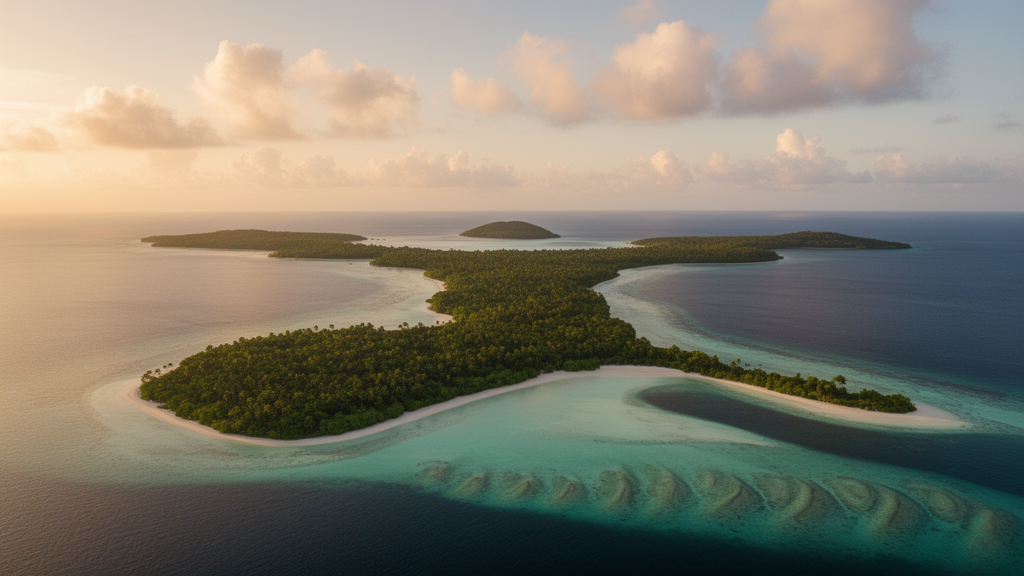
When sea levels fall during ice ages, islands that now sit apart in sparkling blue water can quietly join hands beneath the waves. A new study published in Frontiers of Biogeography extends the Sea-Level Sensitive (SLS) dynamic model of marine island biogeography to capture this hidden choreography, introducing a three-way classification of islands based on whether they merge and split as glaciers wax and wane. The work, led by Sergio P. Ávila and colleagues, argues that these fusion-fission dynamics leave a measurable imprint on the evolution of shallow-water marine life, from the splitting of populations to the birth of new species.
The starting point is a deceptively simple observation: from an evolutionary standpoint, the frequency of complete speciation events is controlled by three processes—the rate at which populations split, the rate at which they go extinct, and the rate at which previously separated populations merge. On land, island biogeographers have long known that these rates vary with island age, area, isolation, elevation, and topographic complexity. Over the past decade, researchers studying terrestrial islands have incorporated the effects of Quaternary glacial-interglacial cycles, during which falling seas can fuse neighboring islands into a single landmass and rising seas can split them apart again. But the marine realm, where the habitat itself is submerged, has remained largely untouched by this fusion-fission framework.
The team’s solution rests on a quantity called the insular littoral area, or ILA: the submarine area between the mean sea level at any given time and the 50-meter isobath. The 50-meter cutoff matters biologically, because below that depth a gradual shift occurs in invertebrate species composition and algal diversity drops sharply. For gastropods and algae, 50 meters is the appropriate lower limit; for organisms with wider bathymetric ranges, such as echinoderms and bivalves, it extends to 100 meters, and for reef fishes with deep-dwelling adults, to 200 meters. Molluscs, with the best fossil record in insular habitats, remain the model group, and the 50-meter limit maximizes the visible effects of sea-level change on their habitats.
From this foundation, the authors carve out three new island categories. Solum islands, from the Latin for
The naming of the three island types reflects the authors’ habit of reaching into classical languages for terms that capture a geological relationship in a single word. Solum islands, from the Latin for “alone,” are islands whose surrounding seafloor drops below the critical depth threshold, so that even when glacial-era sea levels fell by more than a hundred meters, they never joined a neighbor. Their shallow marine habitats contracted and expanded through each cycle, but their biota remained genetically and ecologically isolated throughout the islands’ entire history. Soror islands, from the Latin for “sister,” occupy the opposite dynamic regime: the seafloor between neighboring islands lies deeper than fifty meters, so during interglacial high stands they appear as separate islands, yet during glacial low stands the intervening sill emerges or becomes shallow enough that the islands fuse into a single landmass. Each glacial-interglacial cycle therefore alternately connects and disconnects their shallow-water faunas, imposing a repeated rhythm of population merging and splitting that has no terrestrial analogue at this tempo. Moliones islands, named for the conjoined twins of Greek mythology born to Molione and Poseidon, represent the third case: two or more islands whose intervening seafloor is always shallower than fifty meters, meaning that from the perspective of a shallow-water marine organism they have always functioned as a single island, regardless of where the coastline happens to sit at any moment.
The classification is not merely descriptive. Because the three island types experience fundamentally different histories of habitat connectivity, they should generate different frequencies of the three processes that govern speciation: population splitting, extinction, and merging. On Solum islands, populations persist in continuous isolation, so splitting events driven by the physical separation of habitats should be rare, and the dominant evolutionary dynamics involve local extinction and recolonization shaped by island area alone. On Soror islands, by contrast, every glacial cycle offers an opportunity for previously separated populations to merge, and every interglacial cycle offers an opportunity for a once-continuous population to be divided. This oscillation is predicted to elevate both splitting and merging rates relative to the other island types, with consequences for how quickly new lineages arise and how often they collapse back into genetic contact. Moliones islands, functioning as permanent single units for shallow-water biota, should behave like Solum islands in terms of connectivity, but with the important difference that their effective littoral area is the combined shelf area of the whole group, potentially supporting larger populations and lower extinction rates.
To ground these concepts in real geography, the authors assembled a dataset of 324 islands spanning temperate and tropical climates and a deliberately broad geographic distribution. The classification revealed a striking asymmetry: only 50 islands qualified as Solum islands, standing alone through every sea-level oscillation. Seventy-seven islands fell into 20 groups of Soror islands, the true fusion-fission cases where glacial cycles repeatedly rewired connectivity. The largest share, 197 islands arranged in 34 groups, turned out to be Moliones islands, functionally conjoined for marine purposes no matter what the sea was doing. This distribution suggests that the image of oceanic islands as isolated dots in a vast sea, so influential in the terrestrial tradition of island biogeography since MacArthur and Wilson, may substantially misrepresent the marine experience: for shallow-water organisms, the majority of islands in the sample have always been connected to neighbors across shallow sills, and only a minority have known true isolation.
A second major contribution of the study is the recognition that sea-level change does not translate uniformly into habitat change. When sea level falls, the insular littoral area of an island may shrink, hold steady, or in some configurations even behave counterintuitively, depending on how the submarine terrain is shaped. The authors identify five general types of curves describing how ILA changes through a glacial-interglacial cycle, and they trace this variation back to the depth distribution across each island’s shelf. That depth distribution, in turn, is not random but reflects geological history. Young volcanic islands tend to have steep flanks and narrow shelves, so a given drop in sea level removes little habitat; old, subsiding islands may carry broad, gently sloping shelves where the same drop eliminates vast tracts of littoral ground. Tectonic setting matters, as does the presence of submarine and subaerial terraces, which are relict shorelines carved during earlier sea-level stands and which create stepped profiles that produce abrupt, nonlinear changes in available habitat as the sea crosses each terrace. Coral reefs add yet another layer of complexity, because reef organisms build structures that modify both the topography and the ecological character of the shallow seafloor, and reef growth can partially keep pace with or amplify changes in available habitat.
The Pleistocene context gives these dynamics their tempo. Over the past few million years, Earth has cycled repeatedly between glacial periods, when continental ice sheets locked up enough water to lower global sea level by well over a hundred meters, and interglacial periods like the present, when sea level stands high. For marine organisms restricted to shallow water, each cycle compressed their habitat into a narrow band around a lower coastline and then released it again across a broader shelf. Populations that today appear separated by deep channels may have shared larvae and genes only a few tens of thousands of years ago, when the channel floor was dry land or shallow sea. Conversely, populations that seem contiguous today may have been fragmented across separate basins during the low stands. The fossil record of molluscs in insular settings, the best preserved among shallow marine groups, offers a way to test these predictions, since shells archive both the presence of species and, through geochemical and morphological study, something of the environments they inhabited.
The study’s predictions extend to speciation rates themselves. Shallow-water marine organisms on Soror islands are expected to show elevated rates of population splitting during fission phases, when rising seas subdivide once-connected habitats, and elevated merging during fusion phases, when falling seas reunite them. Whether this oscillation ultimately produces more species or fewer depends on the balance between divergence during isolation and homogenization during contact, a tension familiar from terrestrial fusion-fission studies but now, for the first time, framed explicitly for the sea. Extinction rates should track the ILA curves: islands whose littoral area collapses dramatically during low stands should suffer proportionally greater losses of shallow-water species, while islands whose ILA remains comparatively stable through the cycles should act as refugia. These differential responses across the five ILA curve types and three island categories provide a rich set of testable hypotheses for comparative biogeography.
What emerges from the extended SLS model is a picture of marine island biogeography in which the sea floor’s hidden topography, rather than the visible outline of coastlines, determines the evolutionary fate of shallow-water life. The depth of a sill between two islands, the slope of a shelf, the presence of an ancient terrace, or the growth of a reef can each decide whether populations merge, split, persist, or vanish as glaciers come and go. By classifying islands according to these submerged architectures, the study gives researchers a practical framework for predicting where speciation should be most active, where extinction risk concentrates during sea-level falls, and where the faunas of neighboring islands are, in evolutionary terms, a single interconnected population wearing the disguise of an archipelago.
Subject of Research: Extending the Sea-Level Sensitive dynamic model of marine island biogeography to include fusion-fission islands driven by glacial-interglacial sea-level cycles
Article Title: Extending the Sea-Level Sensitive dynamic model of marine island biogeography to include fusion-fission islands
Article References: Ávila, S. P., Múrias dos Santos, A., Melo, C. S., Porteiro, J. M., Medeiros, A. M., Baptista, L., Pimentel, A., Madeira, P., Rebelo, A. C., Hipólito, A., Voerman, S. E., Ávila, G. C., Moura, M., Berning, B., Rijsdijk, K. F., Martín-González, E., Quartau, R., Ramalho, R. S., & Johnson, M. E. (2025). Extending the Sea-Level Sensitive dynamic model of marine island biogeography to include fusion-fission islands. Frontiers of Biogeography, 18, Article e141200. https://doi.org/10.21425/fob.18.141200
Image Credits: AI Generated
Keywords: island biogeography, sea-level change, marine speciation, fusion-fission islands, insular littoral area, glacial-interglacial cycles, Solum islands, Soror islands, Moliones islands, Cabo Verde, Conus, shallow-water marine biodiversity
Cite Scienmag News
Margaret Porter. (October 18, 2026). Islands that merge and split: new model links ice-age sea levels to marine speciation. Scienmag. https://scienmag.com/islands-that-merge-and-split-new-model-links-ice-age-sea-levels-to-marine-speciation/
Margaret Porter. "Islands that merge and split: new model links ice-age sea levels to marine speciation." Scienmag, 18 October 2026, https://scienmag.com/islands-that-merge-and-split-new-model-links-ice-age-sea-levels-to-marine-speciation/. Accessed 18 October 2026.
Margaret Porter. "Islands that merge and split: new model links ice-age sea levels to marine speciation." Scienmag. October 18, 2026. https://scienmag.com/islands-that-merge-and-split-new-model-links-ice-age-sea-levels-to-marine-speciation/


