


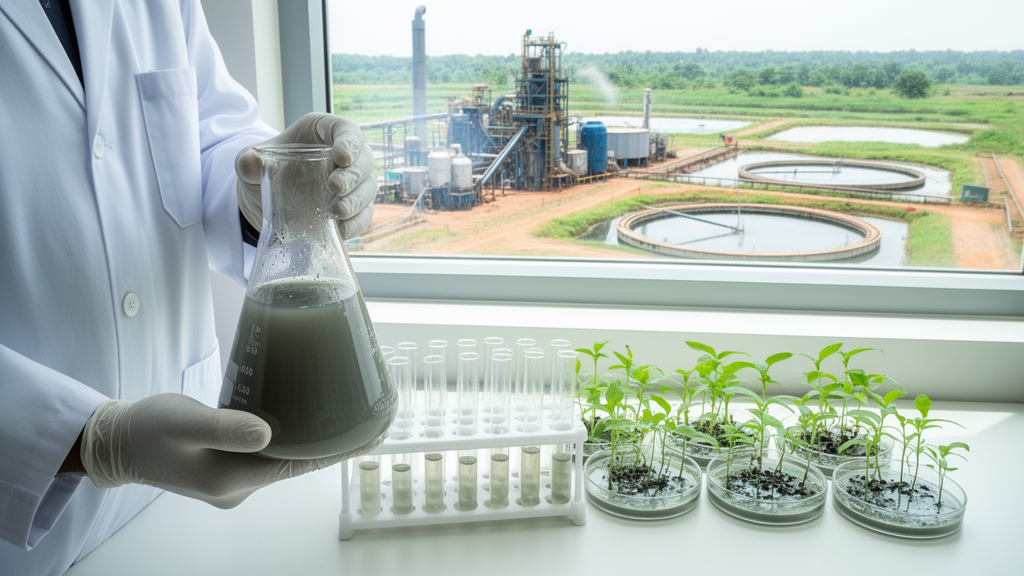
Deep in the rubber-producing heartland of southern India, small factories churn out slabs of processed latex every day, and the water they leave behind is quietly rewriting the chemistry of the local environment. A new study from researchers at Yenepoya (Deemed to be University) in Mangalore has taken a hard look at that wastewater, and the results are a vivid warning about what flows out of acid coagulation tanks when nobody is watching. The team, led by Chandana Ande Neelakantappa with colleagues Pavithra Govinda and Bhagya Nekrakalaya, evaluated wastewater discharged from small-scale rubber industries in the Dakshina Kannada district of Karnataka, and then tested its effects on two familiar plant models: onion bulbs and mung bean seeds. What they found was a cocktail of pollutants well above permissible discharge limits, and clear evidence that this effluent can stunt plant growth and scramble plant chromosomes.
The physicochemical analysis revealed a complex mixture of micronutrients, inorganic salts, and heavy metals in the rubber wastewater. Iron was present at 0.5 milligrams per litre and nitrate at 25 milligrams per litre, while total hardness reached 625 plus or minus 3.60 milligrams per litre. More alarming were the biochemical oxygen demand of 547.10 plus or minus 10 milligrams per litre and the chemical oxygen demand of 866 plus or minus 11 milligrams per litre, both indicators of a heavy load of organic pollutants that consume dissolved oxygen as they break down. Heavy metals such as zinc, measured at 5297.50 plus or minus 167.50 parts per billion, and nickel at 56.00 plus or minus 2.12 parts per billion, were also detected. Every one of these parameters exceeded the permissible limits set for drinking water or for the general discharge of environmental pollutants under Indian standards.
Those numbers matter because rubber processing is fundamentally a colloidal chemistry operation. Liquid latex is a stable suspension of rubber particles that must be destabilised, typically by adding acid, to coagulate into solid slabs. The acid coagulation tanks where this happens generate waste streams loaded with dissolved salts, organic matter from the latex itself, and whatever metals and additives the raw material carried. When that waste is released untreated, it enters streams, soils, and groundwater with its chemical signature intact. The high BOD and COD values in the Dakshina Kannada samples point to exactly this kind of untreated or poorly treated discharge, one that can strip oxygen from receiving waters and suffocate aquatic life before plants and animals ever feel the direct toxic effects of the dissolved contaminants.
To test whether the wastewater actually harms living organisms, and not just looks bad on a lab report, the researchers grew onion bulbs and mung bean seeds in the effluent at different concentrations. The results were dose-dependent and unambiguous. As the concentration of wastewater increased, root and shoot lengths shrank, biomass declined, and the antioxidant capacity of the plants dropped. Protein and sugar contents were altered as well, suggesting that the plants’ basic metabolism was being disrupted. In mung bean, a staple legume widely cultivated across Asia, the effects on germination and seedling growth point to real agricultural risk if such effluent reaches irrigated fields. In onion, a classic bioassay organism used for decades in environmental monitoring, the changes provided a measurable readout of physiological stress.
The most striking findings came from the onion root tips, where the team looked directly at cell division. At higher concentrations of wastewater, the mitotic index, a measure of how many cells are actively dividing, decreased significantly. At the same time, chromosomal aberrations increased. These are the hallmarks of genotoxicity, damage to the genetic material itself. Chromosomal aberrations can include breaks, fragments, and other structural anomalies that arise when dividing cells are exposed to mutagenic agents. A decreased mitotic index means the effluent is suppressing cell proliferation, either by poisoning the division machinery directly or by halting cells before they enter mitosis. Together, these cytogenetic effects confirm that rubber wastewater is not merely a growth inhibitor but a genuine mutagenic hazard to plant cells.
Heavy metals are the leading suspects behind these cytogenetic effects. Zinc at nearly 5300 parts per billion is orders of magnitude above what plants would normally encounter in uncontaminated water, and nickel, even at 56 parts per billion, is a known genotoxic agent in many bioassay systems. Both metals can interfere with DNA replication and repair, generate oxidative stress, and disrupt the spindle apparatus that segregates chromosomes during cell division. The high organic load, indicated by the elevated BOD and COD, may compound the problem by adding additional dissolved contaminants that the physicochemical analysis did not fully characterise. The researchers suggest that these pollutants, acting individually or in combination, are what drove the observed changes in the plants.
The study’s implications reach beyond the laboratory and into the rubber-producing economy of Dakshina Kannada, a district where rubber plantations and processing industries have expanded substantially in recent decades. Small-scale rubber industries are numerous in the region, and their effluent often flows into local water bodies with little oversight. The new data show that this effluent carries a pollutant load capable of damaging crop plants at the cellular level, which raises concerns about food safety, soil health, and the long-term sustainability of agriculture near rubber processing operations. The findings also add to a growing international literature on the genotoxicity of industrial wastewaters, from pharmaceutical effluents to municipal waste, all pointing to the same conclusion: what we discharge matters, and bioassays can detect harm that chemical analysis alone might miss.
The researchers argue that pre-treatment of rubber wastewater before its release into the environment is essential. Various treatment approaches have been explored in the literature, including constructed wetlands, chemical precipitation, flocculation, and membrane filtration, each with its own advantages and limitations. The high organic load and heavy metal content identified in this study suggest that a multi-stage treatment system would be needed to bring the effluent within permissible discharge limits. The authors also note that the presence of micronutrients such as iron and nitrate, while beneficial in small quantities, becomes problematic when combined with the toxic load of heavy metals and organic pollutants, making simple dilution or land application risky strategies.
What makes this study particularly compelling is its integration of chemical analysis with biological testing. Chemical parameters tell us what is in the water, but bioassays tell us what that water does to living organisms. The onion and mung bean models used here are inexpensive, reproducible, and sensitive, which is why they remain standard tools in environmental toxicology decades after their introduction. By combining physicochemical characterisation with phytotoxicity and genotoxicity screening, the researchers built a case that is hard to dismiss: rubber wastewater in Dakshina Kannada is chemically out of compliance and biologically harmful, and the two findings reinforce each other. This kind of convergent evidence is what regulators need to justify stricter enforcement of discharge standards.
The study, published in Environmental Science and Pollution Research, was supported by Yenepoya (Deemed to be University) through a seed grant and a Junior Research Fellowship. The authors declare no competing interests. As rubber production continues to expand across southern India and beyond, the message from this research is clear: the water that rubber factories leave behind is not benign, and treating it before release is not optional. The chromosomes of the plants growing downstream are already telling us what happens when we forget that.
Subject of Research: Evaluation of physicochemical parameters of rubber industry wastewater and screening for its phytotoxicity and genotoxicity from Dakshina Kannada district, Karnataka, India
Article Title: Evaluation of physicochemical parameters of rubber industry wastewater and screening for its phytotoxicity and genotoxicity from Dakshina Kannada district, Karnataka, India
Article References: Neelakantappa, C. A., Govinda, P., & Nekrakalaya, B. (2026). Evaluation of physicochemical parameters of rubber industry wastewater and screening for its phytotoxicity and genotoxicity from Dakshina Kannada district, Karnataka, India. Environmental Science and Pollution Research. https://doi.org/10.1007/s11356-026-38320-8
Image Credits: AI Generated
DOI: 10.1007/s11356-026-38320-8
Keywords: Evaluation, physicochemical, parameters, rubber, industry, wastewater, screening, phytotoxicity, genotoxicity, Dakshina, Kannada, district
Cite Scienmag News
Violet Maxwell. (October 17, 2026). Evaluation of physicochemical parameters of rubber industry wastewater and screening for its phytotoxicity and genotoxicity from Dakshina Kannada district, Karnataka, India. Scienmag. https://scienmag.com/evaluation-of-physicochemical-parameters-of-rubber-industry-wastewater-and-screening-for-its-phytotoxicity-and-genotoxicity-from-dakshina-kannada-district-karnataka-india/
Violet Maxwell. "Evaluation of physicochemical parameters of rubber industry wastewater and screening for its phytotoxicity and genotoxicity from Dakshina Kannada district, Karnataka, India." Scienmag, 17 October 2026, https://scienmag.com/evaluation-of-physicochemical-parameters-of-rubber-industry-wastewater-and-screening-for-its-phytotoxicity-and-genotoxicity-from-dakshina-kannada-district-karnataka-india/. Accessed 17 October 2026.
Violet Maxwell. "Evaluation of physicochemical parameters of rubber industry wastewater and screening for its phytotoxicity and genotoxicity from Dakshina Kannada district, Karnataka, India." Scienmag. October 17, 2026. https://scienmag.com/evaluation-of-physicochemical-parameters-of-rubber-industry-wastewater-and-screening-for-its-phytotoxicity-and-genotoxicity-from-dakshina-kannada-district-karnataka-india/


