


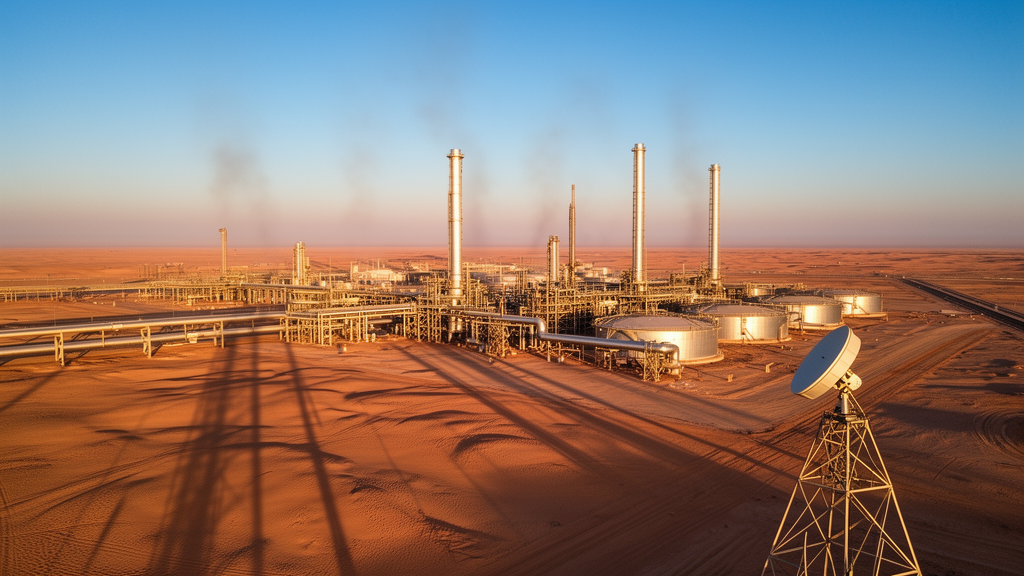
Iran’s oil and gas infrastructure and sprawling waste sites are leaking far more methane than official records suggest, according to a new satellite-based assessment published in Environmental Monitoring and Assessment. The study, led by Hossein Maazallahi of the University of Tehran together with Fathollah Pourfayaz and Maryam Avishan of Iran’s Department of Environment, combed four years of satellite observations from 2022 to 2025 to track methane super-emitters—individual sources releasing more than 100 kilograms of the gas per hour—across the country’s energy and waste sectors. What the team found is a stark portrait of a measurement gap: emissions tallied from orbit differ dramatically from the figures Iran reports to the international community, and even the most widely used global databases disagree with one another by orders of magnitude.
The scale of the discrepancy is striking. Annualized top-down emissions from oil and gas super-emitters, as quantified from satellite data, ranged from 1,390 plus or minus 70 kilotonnes per year to 6,500 plus or minus 200 kilotonnes per year over the study period. Waste-sector emissions from super-emitters ranged from 110 plus or minus 20 kilotonnes to 630 plus or minus 70 kilotonnes annually. These wide inter-annual swings, the authors note, largely reflect genuine variability in the sources themselves as well as the study’s deliberate focus on the largest emitters rather than the full population of leaks. Methane is a particularly potent short-lived climate forcer, with a warming effect many times that of carbon dioxide over a twenty-year horizon, which makes pinpointing and plugging these super-emitter events one of the fastest available levers for slowing near-term climate change.
To establish an independent benchmark, the researchers recalculated methane emissions from Iran’s solid waste disposal sites using the Intergovernmental Panel on Climate Change’s Tier-1 methodology, a bottom-up approach that estimates emissions from waste quantities, composition, and decay behavior. That recalculation yielded roughly 700 kilotonnes per year, with an uncertainty range spanning 160 to 1,900 kilotonnes. The figure towers over Iran’s Third National Inventory Report, which lists just 23 kilotonnes per year from solid waste disposal, and it also substantially exceeds the 400 to 500 kilotonnes per year reported in EDGAR v8.0, the Emissions Database for Global Atmospheric Research maintained by the European Commission. In other words, the official national inventory may be understating landfill methane by a factor of thirty relative to the independent recalculation, while even the global reference database sits well below the bottom-up estimate.
The satellite data also revealed distinct seasonal rhythms in the two sectors. Oil and gas emissions peaked during the warmer months of the year, a pattern consistent with temperature-driven processes such as increased evaporation from storage tanks, higher equipment stress, and greater venting activity in heat. Waste emissions, by contrast, peaked in the cooler months. That inverse seasonality is physically plausible: methane production in landfills depends on microbial activity within the waste mass, which generates heat and can accelerate decomposition in insulated, actively decomposing layers even as surface temperatures drop, while methane-oxidizing bacteria in cover soils slow down in cold conditions, allowing more of the generated gas to escape. Comparable seasonal behavior has been documented at landfills from China to cold-climate Europe, lending confidence to the Iranian pattern.
Yet the study is as much a cautionary tale about satellite monitoring as it is an indictment of the inventories. In communications with the National Iranian Petrochemical Company, the researchers concluded that some of the methane emission points flagged by satellites were questionable. Two mechanisms stand out as likely culprits. The first is spectral overlap: methane absorbs light in the shortwave infrared at wavelengths where other hydrocarbons, such as ethane and heavier volatile organic compounds abundant in oil and gas operations, also leave absorption fingerprints. Retrieval algorithms tuned to methane can therefore misattribute plumes produced by co-emitted gases. The second is spatial misattribution, in which a plume observed at coarse pixel resolution drifts with the wind and is assigned to the wrong facility, or in which emissions from a cluster of nearby infrastructure are lumped onto a single conspicuous source.
These pitfalls do not invalidate satellite monitoring—far from it. Instruments such as the Copernicus Sentinel missions, hyperspectral imagers, and purpose-built methane mappers have transformed the field, enabling the detection of well blowouts, pipeline ruptures, and landfill hotspots that would otherwise go unnoticed. But the Iranian case underscores a principle that is rapidly hardening into consensus among atmospheric scientists: robust quantification, attribution, and verification require layering complementary measurements. Ground-based surveys, vehicle-mounted analyzers, drone flights, and airborne campaigns can resolve individual facilities at source level, while satellites provide the synoptic coverage and revisit rates needed to catch intermittent, transient events. Super-emitters are notoriously intermittent, and sampling frequency strongly affects how well their contribution to total emissions can be captured, a challenge documented across basins from the Permian to the Gulf of Mexico.
The study’s data foundation came from the United Nations Environment Programme’s International Methane Emissions Observatory, whose Methane Alert and Response System publicly distributes satellite-detected emission plumes and quantified rates. The authors acknowledge the MARS program team for data discussions, and their analysis drew on datasets that are freely available to any researcher, a transparency that itself illustrates how international initiatives are lowering the barriers to emissions accountability. For Iran, however, the institutional picture is lagging behind the observational one. The country’s national emission inventories have not been updated since 2017, a gap that leaves policymakers working from figures that the new analysis suggests are unreliable for both the energy and waste sectors.
The mitigation opportunities identified in the paper are concrete and, in many cases, economically rational. Flared gas—the natural gas burned off at oil production sites for lack of capture infrastructure—could instead be utilized for domestic energy supply or industrial feedstock, simultaneously cutting methane and carbon dioxide emissions while recovering a valuable resource. Iran has long been among the world’s largest flaring countries, and global flaring trackers continue to flag the scale of the practice. On the waste side, landfill gas recovery systems can capture methane for electricity generation or heating, converting a potent greenhouse gas into a fuel while reducing odor and fire hazards at disposal sites. Both measures align with findings from other regions that oil infrastructure and landfills hold high mitigation potential when monitoring is paired with targeted engineering interventions.
Engagement with international frameworks offers a further pathway. The Oil and Gas Methane Partnership 2.0, administered under UNEP, provides a standardized protocol for companies and countries to measure, report, and verify methane emissions at progressively rigorous levels, culminating in direct source measurement rather than emission factors. The International Methane Emissions Observatory aggregates these reports alongside satellite and scientific data to build an independent picture of who is emitting what, where, and when. For a country whose inventory reporting has been dormant since 2017, participation in such frameworks would supply both the methodology and the external credibility needed to rebuild a trustworthy accounting system. The authors frame this as a matter of advancing monitoring, reporting, and verification—a triad that underpins not only climate policy but also energy security and, as they argue elsewhere, climate diplomacy in the region.
The broader lesson extends well beyond Iran’s borders. Around the world, national inventories built on sparse data and generic emission factors are being confronted by an expanding constellation of satellites capable of watching individual facilities in near real time. Studies comparing inventories with atmospheric inversions across oil, gas, and coal sectors have repeatedly found material discrepancies, and global satellite surveys of landfill methane have revealed similar uncertainty at waste sites worldwide. The Iranian study adds a nationally grounded case study to this growing literature, demonstrating both the power of orbital observation and its limits. Methane super-emitters are, by definition, the most consequential and most fixable sources in the global methane budget; catching them accurately, attributing them correctly, and verifying that repairs actually work will determine whether the world’s methane pledges translate into measurable climate benefit. For Iran, the message is unambiguous: the satellites are watching, the numbers on paper do not match the sky, and the tools to close the gap already exist.
Subject of Research: Satellite-based assessment of methane super-emitter emissions from Iran's oil and gas and waste sectors compared with national and global emission inventories
Article Title: Iran’s methane super-emitters: assessment of discrepancies between satellite observations and inventories
Article References: Maazallahi, H., Pourfayaz, F., & Avishan, M. (2026). Iran’s methane super-emitters: assessment of discrepancies between satellite observations and inventories. Environmental Monitoring and Assessment, 198(11), Article 1216. https://doi.org/10.1007/s10661-026-16045-y
Image Credits: AI Generated
DOI: 10.1007/s10661-026-16045-y
Keywords: methane, super-emitters, satellite observations, Iran, emission inventories, oil and gas, landfills, EDGAR, IPCC Tier-1, OGMP 2.0, IMEO, gas flaring
Cite Scienmag News
Violet Maxwell. (October 17, 2026). Satellites Reveal Iran’s Methane Super-Emitters—and Where the Numbers Disagree. Scienmag. https://scienmag.com/satellites-reveal-irans-methane-super-emitters-and-where-the-numbers-disagree/
Violet Maxwell. "Satellites Reveal Iran’s Methane Super-Emitters—and Where the Numbers Disagree." Scienmag, 17 October 2026, https://scienmag.com/satellites-reveal-irans-methane-super-emitters-and-where-the-numbers-disagree/. Accessed 17 October 2026.
Violet Maxwell. "Satellites Reveal Iran’s Methane Super-Emitters—and Where the Numbers Disagree." Scienmag. October 17, 2026. https://scienmag.com/satellites-reveal-irans-methane-super-emitters-and-where-the-numbers-disagree/


