


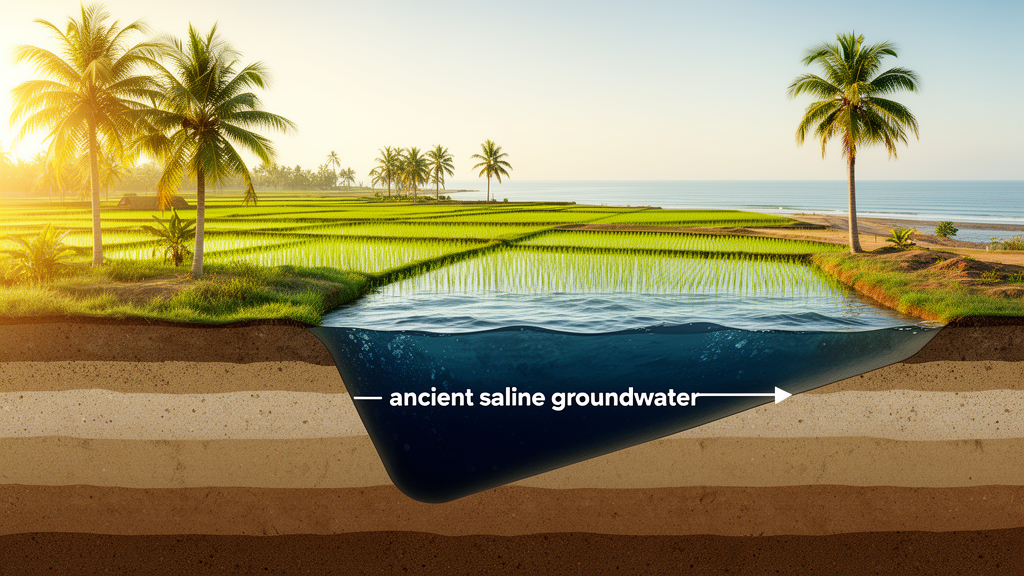
Deep beneath the Luy River catchment in Vietnam’s Binh Thuan Province, some of the groundwater pumping from wells today may have fallen as rain before the pyramids were built. A new study published in Hydrogeology Journal shows that salty water trapped in the coastal aquifer system when sea levels peaked around 5,000 years ago has still not fully flushed out, and that thin, discontinuous layers of clay are largely to blame for its stubborn persistence. The finding, based on a three-dimensional, density-dependent groundwater model built from well logs, geophysical surveys and hydrochemistry, offers a vivid reminder that the water beneath our feet does not always obey the rules of the present.
Coastal aquifers are among the most contested water resources on Earth. Where fresh groundwater meets seawater, the two fluids coexist in a delicate balance: freshwater flows seaward, pushing back the denser saltwater wedge that creeps inland beneath it. Pump too much, and the balance collapses, drawing saline water into wells that communities depend on. But the new research, led by Linh Dieu Pham of Ghent University together with colleagues at Vietnamese and Belgian institutions, adds a crucial twist to this familiar story: not all salinity in a coastal aquifer is modern. Some of it is a fossil inheritance from a time when the coastline stood much closer to where your well is drilled today.
The team focused on the Luy River catchment, a semi-arid coastal basin in south-central Vietnam where saltwater intrusion is an acute management problem. Previous work by the same group had used electrical resistivity tomography and hydrochemical sampling to map the extent of salinization and to identify chemical fingerprints of both intrusion and freshening. Hydrochemistry, the analysis of dissolved ions such as chloride, sodium and calcium in water samples, can reveal whether a water body is actively being invaded by seawater or is slowly being rinsed clean by freshwater percolating from above. Those observations suggested that parts of the aquifer held ancient saline water, but a conceptual picture drawn from chemistry alone needed a rigorous numerical test.
That test took the form of a three-dimensional groundwater flow and solute transport model capable of handling variable density. Density matters enormously in coastal systems: because seawater is roughly 2.5 percent denser than freshwater, salty water sinks and pools in deeper layers, resisting removal by ordinary flow. The researchers first assembled a hydrostratigraphic model of the subsurface, using existing well logs, geophysical data and hydrochemical observations to define the geometry of sandy aquifers and the clay-rich aquitards that separate them. They then ran simulations reaching back to the last marine highstand, the peak of sea level roughly 5,000 years ago, when seawater flooded far into what is now fresh territory.
The simplest experiments assumed a geologically uniform aquifer, and their results were striking in their own right. Under homogeneous conditions, the time needed for freshwater to flush out the saline legacy depended dramatically on hydraulic conductivity, the measure of how easily water moves through sediment. In highly permeable sediments with a conductivity of 18 meters per day, complete freshening took about 500 years. Drop the conductivity to 0.8 meters per day, typical of finer sediments, and the clock stretched to roughly 1,600 years. In other words, even in an idealized, uniform aquifer, the ghost of an ancient marine transgression can linger for many human generations.
Reality, however, is not uniform, and this is where the study delivers its most consequential message. When the researchers incorporated realistic hydrostratigraphic heterogeneity, including discontinuous clay aquitards that patchily interrupt the sandy layers, the freshening timeline changed qualitatively. Saline water became trapped beneath and within these low-permeability barriers, and in low-permeability sediments and deeper aquifers it persisted for more than 5,000 years, essentially surviving from the marine highstand to the present day. The clay layers act like lids on pockets of brine, slowing the downward and lateral migration of freshwater to a geological crawl.
The simulations matched the hydrochemical observations from the field, and that agreement is what elevates the work from a modeling exercise to a confirmed diagnosis of the aquifer’s condition. The chemistry had flagged the presence of paleo-groundwater, water recharged under past climatic and sea-level conditions rather than under today’s hydrological regime, and the density-dependent model independently reproduced salinity patterns consistent with that interpretation. Together, the two lines of evidence support the conclusion that the Luy River catchment still hosts groundwater whose salinity is a relic of the mid-Holocene sea, not a product of modern over-pumping alone.
For water managers, the implications are sobering and practical. If a well draws saline water from a deep aquifer, the natural assumption is that recent exploitation caused the problem and that reduced pumping will fix it. The Vietnamese case shows this reasoning can be badly wrong: the salinity may be thousands of years old, held in place by geology, and no amount of rest will flush it out on a human timescale. Conversely, freshwater pockets found near the coast may themselves be paleo-reserves, legacy freshwater that infiltrated when sea level was lower, vulnerable to depletion that cannot be quickly reversed. Sustainable management therefore requires knowing not just how salty the water is, but how old it is and why it got that way.
The study also speaks to a global challenge. Semi-arid coastal regions around the world, from the Mediterranean to South and Southeast Asia, face intensifying pressure on groundwater as populations grow and climates warm. Sea-level rise pushes saltwater wedges further inland, while reduced recharge shrinks the freshwater flux that keeps them at bay. Models of these systems frequently assume simplified, homogeneous geology, and the Luy River results suggest such assumptions can underestimate salinity persistence by factors of three or more. Heterogeneity is not a refinement; it is the controlling variable.
What makes the research methodologically notable is its integration. Rather than relying on a single data stream, the team stitched together borehole records, geophysical imaging and water chemistry into a coherent three-dimensional picture, then stress-tested that picture with process-based simulation. The approach turns the aquifer into a kind of archive, in which the present-day distribution of salt encodes a 5,000-year history of transgression, regression, rainfall and flow. Reading that archive correctly, the authors argue, is essential for any hope of managing coastal groundwater sustainably, because the past is not merely prologue beneath the Luy River. It is still flowing, slowly and saltily, through the sand.
Subject of Research: Saltwater intrusion and paleo-groundwater freshening in the coastal aquifer of the Luy River catchment, Vietnam, evaluated with three-dimensional density-dependent groundwater modeling.
Article Title: Groundwater modeling to evaluate saltwater intrusion and freshening processes identified from hydrochemistry in a coastal groundwater system in Vietnam
Article References: Pham, L. D., Paepen, M., Cong-Thi, D., Vandenbohede, A., Vu, T. T., Ho, H. H., Nguyen, F., & Hermans, T. (2026). Groundwater modeling to evaluate saltwater intrusion and freshening processes identified from hydrochemistry in a coastal groundwater system in Vietnam. Hydrogeology Journal. https://doi.org/10.1007/s10040-026-03183-3
Image Credits: AI Generated
DOI: 10.1007/s10040-026-03183-3
Keywords: groundwater, saltwater intrusion, coastal aquifer, paleo-groundwater, hydrochemistry, numerical modeling, Vietnam, hydrogeology, aquitard, freshening, density-dependent flow, Binh Thuan
Cite Scienmag News
Violet Maxwell. (October 17, 2026). Ancient Seawater Still Lurks Beneath a Vietnamese Coastal Aquifer, 5,000 Years After the Sea Receded. Scienmag. https://scienmag.com/ancient-seawater-still-lurks-beneath-a-vietnamese-coastal-aquifer-5000-years-after-the-sea-receded/
Violet Maxwell. "Ancient Seawater Still Lurks Beneath a Vietnamese Coastal Aquifer, 5,000 Years After the Sea Receded." Scienmag, 17 October 2026, https://scienmag.com/ancient-seawater-still-lurks-beneath-a-vietnamese-coastal-aquifer-5000-years-after-the-sea-receded/. Accessed 17 October 2026.
Violet Maxwell. "Ancient Seawater Still Lurks Beneath a Vietnamese Coastal Aquifer, 5,000 Years After the Sea Receded." Scienmag. October 17, 2026. https://scienmag.com/ancient-seawater-still-lurks-beneath-a-vietnamese-coastal-aquifer-5000-years-after-the-sea-receded/


