


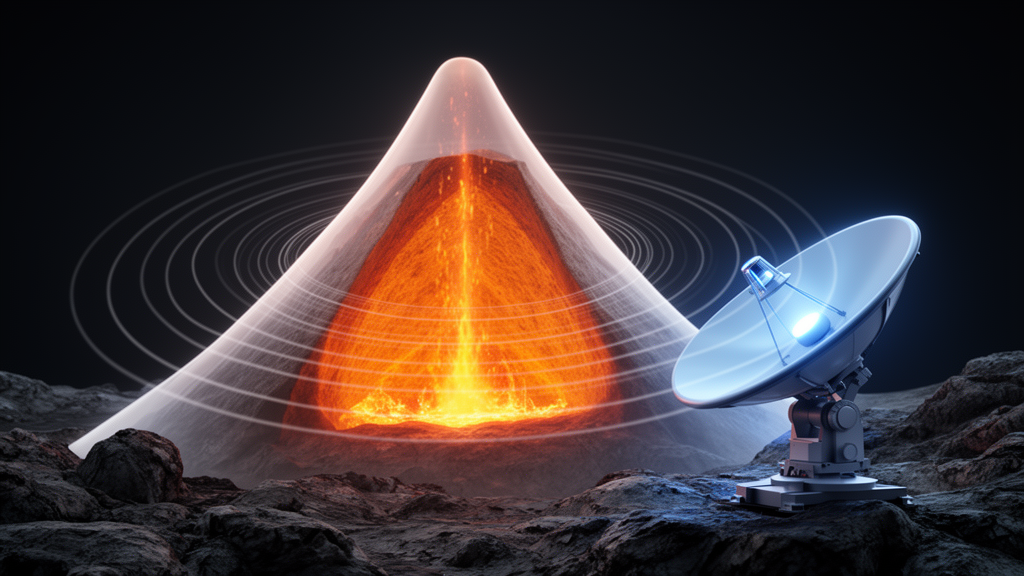
Deep beneath active volcanoes, hot water and steam carve conductive pathways through rock, and geophysicists have long struggled to read those signatures reliably from transient electromagnetic measurements. A new study published in Earth Science Informatics presents an inversion framework built on an adaptive evolutionary algorithm known as iL-SHADE, short for Improved Linear Population Size Reduction Success-History-based Adaptive Differential Evolution, and demonstrates it on field data from Unzen Volcano in Japan. The work, led by Cahyo Aji Hapsoro of the State University of Malang together with colleagues at Institut Teknologi Bandung, tackles the notoriously ill-posed problem of recovering subsurface resistivity from time-domain electromagnetic data, a task where conventional gradient-based schemes frequently stall in local minima or produce misleadingly smooth models.
Time-domain electromagnetic sounding works by driving a strong current through a grounded electric wire transmitter and recording the decaying secondary fields induced in conductive layers below. At the Unzen station UZ01, the researchers used a 1.4 kilometer grounded wire with a 2.0 kilometer receiver offset, a configuration capable of sensing resistivity structure to depths of several kilometers. The measured transients depend on the electrical resistivity of each layer, but the relationship is highly nonlinear and ill-conditioned: different combinations of layer thickness and resistivity can produce nearly identical responses, a phenomenon known as equivalence, and parameters couple strongly so that adjusting one distorts the fit of another. These properties make the inverse problem a challenging global optimization exercise rather than a straightforward parameter estimation task.
Differential evolution, the stochastic optimizer underlying the new framework, evolves a population of candidate layer models by generating trial vectors from weighted differences among existing members, then retaining whichever candidates fit the data better. Its performance, however, depends critically on mutation scale and crossover rate, settings that practitioners traditionally tune by hand for each problem. The iL-SHADE variant removes that burden through success-history adaptation, maintaining a memory of parameter values that recently produced improved models and sampling new mutation and crossover settings from that memory. As the search proceeds, the memory shifts toward the parameter combinations that work best for the specific resistivity inversion at hand, balancing broad exploration of the model space with fine local refinement near promising solutions.
The second key ingredient is linear population size reduction. The algorithm starts with a large population, maximizing the diversity of candidate earth models, then progressively shrinks it as generations advance. Early on, the swarm of candidates wanders widely, escaping the traps that catch gradient methods; later, the reduced population concentrates computational effort on exploiting the basins that contain the best solutions. This schedule is fixed and requires no manual intervention, which the authors argue is essential for geophysical inversion, where each forward model evaluation carries a real computational cost and repeated tuning campaigns are impractical.
To test the framework rigorously, the team ran inversions on four synthetic five-layer earth models, named Ascending, Bell, Bowl, and Descending, each representing a different pattern of resistivity contrast with depth. Across 30 independent stochastic runs per model, iL-SHADE reached median data misfits between 10^-7 and 10^-9, outperforming standard differential evolution and the earlier SHADE variant by one to six orders of magnitude. Because evolutionary algorithms are randomized, the researchers did not rely on single runs or averages alone. They applied the non-parametric Wilcoxon rank-sum hypothesis test to compare solution quality distributions, confirming that the improvements were statistically significant at p < 0.01, a level of scrutiny rarely applied in geophysical inversion papers.
Noise robustness matters as much as raw accuracy, since field measurements always contain contamination from cultural interference, transmitter instability, and instrument noise. The team added Gaussian noise at levels up to 20 percent of the signal to the synthetic data and repeated the inversions. Rather than chasing the noise and producing spurious structure, iL-SHADE consistently converged to minima bounded by the noise floor, meaning the recovered models stopped improving once they explained the data to within the uncertainty of the measurements. This behavior indicates the optimizer resists overfitting, a critical property for interpreting real volcanic environments where the true subsurface is unknown.
The field demonstration at Unzen Volcano recovered a five-layer resistivity structure extending to a depth of 5.6 kilometers beneath station UZ01. Unzen has been studied extensively with electromagnetic methods since the 1990s, and prior work by Kagiyama and colleagues as well as Srigutomo and colleagues established that its edifice contains conductive zones associated with hydrothermal alteration and magma-related fluids. The new inversion framework, applied to the same kind of grounded-source time-domain electromagnetic data, provides a more reliable and reproducible route to such images, avoiding the manual parameter tuning and local-minimum sensitivity that hampered earlier nonlinear schemes based on simulated annealing or particle swarm optimization.
For volcanic-hydrothermal systems, the practical stakes are considerable. Conductive layers revealed by electromagnetic sounding often mark clay alteration halos, perched water tables, or brine accumulations heated by residual magma, and their geometry informs assessments of geothermal resource potential as well as volcanic hazard monitoring. An optimizer that reliably recovers the same structure regardless of random seed, that degrades gracefully under realistic noise, and that requires no expert tuning of mutation and crossover parameters makes electromagnetic imaging more accessible to monitoring teams and exploration geophysicists alike. The authors note that their inversion codes, implemented in MATLAB and Python, along with the Unzen field data, are available upon reasonable request, subject to collaborative agreements.
Beyond volcanology, the framework extends naturally to other electromagnetic and geophysical inverse problems, from mineral exploration to groundwater characterization, wherever the forward response is nonlinear and the inverse problem ill-posed. The combination of memory-driven parameter adaptation, population size reduction, and non-parametric statistical validation offers a template for how stochastic inversion should be evaluated: not by a single lucky run, but by distributions of outcomes across many randomized trials. As computational electromagnetic geophysics matures, such rigorous optimization and validation practices may become the standard against which new inversion schemes are measured.
}
Subject of Research: Nonlinear 1D time-domain electromagnetic inversion using adaptive differential evolution: application to volcanic-hydrothermal system
Article Title: Nonlinear 1D time-domain electromagnetic inversion using adaptive differential evolution: application to volcanic-hydrothermal system
Article References: Hapsoro, C. A., Sabil, F. Q., Rifai, M. K., & Srigutomo, W. (2026). Nonlinear 1D time-domain electromagnetic inversion using adaptive differential evolution: application to volcanic-hydrothermal system. Earth Science Informatics, 19(12), Article 213. https://doi.org/10.1007/s12145-026-02279-4
Image Credits: AI Generated
DOI: 10.1007/s12145-026-02279-4
Keywords: Nonlinear, time-domain, electromagnetic, inversion, adaptive, differential, evolution, application, volcanic-hydrothermal, system, scientific research
Cite Scienmag News
Violet Maxwell. (October 17, 2026). Adaptive Evolution Algorithm Sharpens Volcano Imaging From Electromagnetic Signals. Scienmag. https://scienmag.com/adaptive-evolution-algorithm-sharpens-volcano-imaging-from-electromagnetic-signals/
Violet Maxwell. "Adaptive Evolution Algorithm Sharpens Volcano Imaging From Electromagnetic Signals." Scienmag, 17 October 2026, https://scienmag.com/adaptive-evolution-algorithm-sharpens-volcano-imaging-from-electromagnetic-signals/. Accessed 17 October 2026.
Violet Maxwell. "Adaptive Evolution Algorithm Sharpens Volcano Imaging From Electromagnetic Signals." Scienmag. October 17, 2026. https://scienmag.com/adaptive-evolution-algorithm-sharpens-volcano-imaging-from-electromagnetic-signals/


