


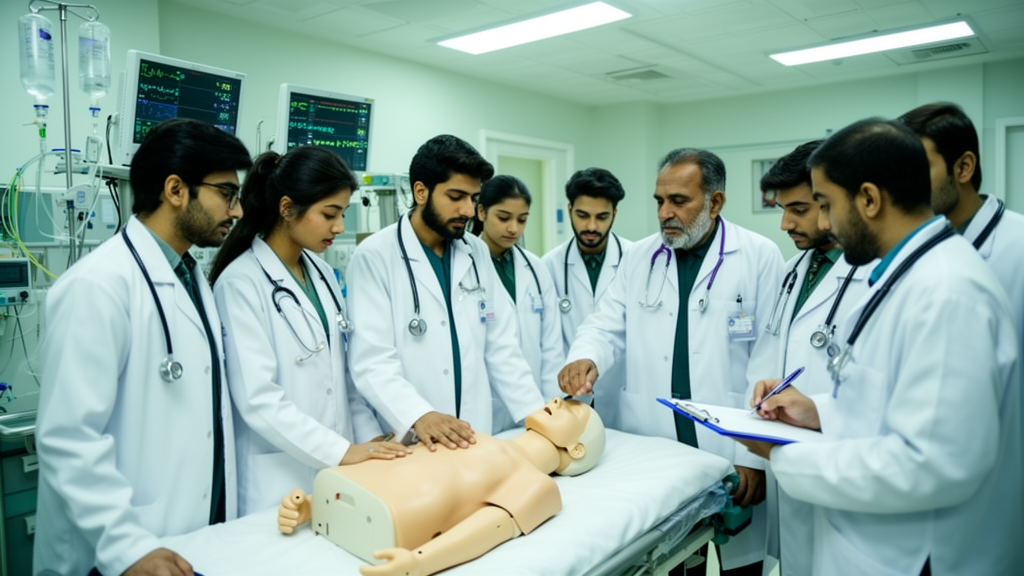
Emergency medicine has long been described as the front door of the hospital, the specialty where seconds decide outcomes and where a clinician’s first decisions can mean the difference between life and death. Yet in much of the world, and particularly in low- and middle-income countries, this discipline remains under-recognized as a distinct career path. A new cross-sectional study from Pakistan, published in BMC Medical Education, offers one of the clearest snapshots yet of how future doctors in a South Asian health system actually understand, value, and contemplate emergency medicine, and the results reveal a striking gap between enthusiasm and preparedness.
The research team, led by Hashaam Jamil of Lahore General Hospital alongside collaborators from institutions across Pakistan, Sudan, and Grenada, surveyed 528 undergraduate medical students using a structured, web-based questionnaire. Participants had a mean age of 22.22 years with a standard deviation of 1.84, placing them squarely in the middle of clinical training. The survey instrument was designed to capture three distinct dimensions: factual clinical knowledge of common medical emergencies, attitudes toward emergency medicine as a specialty, and the personal and structural factors that either pull students toward or push them away from choosing it as a career.
The headline finding is deceptively simple: 58.9 percent of students demonstrated good clinical knowledge of common medical emergencies. That means nearly four in ten future physicians could not reliably answer questions about conditions they will almost certainly encounter, from acute coronary syndromes to trauma resuscitation. The researchers used logistic regression, performed in SPSS version 26, to identify which variables predicted stronger knowledge, and two factors emerged with statistical confidence. Students living in urban areas had 1.755 times the odds of good knowledge compared with rural residents, with a 95 percent confidence interval of 1.04 to 2.93 and a p-value of 0.032. More dramatically, fifth-year students had 3.401 times the odds of good knowledge compared with first-year students, with a 95 percent confidence interval of 2.03 to 5.67 and a p-value below 0.001.
That year-of-study gradient is the study’s most technically revealing result. It suggests that clinical knowledge of emergencies is not something students arrive with or absorb passively; it accumulates through exposure, clerkships, and repeated patient contact. The urban-rural divide, meanwhile, likely reflects differences in resource access, teaching hospital proximity, and early exposure to emergency scenarios that rural students may simply not encounter before medical school. Both findings point toward a structural rather than individual explanation: the curriculum itself, and the environment surrounding it, shape emergency competence more than innate ability or motivation.
Attitudes told a warmer story. A full 79.0 percent of participants expressed a positive attitude toward emergency medicine as a specialty, recognizing its pace, its intellectual demands, and its societal importance. Yet when the question shifted from admiration to personal commitment, the numbers dropped sharply. Only 52.5 percent considered emergency medicine a viable career option. That 26.5 percentage point gap between positive sentiment and career intent is the study’s central paradox, and understanding it requires looking at what students said motivated and deterred them.
On the motivating side, three factors dominated. Personal interest was cited by 93.9 percent of respondents, making it the single strongest pull toward the field. The satisfaction of seeing immediate intervention results, the near-instant feedback loop that distinguishes emergency care from most other specialties, was cited by 88.1 percent. Career opportunities, reflecting growing demand for emergency physicians in Pakistan and globally, were cited by 86.3 percent. These numbers paint a picture of a specialty that students find intellectually exciting, emotionally rewarding, and professionally promising, at least in the abstract.
The deterrents, however, were equally powerful and far more systemic. Burnout risk topped the list, cited by 83.7 percent of respondents, a figure that echoes global concerns about emergency department workload, shift work, and emotional exhaustion. Lack of mentorship followed closely at 82.5 percent, suggesting that students who might otherwise choose emergency medicine simply have no senior figure guiding them through the decision. Lack of structured rotations and postgraduate training pathways rounded out the top three at 80.9 percent, pointing to a critical infrastructure gap: without formal residency programs and defined training tracks, even interested students have no clear route into the field.
The authors are careful to contextualize their findings within the broader landscape of emergency medicine in low- and middle-income countries. Roughly 90 percent of healthcare emergencies worldwide occur in these settings, yet emergency medicine as a recognized specialty remains nascent in many of them. In Pakistan specifically, awareness of emergency medicine as a distinct discipline and opportunities for formal exposure during undergraduate training remain limited. The study’s conclusion is therefore not merely descriptive but prescriptive: structured exposure to emergency care, robust mentorship programs, and improved undergraduate teaching are identified as the three levers most likely to convert positive attitudes into actual career choices.
Methodologically, the study is an analytical, cross-sectional, web-based survey, which carries both strengths and limitations that the authors acknowledge. The convenience-based sampling means the 528 participants may not represent all Pakistani medical students, and the inclusion of students at different stages of training means the knowledge comparisons, while statistically adjusted, reflect a snapshot rather than a longitudinal trajectory. The web-based format, while efficient, may also skew toward students with better digital access, potentially amplifying the urban advantage observed in the knowledge data. The study was approved by the Ethical Review Committee of Lahore General Hospital under reference number 00/80/2022, conducted according to the Declaration of Helsinki, and all participants provided written informed consent.
What makes this study resonate beyond Pakistan is its illustration of a problem that repeats across dozens of health systems: a specialty that saves lives daily remains invisible to the very people who will one day staff it. The 79 percent who admire emergency medicine and the 52.5 percent who would consider joining it represent a reservoir of untapped workforce potential. Closing the gap between those two numbers, the authors argue, requires not just better teaching but deliberate mentorship structures and visible postgraduate pathways. For a country where emergency care demand continues to grow, that gap is not an academic curiosity; it is a staffing crisis waiting to happen, and one that targeted educational reform could still prevent.
Subject of Research: Clinical knowledge, attitudes, and career perceptions of emergency medicine among Pakistani medical students
Article Title: Assessing clinical knowledge of common medical emergencies, attitudes toward emergency medicine, and career perceptions among Pakistani medical students: a cross-sectional study
Article References: Jamil, H., Kousar, W., Naseer, H. Z., Nadeem, M. U., Iqbal, A., Tariq, W., Tahir, M. J., Nadeem, A., & Mohamed Ahmed, K. A. H. (2026). Assessing clinical knowledge of common medical emergencies, attitudes toward emergency medicine, and career perceptions among Pakistani medical students: a cross-sectional study. BMC Medical Education. https://doi.org/10.1186/s12909-026-10447-9
Image Credits: AI Generated
DOI: 10.1186/s12909-026-10447-9
Keywords: emergency medicine, medical students, Pakistan, medical education, clinical knowledge, career perceptions, burnout, mentorship, cross-sectional study, low- and middle-income countries, undergraduate training, BMC Medical Education
Cite Scienmag News
Courtney Benton. (October 17, 2026). Pakistani Medical Students Show Strong Emergency Medicine Attitudes but Shaky Clinical Knowledge, Survey Finds. Scienmag. https://scienmag.com/pakistani-medical-students-show-strong-emergency-medicine-attitudes-but-shaky-clinical-knowledge-survey-finds/
Courtney Benton. "Pakistani Medical Students Show Strong Emergency Medicine Attitudes but Shaky Clinical Knowledge, Survey Finds." Scienmag, 17 October 2026, https://scienmag.com/pakistani-medical-students-show-strong-emergency-medicine-attitudes-but-shaky-clinical-knowledge-survey-finds/. Accessed 17 October 2026.
Courtney Benton. "Pakistani Medical Students Show Strong Emergency Medicine Attitudes but Shaky Clinical Knowledge, Survey Finds." Scienmag. October 17, 2026. https://scienmag.com/pakistani-medical-students-show-strong-emergency-medicine-attitudes-but-shaky-clinical-knowledge-survey-finds/


