


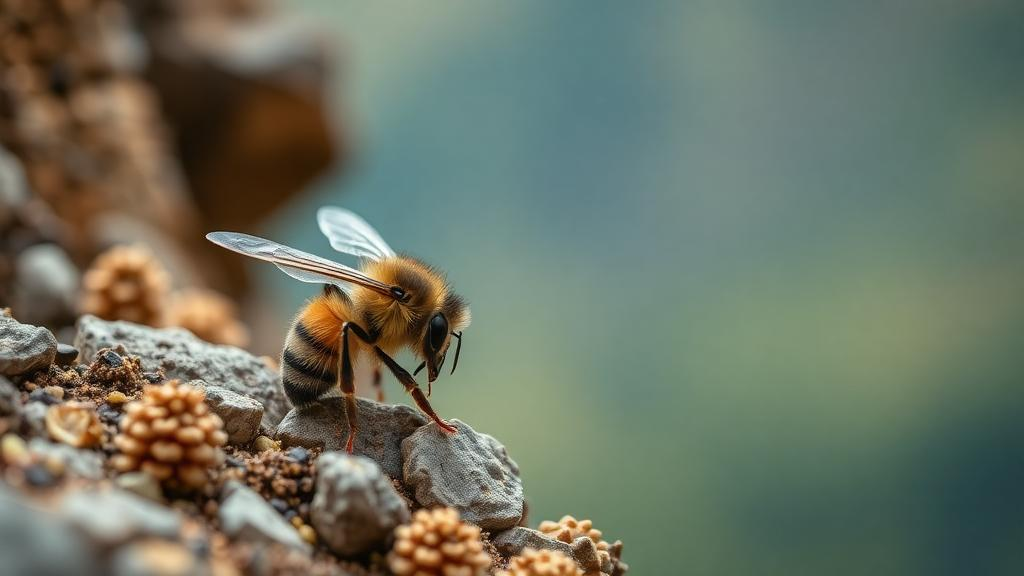
In the rugged Sierra de Cazorla of southeastern Spain, one of the Mediterranean’s great biodiversity hotspots, a decades-long study has revealed how a hyperdiverse lineage of mining bees relates to the flowering plants around it — and has uncovered three bee species entirely new to science. The research, published in the Journal of Hymenoptera Research, combines exhaustive field observation with modern taxonomic analysis to deliver one of the most complete pictures ever assembled of the genus Andrena, a group of ground-nesting bees with roughly 1,740 described species and a reputation for rapid, puzzling diversification.
Andrena is the second largest bee genus in the world and a dominant pollinator of early-flowering plants across temperate Eurasia and North America. Yet its evolutionary story has remained stubbornly opaque precisely where the genus is richest: the Mediterranean basin. The obstacle has been taxonomic. Without reliable identification tools, ecologists could not say which Andrena species used which flowers, and without that information, hypotheses about what drove the genus’s explosive radiation — pollen specialization, phenological partitioning, climatic tolerance — could not be tested. Previous plant-pollinator network studies from the Iberian Peninsula typically considered a median of only 12 plant species, a fraction of regional Mediterranean diversity.
The new study closes that gap with extraordinary sampling effort. Between 1997 and 2024, researchers conducted 38,506 standardized pollinator censuses — each a three-minute watch of a flowering patch — on 803 different dates, covering 292 insect-pollinated plant species in 187 genera and 54 families, essentially the entire entomophilous flora of the Cazorla range. During these censuses, 2,098 Andrena individuals from about 60 species were recorded visiting flowers. These data were combined with 1,948 reliably identified voucher specimens from 89 regional Andrena species, each with information on the plant it was feeding from when captured, accumulated since 1982.
The results show that Andrena bees visited flowers of 166 plant species, or 56.5 percent of the surveyed entomophilous flora. Most plants, however, were visited by just one to three Andrena species, and visitation was sparse: for the vast majority of plants, the probability of an Andrena bee arriving at a flowering patch in any given minute was below 0.05, meaning average intervals between successive visits exceeded 20 minutes. Collectively, Andrena accounted for only 10.8 percent of the 19,387 bee individuals recorded. A handful of taxonomically unrelated plants — Rosa canina, Crepis vesicaria, Cistus salviifolius, Hormathophylla spinosa, Linum bienne, Trifolium campestre and the endemic Narcissus hedraeanthus — stood out with visitation probabilities above 0.10 per minute.
Crucially, the distribution of Andrena activity across the plant community was not random. Statistical tests using Pagel’s lambda revealed significant phylogenetic signal in both the number of associated Andrena species and their combined visitation probability, meaning that related plants tended to resemble each other in their appeal to these bees. Certain clades — Amaryllidaceae, Ranunculales, Malvales, Brassicaceae, Rosaceae and the dandelion-related Cichorioideae — were distinctly attractive, while others, including Caryophyllaceae, Boraginaceae, Plantaginaceae and the thistle clade Carduoideae, were largely ignored. The pattern maps onto bee biology: Andrena species have short mouthparts and a limited capacity for autonomous endothermy, weak thermoregulation and low flight-muscle temperatures, so they gravitate toward early-blooming lineages with large, radially symmetric, bowl-shaped flowers whose pollen and nectar are easily accessible.
Viewed from the bees’ perspective, the picture is one of extreme rarity and narrow resource use. Of the 89 Andrena species analyzed, the vast majority were each recorded from one or a few plant taxa. Only a small set of generalists — including A. nigroaenea, A. flavipes and A. bicolor, each associated with more than 20 plant species — visited a broad taxonomic array of flowers, and these species all share wide continental distributions spanning most of western Europe. Interestingly, males and females showed nearly identical patterns in the breadth of their floral associations, challenging the standard assumption in wild bee studies that males feed only on nectar while females gather both nectar and pollen. The authors suggest this contrast may not hold universally in Andrena.
The rarity of most species carries a sobering implication. Applying interpolation-extrapolation and singleton-frequency estimators to the species abundance distribution, the team projected a regional total of about 102 Andrena species — roughly 12 percent more than the 89 actually documented. This so-called dark diversity, the pool of species present but undetected, is far larger than the 4 percent estimated for Spain as a whole using the same methods on a database of 10,619 specimens from 238 species. Even decades of intensive sampling in a hotspot, the study warns, may fail to capture hyperdiverse bee assemblages dominated by rare specialists, some of which may go extinct before ever being recorded — a plausible scenario given Andrena’s poor heat tolerance and the rapid warming now underway in the region.
The fieldwork itself turned up three new species, formally described and illustrated in the paper. Andrena (Euandrena) officinalis, a 9–10 mm bee named for its strong association with rosemary, Rosmarinus officinalis, is remarkable because no Andrena species worldwide is known to specialize on the Lamiaceae family; in a global analysis of bee pollen diets, the highest Lamiaceae use by any Andrena was a mere 5.2 percent. A DNA barcode from the COI mitochondrial gene, 658 base pairs long, separated A. officinalis from its relative A. lavandulae by an average of 10.03 percent and from A. angustior by 4.22 percent, suggesting an isolated lineage. Its sister species, A. (Euandrena) rostro — named for the elongate, beak-like head and clypeus that distinguish it — was collected from Viburnum tinus, Prunus avium and rosemary. The third, A. (Notandrena) cazorlae, known only from a single female collected at La Cabrilla in May 2022, honors the mountain range itself and is recognized by its broad facial foveae and dense scutal punctation.
Separating the two Euandrena species demanded forensic attention to subtle morphology: the step-like junction of the second tergal margin in A. officinalis, the visibility of scutal punctures against the underlying microreticulation, the length of apical hair fringes, and the breadth of the hyaline tergal rims — characters so fine that the authors advise associating concurrently active males for confirmation. Such painstaking diagnosis illustrates why Mediterranean Andrena diversity has long been underestimated, with a profusion of new species and subgenera described in recent years as taxonomic resources finally catch up.
Taken together, the findings support the idea that Andrena’s remarkable diversification was facilitated by a broad food niche combined with fine-grained resource partitioning among species at local and regional scales — rare specialists each exploiting a narrow slice of the flowering community, while a few wide-ranging generalists roam across plant families. The study also demonstrates the power of pairing community-level ecological observation with state-of-the-art taxonomy, an approach the authors argue is essential for understanding species-rich pollinator lineages. As Mediterranean mountains warm and rare bee species face mounting thermal stress, the hidden diversity documented in Cazorla may represent a race against time: species waiting to be discovered that could disappear before science ever meets them.
Subject of Research: The genus Andrena Fabricius, 1775 (Hymenoptera, Andrenidae) in a Mediterranean biodiversity hotspot: community-wide relationships with plants and description of three new species
Article Title: The genus Andrena Fabricius, 1775 ( Hymenoptera , Andrenidae ) in a Mediterranean biodiversity hotspot: community-wide relationships with plants and description of three new species
Article References: Herrera, C. M., Alonso, C., Valverde, J., Núñez, A., & Wood, T. J. (2025). The genus Andrena Fabricius, 1775 (Hymenoptera, Andrenidae) in a Mediterranean biodiversity hotspot: community-wide relationships with plants and description of three new species. Journal of Hymenoptera Research, 98, 1039-1066. https://doi.org/10.3897/jhr.98.165915
Image Credits: AI Generated
Keywords: genus, Andrena, Fabricius, Hymenoptera, Andrenidae, Mediterranean, biodiversity, hotspot, community-wide, relationships, plants, description
Cite Scienmag News
Margaret Porter. (October 17, 2026). Hidden bee diversity uncovered in Mediterranean mountain hotspot. Scienmag. https://scienmag.com/hidden-bee-diversity-uncovered-in-mediterranean-mountain-hotspot/
Margaret Porter. "Hidden bee diversity uncovered in Mediterranean mountain hotspot." Scienmag, 17 October 2026, https://scienmag.com/hidden-bee-diversity-uncovered-in-mediterranean-mountain-hotspot/. Accessed 17 October 2026.
Margaret Porter. "Hidden bee diversity uncovered in Mediterranean mountain hotspot." Scienmag. October 17, 2026. https://scienmag.com/hidden-bee-diversity-uncovered-in-mediterranean-mountain-hotspot/


